%20png%20copy.avif)
Most sales battlecards are well-intentioned failures. They’re dense PDFs, filled with outdated features and generic talking points no rep can use on a live call. Founders and revenue leaders commission them, watch adoption flatline, and conclude the concept is flawed.
The concept isn't the problem. The execution is.
High-performing GTM teams don't use battlecards as encyclopedias; they use them as precision instruments. Each card is engineered for a specific moment in the sales cycle: a pricing objection, a competitor mention, a C-level ROI conversation. They are not collections of information. They are condensed strategic arguments designed to move a deal forward. To make battlecards effective, they must function like tactical briefings—delivering quick, actionable intelligence when reps need it most, similar to the logic behind these microlearning examples.
This isn’t about creating a library of facts. It's about weaponizing clarity.
Below are eight sales battlecard examples drawn from a decade of go-to-market work with B2B SaaS companies. I will deconstruct why they work, how they are structured, and how to build them to win deals—not just check a sales enablement box. Each example is designed to give your team the precise language and logic needed to dismantle objections, reframe competitor weaknesses, and articulate value with unshakable confidence. Forget the data dumps. This is the playbook for turning information into revenue.
The competitor comparison card is the most fundamental and misused tool in the sales arsenal. Most companies build a feature-by-feature checklist, which is precisely how reps lose control of the narrative. A potent battlecard is not a defensive document; it’s an offensive tool for reframing the customer’s buying criteria around your core strengths.
This card is your team’s cheat sheet for answering the inevitable “How are you different from [Competitor X]?” It shifts the conversation from a generic comparison to a strategic discussion about the prospect’s actual problems and which solution is fundamentally better equipped to solve them. It's not about listing what you have and they don't. It's about connecting your unique value to a business outcome they can't achieve with anyone else.
For example, a HubSpot vs. Marketo battlecard wouldn’t just list features. It would frame HubSpot as the integrated growth platform for mid-market teams that value ease of use and speed, while positioning Marketo as a powerful but complex tool better suited for enterprise-level teams with dedicated technical resources. The goal is to force the prospect to self-select into your ideal customer profile.
Effective competitive battlecards are built on a deep understanding of your rival's go-to-market strategy, not just their product specs. They provide sharp, memorable talking points that your reps can use to confidently navigate difficult questions and proactively set traps.
Key Insight: A winning competitor battlecard doesn’t focus on competitor weaknesses. It focuses on the consequences of those weaknesses for the customer. Instead of saying, “They lack Feature Y,” you say, “Customers who need to accomplish Z find our integrated approach avoids the costly data silos created by their bolt-on solution.”
A pricing battlecard isn't about giving reps permission to discount; it’s a strategic document that enforces discipline and protects margins. Without it, pricing becomes a negotiation free-for-all where the loudest customer dictates your value. This card arms your reps with the confidence and guardrails to defend your price, justify your value, and use discounts as a strategic lever—not a crutch.
This tool transforms a chaotic discounting culture into a structured process. It clarifies precisely when and why a discount is appropriate, tying concessions to specific customer commitments like multi-year contracts, upfront payments, or strategic logo acquisition. Instead of caving on price, reps learn to trade value for value, strengthening the deal structure and setting a precedent for a healthy partnership.
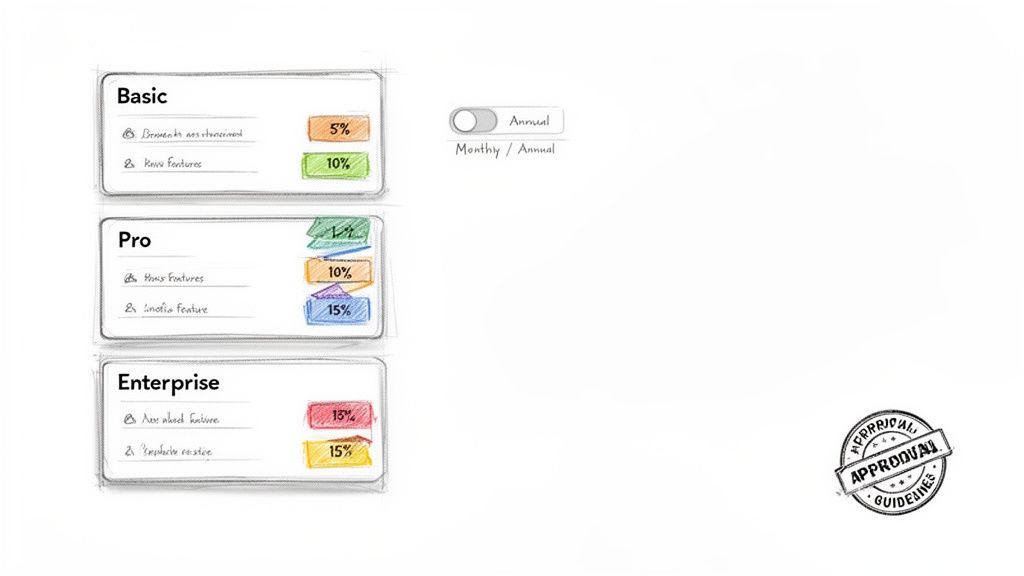
For instance, a Zendesk battlecard would detail specific discount gates for moving from a monthly to an annual contract or for bundling their Support and Sell products. A Stripe card might outline the exact transaction volume required to unlock the next pricing tier. The goal is to make discounting a predictable, data-driven motion, not an emotional reaction to "your price is too high."
An effective pricing battlecard is built on a clear understanding of your unit economics and value metrics. It codifies the negotiation playbook, providing reps with pre-approved scenarios and escalation paths. This moves the conversation from "Can I get a discount?" to "What can we do to build a deal that works for both of us?"
Key Insight: A strong pricing battlecard isn’t a price list. It’s a value articulation guide. It frames your pricing tiers around the problems solved and outcomes delivered for different customer segments, giving reps the language to anchor the conversation on value, not cost. The discount is the final piece of the puzzle, not the starting point.
An objection is not a "no." It's a request for more information, disguised as a roadblock. The objection-handling battlecard is the most tactical tool a sales rep can have, designed to neutralize friction and transform moments of doubt into opportunities for deeper qualification. Most reps either get defensive or concede value when faced with objections. This card changes that dynamic, arming them with proven, de-escalating responses that maintain control of the conversation.
This is your team’s script for turning common pushback into productive dialogue. Instead of reacting to "Your price is too high," reps are trained to uncover the underlying concern. Is it a true budget constraint, a perceived lack of value, or a procurement tactic? The battlecard provides the questions and proof points to diagnose the real issue and reframe the value conversation around ROI, not cost. It’s about making the rep the calmest, most prepared person in the room.
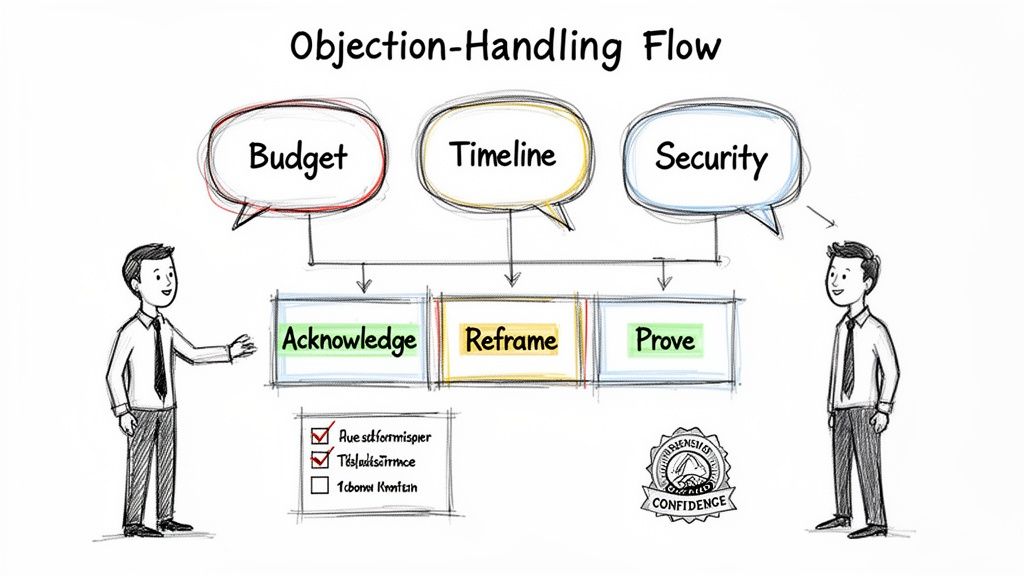
For instance, when a prospect says, "We need board approval," a weak rep hears a delay. A rep with this battlecard hears an opportunity and responds by reframing the conversation around risk mitigation, providing a pre-built ROI calculator to help their champion sell the solution internally. This is one of the most critical sales battlecard examples for moving deals from "stalled" to "closed."
A world-class objection-handling battlecard is built on pattern recognition from hundreds of sales calls, not just theory. It maps the top 10-15 objections to a three-part response: Acknowledge, Reframe, and Prove. This structure, popularized by methodologies like the Challenger Sale, prevents reps from arguing and instead pivots them toward consultative problem-solving.
Key Insight: The best reps don't "handle" objections; they anticipate and dissolve them. This battlecard isn't just a reactive tool. It provides the language to proactively address likely concerns about security, implementation, or a key feature gap before the prospect even raises them.
The ROI/Value battlecard is where a sales conversation graduates from discussing features to justifying a business decision. When you move up the org chart to speak with VPs, Directors, and C-level executives, their primary concern isn’t your technology; it's the financial impact on their P&L. This battlecard translates your solution’s capabilities into the language of business outcomes: cost reduction, revenue generation, risk mitigation, and productivity gains.
This asset arms your reps to build a watertight business case for your solution against the most dangerous competitor of all: the status quo. It moves the discussion from "Can we afford this?" to "Can we afford not to do this?" by quantifying the cost of inaction. It’s the tool that equips an internal champion to get budget approval when you’re not in the room.
For instance, an automation platform’s battlecard won't just say it's "faster." It will calculate that a "90% reduction in manual processing time saves 1,200 hours per quarter, translating to $150K in operational savings and a 3-month payback period." This reframes the purchase as a self-funding initiative, not an expense.
An effective ROI/Value battlecard isn’t a collection of exaggerated marketing claims; it’s a conservative financial model based on real customer data and industry benchmarks. It provides a credible, defensible framework for prospects to understand the financial upside of choosing you. The goal is to co-create the business case with the buyer, making them a partner in the evaluation.
Key Insight: The most powerful ROI calculations aren't just about showing massive savings. They are about demonstrating a clear, believable path to achieving those savings. A credible model with a 3x ROI is far more effective than a hyped-up model with a 10x ROI that the CFO will immediately dismiss.
When selling to a technical audience like a CTO, engineer, or solution architect, the conversation shifts from business outcomes to architectural integrity. A standard feature comparison won't work. The Technical Differentiator Battlecard is purpose-built for these discussions, arming your reps to prove your solution’s superiority in ways that technical buyers respect: scalability, reliability, security, and integration capabilities.
This battlecard bypasses marketing language and focuses entirely on the “how.” It's not about what your product does; it’s about why your underlying architecture enables it to perform better, scale more efficiently, and operate more securely than any alternative. This is a critical tool for any product-led company where the technology itself is the core moat.
For example, a battlecard for Stripe doesn’t just say “we process payments.” It highlights its 99.999%+ uptime, sub-second API latencies, and sophisticated, AI-driven fraud detection models. Similarly, Datadog’s battlecard would focus on its unified data model that allows it to ingest metrics, traces, and logs from over 700 integrations without re-indexing, a core architectural advantage that competitors struggle to replicate.
Technical buyers are trained to spot architectural flaws and marketing fluff. This battlecard builds credibility by speaking their language and providing verifiable proof of your product’s engineering excellence. It’s designed to win the technical evaluation by demonstrating a fundamentally sounder approach to solving the problem, making your solution the logical and safest choice.
Key Insight: Technical buyers don’t care about your features as much as they care about the architectural decisions that enable those features. Instead of saying “We have an API,” you say, “Our API-first architecture ensures 100% of our platform’s functionality is programmatically accessible, unlike competitors who bolt on APIs as an afterthought, creating functional gaps.”
A customer case study battlecard is not a marketing brochure; it's a strategic weapon for turning abstract claims into concrete, undeniable proof. When a prospect is on the fence, facts and features fade. What resonates is seeing a peer—a company just like them—that faced the same problems and won by choosing your solution. This is the art of "pattern matching" for the buyer.
This battlecard equips your sales reps to move beyond "we can help" to "here is how we helped a company just like you solve this exact problem." It’s the ultimate tool for de-risking the purchase decision. Instead of just listing impressive logos, it provides the narrative, the data, and the specific outcomes that make your value proposition feel not just plausible but inevitable for the right-fit customer.
For example, a rep selling to an e-commerce company struggling with cart abandonment wouldn't just talk about their features. They would pull up the battlecard, point to a case study, and say, "Klarna was losing an estimated 15% of revenue at checkout. Using our one-click process, they recovered 40% of those abandoned carts in the first quarter, which translated to $1.2M in new revenue." Suddenly, the conversation shifts from product specs to tangible business impact.
An effective case study battlecard is a curated library of relevance. It’s not about having the most stories; it’s about having the right stories, ready to be deployed at the precise moment a prospect needs to see themselves in your customer base. The goal is to build an overwhelming case for your solution by stacking validated, quantified proof points.
Key Insight: Prospects don't trust vendors; they trust peers. This battlecard weaponizes that trust. It’s not about showcasing your best customer; it’s about showcasing the customer that looks most like your prospect's future successful self.
The feature-by-feature battlecard is often dismissed as a tactical, low-level tool, yet it's indispensable for cutting through noise in crowded, mature markets. This is not a strategic positioning document; it's a granular comparison matrix designed for one specific job: answering the direct "Does it do X?" question with speed and confidence. In markets where buyers have a checklist, this battlecard prevents your reps from getting bogged down in a technical quiz they are unprepared for.
This card is the ultimate defensive tool, particularly when feature parity is high across the market. It allows a rep to acknowledge a competitor's capability, validate the prospect's question, and immediately pivot the conversation to a higher-value topic like implementation, user experience, or the business outcome the feature enables. For example, a comparison between Intercom, Zendesk, and Drift might show all three have chatbots, but the battlecard equips the rep to pivot to the speed of bot deployment or the quality of its CRM integration.
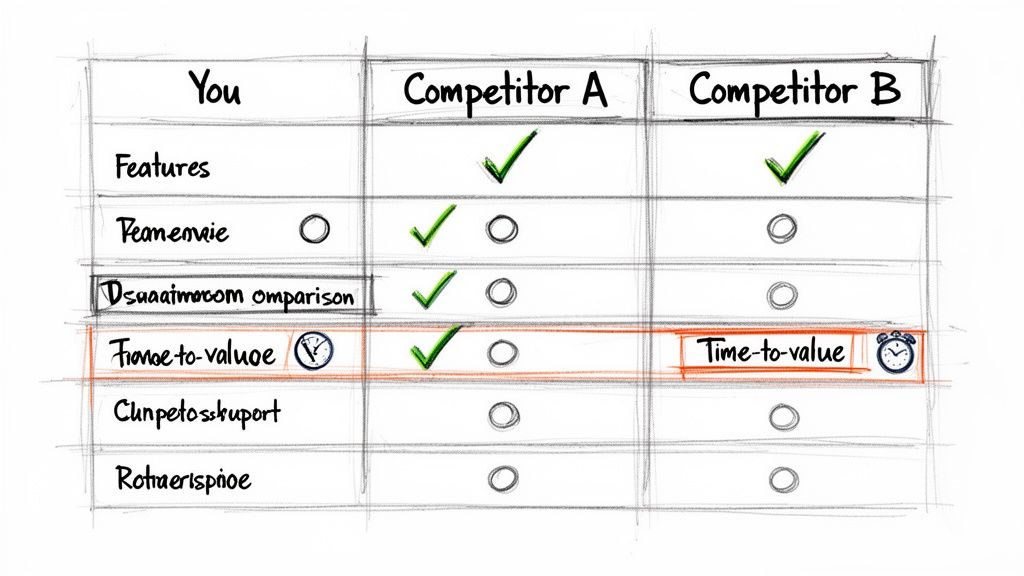
An effective feature matrix is not about winning every check box. Its strategic value lies in controlling the feature conversation. It gives reps the factual grounding to concede minor points gracefully while holding the line on the capabilities that actually drive customer success. This builds credibility and shifts the rep’s role from a defensive product expert to a confident advisor. It neutralizes a competitor's attempt to commoditize the sales cycle by turning it into a feature race.
Key Insight: The purpose of a feature battlecard is not to prove you have more features. It's to prove you have the right features, implemented in a way that delivers superior value. Instead of just a "yes/no" checkbox, add a column for "Our Advantage" that explains why your implementation is better (e.g., "Native integration, no third-party connector required").
Generic, one-size-fits-all messaging is a death sentence in specialized markets. An industry-specific battlecard is the antidote, proving to a prospect in seconds that you aren't just a vendor; you are a partner who understands their world. It’s a tool designed to build instant credibility by speaking the native language of a vertical, from its regulatory pressures to its unique operational workflows.
This battlecard equips your reps to move beyond product features and discuss business outcomes in the context that matters to the buyer. For a healthcare provider, this means framing your value around HIPAA compliance and EHR integration. For a fintech company, it’s about AML/KYC capabilities and regulatory reporting. This isn't just marketing spin; it’s a demonstration of deep market empathy that separates you from horizontal competitors.
For example, a security SaaS selling to e-commerce would create a battlecard focusing on PCI DSS compliance, fraud prevention at checkout, and protecting customer data during peak holiday traffic. The same company selling to a government agency would use a completely different battlecard emphasizing FedRAMP authorization, data sovereignty, and secure protocols for sensitive information. The product is the same, but the context is everything.
An effective industry-specific battlecard isn’t just a glossary of terms; it’s a strategic asset that repositions your solution as the default choice for a vertical. It codifies the specific pain points, compliance mandates, and buying triggers unique to that market, enabling reps to lead conversations with unparalleled authority and relevance. This is how you win lucrative, high-margin verticals.
Key Insight: Prospects don't buy software; they buy solutions to their specific, high-stakes problems. An industry-specific battlecard proves you’ve done the work to understand those problems better than anyone else. It shifts the sales conversation from "What does your product do?" to "How do you help companies like mine solve X?"
I've deconstructed eight distinct sales battlecard examples, from direct competitor comparisons to nuanced value justification. The common thread is not the format or the tool used to create them; it's the underlying strategic clarity. A battlecard is merely a container for your go-to-market thinking. If your positioning is weak, your battlecards will be useless. If you don’t truly understand your competitor’s vulnerabilities, your reps will be left exposed.
These examples are not just templates to copy. They are artifacts of a disciplined process. They reveal how winning B2B SaaS companies translate high-level strategy into tactical, field-ready assets. The ROI/Value battlecard isn’t just about numbers; it’s about weaponizing your customer’s success stories. The Objection-Handling card isn’t a script; it’s a framework for reframing a prospect’s core anxieties.
Most sales enablement initiatives fail because they treat battlecards as static documents. They are created in a flurry of activity, pushed to a shared drive, and quickly become obsolete. This is a fatal error. Your market, competitors, and product are constantly evolving. Your sales battlecards must be living instruments, not museum pieces.
To prevent your battlecards from becoming digital dust, internalize these principles:
The ultimate goal is to build a system, not just a set of documents. This system is a continuous feedback loop connecting your prospects, your sales team, and your strategy.
Building effective sales battlecard examples is a microcosm of building a winning GTM motion. It demands clarity in positioning, discipline in execution, and a relentless focus on enabling your team to win. It’s not about having more information; it’s about having the right information, at the right time, to make the move that closes the deal.
Turning positioning theory into revenue-generating sales tools is a core part of building a resilient GTM engine. If you're a founder or revenue leader who needs to sharpen your company's competitive edge and arm your sales team to win, Big Moves Marketing can help you build the strategic infrastructure required. Visit Big Moves Marketing to see how we help B2B SaaS companies achieve market clarity and scalable growth.
Explore Big Moves Marketing services and resources:

%20-%20white.svg)