%20png%20copy.avif)

Pick 6sense when your biggest gap is finding in-market accounts before your competitors do. Pick Demandbase when your gap is running account-based ads and orchestration at scale. That’s the core split. Two things change the answer: whether your CRM is Salesforce or HubSpot, and whether your program touches a few thousand accounts or a much larger book of business.
TL;DR:
- For companies with a prediction gap, 6sense offers robust scoring based on intent signals, best suited for teams needing visibility into buying readiness.
- Demandbase is ideal for teams that already have a defined target list and want to activate and orchestrate account-based ads across multiple channels efficiently.
- Deploying either platform typically takes 3 to 6 months and involves significant integration, model training, and user onboarding costs, often exceeding $50,000 annually.
- Native ad activation reduces operational complexity and increases match rates, but requires larger budgets, while partner integrations offer more flexibility at potentially higher management overhead.
- Prior to purchase, teams should evaluate their CRM use, target account volume, and prediction versus activation needs to choose the platform that addresses their primary bottleneck most directly.
The fastest way to sort this out: match your team’s biggest bottleneck to what each platform actually does best.
6sense built its reputation on predictive buying-stage scoring. It tells you which accounts are ready to buy, before they raise a hand. It fits teams whose problem is visibility, not distribution.
Demandbase leans harder into activation. It owns the ad experience, from account-based display to orchestration across channels. It fits teams that already know their target list and need to reach it efficiently.
Both vendors sit in the Gartner Leader quadrant for ABM, so neither is a safe default over the other. The right pick depends on where your team is actually stuck.
Both platforms share a category, but the internal mechanics diverge fast once you look past the marketing pages. This is where a feature-by-feature read pays off, because the differences aren’t cosmetic. They change your daily workflow.
Intent and predictive scoring. 6sense runs a predictive model that scores accounts by buying stage, drawing on a mix of intent signals, firmographic data, and behavioral patterns. Demandbase leans on a broader intent feed that surfaces topic-level interest across a wider account pool. Predictive models tend to perform best in tech and software verticals with rich digital footprints, while broader intent approaches often hold up better in traditional industries where digital signal is thinner.
Account identification. Deanonymization quality depends on data co-op depth and IP resolution accuracy. Both platforms have coverage gaps, particularly for smaller companies or accounts behind corporate VPNs, and neither claims full visibility into every visitor.
Activation. This is the clearest divide. Demandbase runs a native demand-side platform, meaning ad orchestration happens inside the same system that scores your accounts. 6sense activates primarily through partner integrations. That difference matters for ad ops teams: native activation usually means tighter match rates and fewer handoffs, while partner-based activation adds a step but keeps you flexible on ad vendor choice.
CRM and integration depth. G2 reviews of Demandbase One show that platforms pushing signals directly into a rep’s CRM view see meaningfully higher usage rates than those requiring a separate dashboard login. That pattern holds for both vendors: the deeper the native Salesforce or HubSpot sync, the faster reps actually adopt the tool instead of ignoring it.
Analytics and measurement. Attribution modeling differs enough that switching platforms mid-year can scramble your reporting baseline. G2’s side-by-side comparison shows closely matched user sentiment overall, but with real gaps in ease of use, ad activation, and account-level insight depth depending on which feature set you weigh most.
Run these diagnostics before you take a single demo call. They cut through vendor pitch decks faster than any feature matrix.
Minimum readiness for either platform usually means a dedicated RevOps person (or team), a defined target-account list, and budget that clears the mid-market floor. Without those three, you’ll pay for capability you can’t operationalize.
Pro Tip: Before signing anything, ask the vendor for a 90-day pilot with a hard success metric tied to pipeline, not platform logins. If they resist, that tells you something about how confident they are in fast time-to-value.
Expect a real runway before either platform pays for itself. Deployment timelines commonly run 3 to 6 months to reach operational maturity, and that clock includes data integration, model training, and rep onboarding, not just the initial setup call.
Cost drivers beyond the base contract include ad spend (for activation-heavy deployments), the number of CRM seats synced, and how many data enrichment modules you add. Budget accordingly:
Switching platforms later carries real friction. Practitioners report losing historical intent data and facing 60 to 90 day rebuilding periods when migrating between enterprise ABM systems. Some large organizations run both platform types at once, prediction on one, activation on another, but that only pencils out at very large budgets with dedicated headcount to manage deduplication between the two signal sets.
Two patterns show up again and again when we help clients through this decision. A Series B SaaS company with a tight ICP and almost no visibility into buyer intent needed 6sense’s predictive layer far more than any ad platform, their sales team just needed a shorter, smarter call list. A later-stage company with a well-defined 3,000-account target list, but weak ad reach, got more value from Demandbase’s native activation than from another layer of scoring they didn’t need.
The mistake we see most often in procurement calls: buyers negotiate hard on price and skip the integration SLA entirely. Insist on native CRM object parity and a bidirectional, low-latency sync before you sign, and negotiate the pilot’s success metric around pipeline, not dashboard logins.
Support quality shows up fastest in onboarding speed, not in the sales deck. Both vendors offer dedicated customer success managers for enterprise tiers, along with certification programs aimed at getting RevOps and marketing ops staff fluent in the platform quickly.
The practical difference tends to surface in how fast a support ticket gets resolved during the first 90 days, which is exactly when a new deployment is most fragile. Teams that negotiate a named implementation contact upfront, rather than a shared support queue, report smoother rollouts. That’s worth asking for explicitly during your pilot negotiation, regardless of which platform you choose.

Training resources on both sides include on-demand video libraries, live onboarding sessions, and admin certification tracks. Neither vendor’s public documentation goes especially deep on advanced use cases like multi-region deployments or complex attribution setups. For those scenarios, expect to lean on your assigned customer success manager or a implementation partner rather than self-serve documentation.
If your team lacks a dedicated RevOps hire to own the relationship, budget extra time for support tickets to get resolved. A platform without an internal champion tends to underperform its feature set, regardless of how good the vendor’s own support desk is.
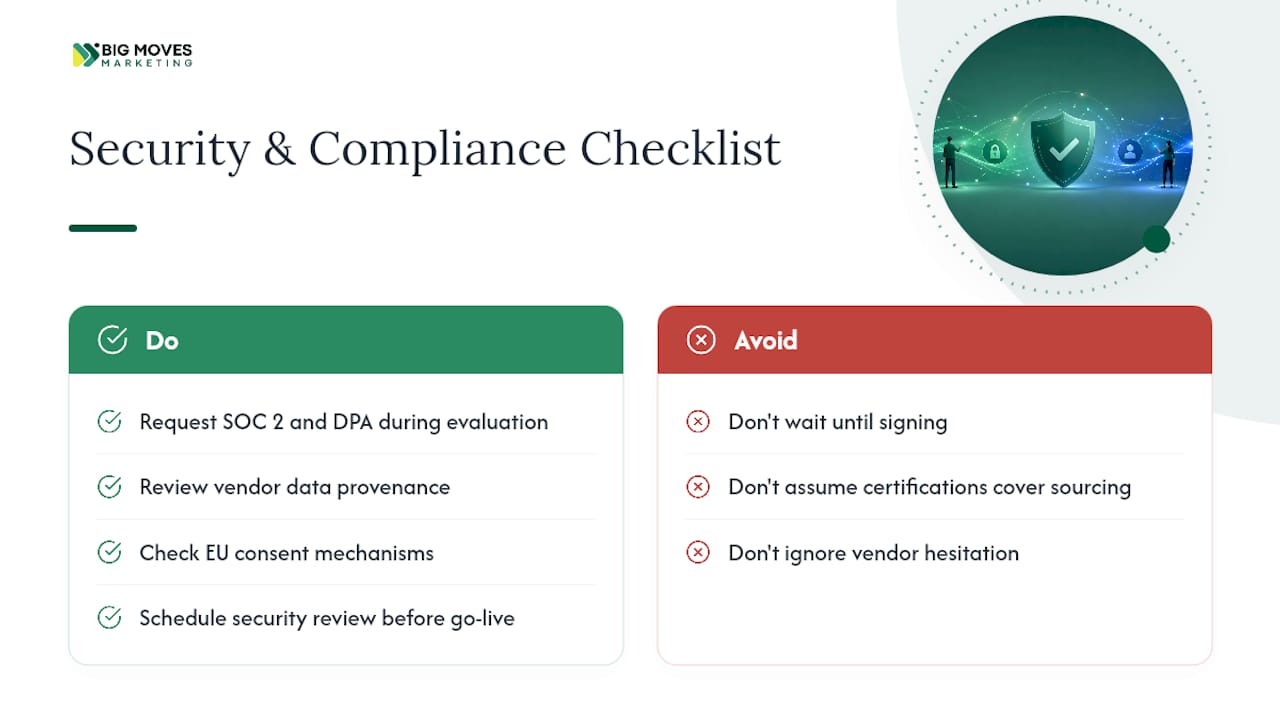
Both platforms operate at enterprise scale, which means both carry the baseline compliance certifications large buyers expect: SOC 2 Type II reporting and GDPR-aligned data handling practices for European contacts. Neither publicly claims an advantage over the other on core certification coverage.
Where the practical difference shows up is data sourcing. Since both platforms pull from third-party data co-ops and web signal providers to power intent and identification models, your legal and security teams should review each vendor’s data provenance documentation before finalizing a contract, particularly around consent mechanisms for EU-based visitor tracking.
Enterprise deployments typically require a security review cycle before go-live. Build that review into your implementation timeline early. Waiting until contract signing to loop in your security team is one of the most common causes of a delayed launch, and it has nothing to do with either platform’s actual security posture.
Ask both vendors directly for their current SOC 2 report and data processing agreement during evaluation, not after signing. Any hesitation to share those documents promptly is itself useful information about how procurement will go long term.
Interface philosophy differs more than most feature comparisons capture. 6sense organizes its dashboard around account scoring and prioritization, so sales-facing users tend to find the daily workflow intuitive: log in, see the ranked list, start calling. Demandbase’s interface leans toward campaign and ad management, which fits a marketing ops user better than a sales rep checking accounts between calls.
That design difference has a real consequence: which team logs in daily. If your sales team needs a prioritized worklist, 6sense’s account-first layout gets out of their way faster. If your marketing team is managing live ad campaigns across channels, Demandbase’s campaign-centric view keeps everything in one place.
Neither platform is difficult to learn, but the learning curve length depends on how far your use case sits from the platform’s core design intent. Ask for a sandbox trial with your actual users, not just the buying committee, before you commit.
Both platforms scale to large account volumes and add modules as your program grows, but the customization ceiling looks different depending on what you’re trying to configure. 6sense allows fairly granular scoring model adjustments, letting RevOps teams tune what “in-market” means for their specific vertical. Demandbase offers deeper campaign-level customization for ad targeting rules and audience segment logic.
Scaling from a pilot to a full enterprise deployment usually means adding data modules, expanding user seats, and, in Demandbase’s case, increasing ad budget tied to broader account coverage. Neither platform’s pricing scales linearly. Expect step-function jumps in cost as you cross certain account-volume or module thresholds, not a smooth per-account rate.
For teams planning to grow target-account volume significantly within 12 to 18 months, ask each vendor directly how pricing changes at each volume tier before signing a multi-year contract. That question alone often reveals more about total cost of ownership than the initial quote does.
Most comparison articles hand you a fifty-row feature matrix and let you drown in it. That’s the wrong approach. The evidence points to three variables that decide the outcome: your primary gap, your CRM centroid, and your scale readiness. Everything else, dashboard aesthetics, minor integration counts, is noise most buying committees waste weeks on.
The conventional advice, “pick the Gartner Leader with the better G2 score,” ignores that both platforms qualify on that front. It doesn’t tell you which one fits your actual bottleneck. A team with strong intent visibility but weak activation buying 6sense is solving the wrong problem, and vice versa.
Prioritize the diagnostic conversation before the demo. Get your RevOps lead, your CRM admin, and your head of sales in the same room and answer the three questions above honestly. If you’re under 5,000 target accounts, don’t let a vendor talk you out of the lighter stack option just because it’s a smaller deal for them.
— Veb
Choosing between platforms is only half the problem. Getting a pilot structured with real success metrics, and a CRM integration that reps actually use, is where most ABM budgets quietly get wasted. Bigmoves works alongside founders, CMOs, and RevOps leads to run that evaluation without the guesswork of a vendor-led sales process.
Our team helps mid-market and scaling B2B SaaS companies scope pilots, negotiate integration SLAs, and build the go-to-market website and demand generation motion that makes any ABM platform investment pay off faster. If you’re deciding between a prediction-first and activation-first platform, start with our account-based marketing pilot playbook for a structured way to test before you commit budget. When you’re ready to pair that platform decision with a website built to convert the accounts you identify, launch your go-to-market website with a team that has done this for SaaS companies before.
The comparisons and figures above draw on a handful of sources worth bookmarking if you want to go deeper before your own evaluation.
Teams targeting under roughly 5,000 accounts or running a sub-$50,000 ABM budget often get better near-term ROI from a lighter, composable stack than from either full enterprise platform.
6sense focuses on predictive intent scoring to identify in-market accounts, while Demandbase focuses on native ad activation and account-based orchestration once you already know your target list.
Most deployments need 3 to 6 months to reach operational maturity, including data integration, model training, and rep onboarding.
Some large organizations do, using one for prediction and one for activation, but this only pencils out at very large budgets with dedicated headcount to manage overlapping signals.
Yes. Bigmoves works with B2B SaaS and technology companies to scope pilots, evaluate CRM integration fit, and build the go-to-market website and demand generation motion that supports whichever platform a team chooses.




%20-%20white.svg)