%20png%20copy.avif)
Most sales training frames objections as obstacles to overcome. This mental model is broken. It traps B2B SaaS teams in a reactive loop of defending price, features, and timing, forcing them to cede control of the sales cycle.
The reality is that objections are not barriers. They are unfiltered market feedback and qualification data. A genuine objection is an expression of interest wrapped in concern. Silence is the real enemy, indicating disinterest or complete misalignment. An objection signals engagement—an invitation to clarify value, realign expectations, and demonstrate your strategic understanding of the prospect's world.
Most sales objection handling techniques focus on tactical rebuttals. They treat the symptom, not the cause. This guide is different. We will move beyond surface-level scripts to the strategic frameworks that separate high-growth sales organizations from the rest. You will learn how to deconstruct concerns about pricing, ROI, and vendor risk not as a defender, but as a diagnostician.
The goal is not to "win" an argument. It’s to precisely qualify the opportunity, expose the underlying business problem, and control the narrative. Forget clever comebacks. These are the models that turn skepticism into signed contracts by proving you understand the buyer's problem better than they do.
Most reps react to objections defensively. They argue on price, challenge assumptions about implementation, or rush to prove a feature's value. This is a fundamental mistake. The Feel-Felt-Found framework is one of the most durable sales objection handling techniques precisely because it does the opposite. It de-escalates conflict by aligning with the prospect before redirecting their perspective.
The method uses a three-part structure that validates the prospect’s concern, normalizes it with social proof, and then reframes it with a new conclusion. It shifts the conversation from a debate to a shared journey.

Here’s the breakdown:
This framework is most effective for emotionally charged or assumption-based objections, not tactical feature questions. It excels when prospects express concerns about:
It works because it respects the buyer's reality instead of challenging it. By using past customer stories as the proof point, you avoid making it your opinion versus theirs. You become a guide, not an opponent.
Where most reps see a roadblock, elite sellers see an opening. The Reversal is an advanced sales objection handling technique that reframes a prospect's concern as the very reason they need your solution. Instead of defending against an objection, you absorb its energy and redirect it, turning a perceived weakness into a compelling strength.
This technique fundamentally alters the sales conversation. It shifts the dynamic from you justifying your product's value to the prospect’s own logic proving the case for you. For B2B SaaS founders, mastering this move demonstrates deep conviction in your product’s problem-solving ability and an expert understanding of your buyer's world.
The goal is to agree with the premise of the concern, then pivot to show how that concern makes your solution more critical, not less.
The Reversal is powerful but requires a foundation of trust. It's best used in mid-to-late-stage conversations when you've already established credibility. It’s particularly effective for objections related to:
By flipping the script, you prove that their hesitation isn't a barrier; it's the trigger. You’re not just selling a tool; you’re solving the exact operational drag they just identified.
Top-down sales pitches assume the rep knows more about the prospect's problem than the prospect does. This is an arrogant and ineffective starting point. The Question-Based Approach, often called the Colombo Method, flips this dynamic entirely. Instead of providing answers, you use strategic questions to guide prospects to their own conclusions about your solution’s value. It turns a monologue into a guided discovery.
Named after the unassuming TV detective, this method disarms prospects by replacing assertions with curiosity. You aren't telling them they're wrong; you're asking for their help in understanding their reality. This empowers prospects to build the business case for you, making them the hero of their own story and equipping them with the logic needed for internal justification. This is one of the most powerful sales objection handling techniques for complex enterprise deals.
The goal is to peel back the layers of a surface-level objection to expose the root cause.
This method is essential for navigating the complex and often political landscape of B2B sales. It is most effective for uncovering hidden or unstated objections. Use it when you face:
This approach respects the prospect’s intelligence and positions you as a strategic consultant, not just a vendor. By co-creating the diagnosis, you make the solution an inevitable conclusion, significantly strengthening your position throughout the B2B sales cycle.
The best sales objection handling techniques don't involve clever retorts; they eliminate the objection before it’s ever voiced. Most sales teams operate in a defensive posture, waiting for prospects to raise concerns about price, implementation, or risk. The Objection Prevention Strategy flips this dynamic. Instead of reacting, you proactively integrate the answers to common objections directly into your core narrative.
This is a foundational GTM motion that embeds objection resolution into your positioning, messaging, and sales assets. It’s about anticipating friction points and neutralizing them with transparency and proof before they can derail a conversation. This transforms the sales process from a series of hurdles to a guided validation of a decision already leaning in your favor.
This strategy is about front-loading your value proof. You map out the most common deal-breakers and build preemptive "answers" into your standard sales flow.
Objection Prevention isn't a single moment; it's a strategic layer woven throughout your entire go-to-market engine. It is most critical for:
This approach requires deep collaboration between sales and marketing. When you get this right, you’re not just handling objections; you're making them irrelevant. You can learn more about building this crucial internal alignment to strengthen your GTM strategy.
Prospects rarely present their true, single objection upfront. Instead, they often raise surface-level concerns or group multiple issues together, creating a moving target that’s impossible to hit. The Isolate and Confirm technique is a surgical tool designed to cut through this noise, pinpoint the real barrier, and force a clear path forward. It prevents reps from wasting time solving for the wrong problem.
This method forces clarity by separating a stated objection from any hidden ones and then confirming if resolving it is the only thing standing in the way of a commitment. It transforms a vague "we need to think about it" into a specific, solvable business problem. This is one of the most critical sales objection handling techniques for complex B2B SaaS deals with multiple stakeholders.
The process is a two-step diagnostic:
For example, if a prospect says, "We need to see if this fits our tech stack," the response is: "That's a critical point. So just to confirm, if we demonstrate that our API and pre-built connectors integrate seamlessly with your existing systems, is there anything else that would prevent us from signing the agreement?"
This technique is a high-leverage tool for de-risking deals and creating commitment. It is most effective when you encounter:
The power of this method lies in its ability to create a logical trap. If the prospect agrees that the isolated issue is the only barrier, they have committed to moving forward once it’s resolved. If they introduce a new objection, you simply reset and isolate again, revealing their true concerns one by one. You stop chasing ghosts and start solving real problems.
Prospects are wired to be skeptical. Their default pattern is to find reasons a solution won't work, making objections a predictable part of any sales cycle. The most effective sales objection handling techniques don't just counter this skepticism—they interrupt it. This approach combines the psychological force of social proof with the tactical disruption of a pattern interrupt, shifting the conversation from a defense of your product to an undeniable showcase of peer success.
Instead of arguing your value, you present evidence that companies just like theirs have already overcome the exact same hesitation and succeeded. This leverages the prospect’s desire for safety and validation, showing them they aren’t taking a risk but following a proven path.

This technique is about replacing your claims with customer proof, immediately and decisively.
This method is most potent for objections rooted in risk, cost, or perceived complexity. It’s your go-to move when prospects are comparing you to competitors or are hesitant to be an early adopter. Use it to address:
The goal is to stop the debate before it starts. By immediately presenting proof from a peer, you reframe the discussion around their potential success, not your product’s features. This requires building a strong library of evidence, and you can discover more about how to influence B2B buyers with impactful case studies to get started.
The default sales instinct is to treat every objection as a problem to be solved. This mindset is a trap. The most strategic sales objection handling techniques don't aim to win every argument; they aim to win the right deals. This counterintuitive approach reframes objections not as obstacles, but as critical qualification data.
For a B2B SaaS founder, this is a non-negotiable principle. A well-timed objection is a gift. It reveals a prospect's true needs, priorities, and constraints, telling you whether they belong in your customer base. An objection isn’t a failure of your pitch; it’s a filter for your business, saving you from the immense cost of supporting a bad-fit customer.
Instead of reflexively defending your product, use the objection to diagnose the fit between the prospect's reality and your solution's core value.
This isn’t a tactic; it’s a philosophy. It should be the default operating system for your entire revenue team, especially when objections reveal a fundamental mismatch with your ideal customer profile. It is most powerful in situations where the objection signals:
Walking away from a bad-fit deal isn't losing; it's a strategic decision that protects your resources, team morale, and product roadmap. The goal is not to solve every objection, but to recognize which ones are telling you to move on. Developing a clear ideal customer profile is the first step in knowing which objections are opportunities and which are red flags.
Sales conversations often get derailed by objections, not because they are insurmountable, but because reps fail to manage the conversational momentum. They either argue, which creates friction, or they over-validate and get stuck in a loop of appeasement. The Acknowledge-Pivot-Redirect framework strikes the perfect balance: it shows empathy without surrendering control, maintaining forward motion toward a decision.
This structured, three-step approach is less of a script and more of a mental model for navigating turbulence. It allows a rep to address a prospect's concern respectfully and then immediately re-center the conversation on value and next steps. It is a fundamental building block for any B2B SaaS sales playbook, providing a reliable structure for handling objections in real-time.
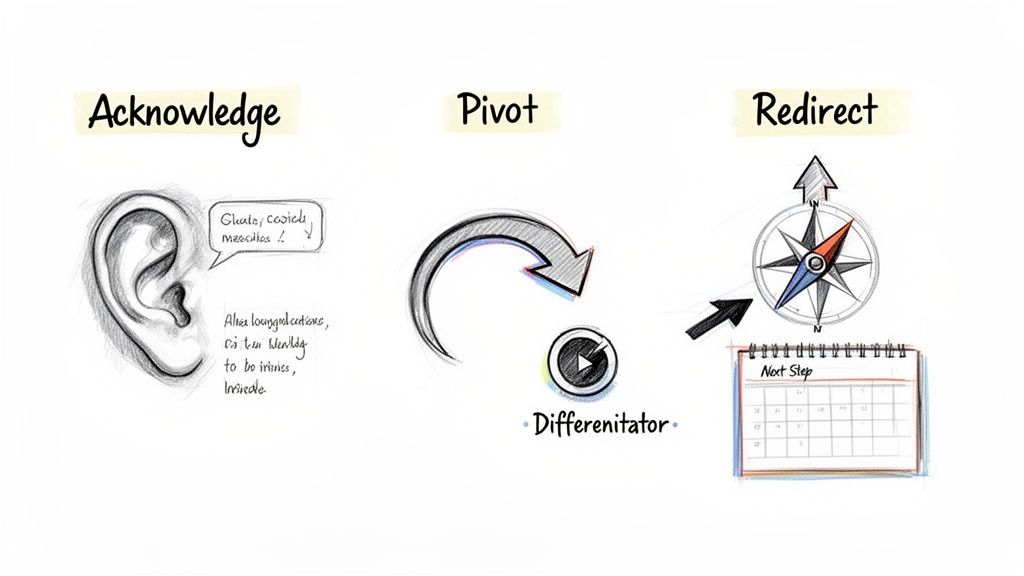
Here’s the breakdown:
This framework is the go-to utility player for most mid-funnel objections that threaten to stall a deal. It's particularly effective for:
The power of this technique is its efficiency. It prevents reps from getting dragged into long, defensive explanations. By acknowledging, offering a quick reframe, and redirecting, you respect the objection while steering the conversation back to productive ground.
When a prospect brings up a competitor, most reps default to one of two losing strategies: attacking the competitor or becoming overly defensive. Both approaches signal a lack of confidence and immediately put the buyer on guard. Competitive objections are not threats; they are opportunities to clarify your positioning and prove your relevance.
The Competitor Reframe Technique shifts the conversation from a feature-for-feature comparison to a discussion about which approach is best suited for the prospect’s specific goals. Instead of arguing about who is "better," you acknowledge the competitor's strengths and then pivot to highlight how your distinct philosophy and design choices deliver a more relevant outcome for the buyer's unique situation. This turns a potential roadblock into a moment of strategic alignment.
The goal is to move the conversation up a level, from tactical features to strategic fit. To effectively deploy this technique, start by understanding how to perform a robust competitive price analysis, which provides the foundation for your positioning.
This technique is essential for any deal where a competitor is actively being evaluated. It is particularly powerful when the prospect fixates on a single dimension of comparison, such as price or a specific feature. Use it for objections like:
The reframe works because it elevates you from a commodity being compared on a spreadsheet to a strategic partner who understands the market's nuances. You stop defending your product and start guiding the prospect toward a smarter decision for their business. This requires well-researched competitive battlecards that go beyond features to articulate your core strategic differentiators.
In B2B SaaS, reps often treat objections as problems to be solved instantly. When faced with a feature gap or a timeline mismatch, the default reaction is to downplay its importance or pretend a workaround is a perfect substitute. This erodes trust. The Delay-Not-Deny approach is one of the most credible sales objection handling techniques because it embraces transparency, turning a potential deal-breaker into a foundation for a long-term partnership.
Instead of denying a limitation, you acknowledge it, frame it as a temporary gap, and build a concrete bridge to the future solution. This method replaces a defensive posture with collaborative problem-solving, demonstrating that you see the prospect as a partner, not just a contract to be signed. It builds immense credibility by proving you're willing to tell the truth, even when it’s inconvenient.
This technique is about managing expectations and co-creating a temporary solution.
Delay-Not-Deny is specifically for objections rooted in real, temporary limitations of your product or offering. It is not for overcoming philosophical disagreements or fundamental product-fit issues.
Use it when prospects raise concerns about:
This approach works because it honors the prospect's reality. By providing a clear plan and a practical interim solution, you transform a "no" into a "not yet," maintaining momentum and proving your commitment to their success. You're not just selling software; you're selling a partnership with a clear vision.
The techniques detailed here are not a collection of clever retorts. They are diagnostic tools. Founders and revenue leaders who treat sales objection handling techniques as a memorization exercise miss the point entirely. You are not training your team to win arguments; you are equipping them to uncover the truth behind a prospect’s hesitation.
A memorized script fails the moment a conversation deviates. A system, however, provides a durable mental model for navigating uncertainty. The real leverage isn't in having the perfect line for a pricing objection. It’s in building a go-to-market engine that understands why that objection exists in the first place and systematically addresses it across your messaging, positioning, and product.
The most common failure we see in early-stage SaaS teams is treating objections as isolated events at the end of the sales cycle. This is a reactive, low-leverage posture. Elite teams understand that objections are lagging indicators of upstream GTM problems.
Mastering these sales objection handling techniques is about more than closing the deal in front of you. It's about harvesting market intelligence to sharpen every facet of your growth strategy.
The ultimate expression of skill isn't deflecting objections. It's using them as a fulcrum to accelerate the deal. An objection is a moment of truth where a prospect reveals what they truly care about. It is the most direct feedback you will ever receive on your positioning and value proposition.
Instead of fearing objections, treat them as the most valuable data your company can collect. Each one is an opportunity to qualify more deeply, build more trust, and differentiate more clearly. When your team sees an objection not as a roadblock but as a signpost pointing directly to the buyer's core motivation, you have moved beyond simple tactics. You have built a resilient, intelligent sales culture.
That is the transition from a team that sells to a team that guides. You stop pushing a solution and start collaborating on a business case. This shift doesn’t just improve close rates. It shortens sales cycles, increases deal sizes, and builds a foundation of customers who see you as a strategic partner, not just another vendor. Stop building a playbook of rebuttals. Start building a system for understanding. That is the only approach that scales.
Most SaaS companies treat objection handling as a sales training problem. The best founders know it's a go-to-market strategy problem. If you’re seeing the same objections repeatedly, it’s a signal that your core positioning or messaging is misaligned with the market. At Big Moves Marketing, we help founders fix these upstream issues, so your sales team faces fewer objections and closes deals with far less friction. Learn more about our approach at Big Moves Marketing.
Explore Big Moves Marketing services and resources:





%20-%20white.svg)