%20png%20copy.avif)
A solid marketing strategy isn't about flashy ads or chasing vanity metrics. It's about building an almost obsessive understanding of a very specific business customer. It all starts by pinpointing exactly which companies you serve and then articulating precisely why they should care.
This is the unshakeable foundation for every single thing you do next. Getting this right ensures your limited resources are aimed where they'll make the biggest impact, right from day one.
Before you even think about spending a single dollar on a campaign, the most important work needs to happen. This is where you move past abstract ideas and start bolting together the core components of your marketing engine.
Forget about chasing every possible lead. Your real goal is to attract the right business customers—the ones who will eventually become your biggest champions.
This foundational stage isn't just a box-checking exercise. It’s what separates a marketing plan that generates random, unpredictable activity from one that drives reliable revenue. A well-defined foundation ensures every blog post, every sales call, and every marketing dollar is spent with purpose.
First mission: nail down your Ideal Customer Profile (ICP). And no, I'm not talking about a vague persona with a stock photo and a cute name like "Marketing Mary." For a B2B startup, your ICP is a detailed blueprint of the company that is a perfect match for your solution.
This is the organization that will get the most value, adopt your product the fastest, and stick around for the long haul.
To build this, you need to get specific about firmographics and other key details:
A precise ICP is your filter. For instance, if you're selling a project management tool built for creative agencies, a strong ICP stops you from wasting time and money chasing a huge deal with a construction firm. It just isn't a fit. To get started, you can use an ideal customer profile template to give your research some structure.
Once you know which companies you're targeting, you need to understand their world inside and out. It's time to uncover the deep, nagging operational pain points your product actually solves. This means getting out of your own head and having real conversations.
Set up interviews with people at companies that fit your ICP. But don't pitch them. Just listen. Ask open-ended questions about their daily workflows, their biggest frustrations, and the "good enough" hacks they're currently using to get by.
The goal of these interviews isn't to validate your product's features. It's to validate the customer's problem. When you can articulate their business problem better than they can, you've earned their trust.
Pay close attention to the exact words they use. Are they talking about "inefficient workflows," "wasted hours," or "missed revenue opportunities"? That's the language that needs to show up in your copy, your ads, and your sales decks.
Now you can finally connect their pain to your solution by crafting a unique value proposition. This is just a clear, simple statement that explains the real-world results a business gets from using your product. It has to answer the question: "Why should I buy from you and not your competitor, or just keep doing what I'm doing?"
A killer B2B value proposition has three parts:
For a more detailed blueprint on getting these foundational pieces right, check out this Startup Marketing Strategy: An Actionable Guide to Growth. Don't skip this work—defining your ICP, digging into their pain, and nailing your value prop is the most important part of your entire marketing strategy.
Now that you've laid the groundwork, it’s time to make a critical decision: choosing your go-to-market (GTM) motion. Think of this as the operating system for how you’ll find, win, and keep customers. It's the core engine that turns your strategy into revenue.
This isn’t about throwing a bunch of tactics at the wall to see what sticks. Your GTM motion has to be a perfect match for your product, your pricing, and how your Ideal Customer Profile actually buys software. Get this wrong, and you'll burn through your runway going nowhere fast.
The foundational work you’ve just done—nailing your ICP, uncovering their real pain points, and crafting your value prop—is what makes this next decision possible. It all flows together.
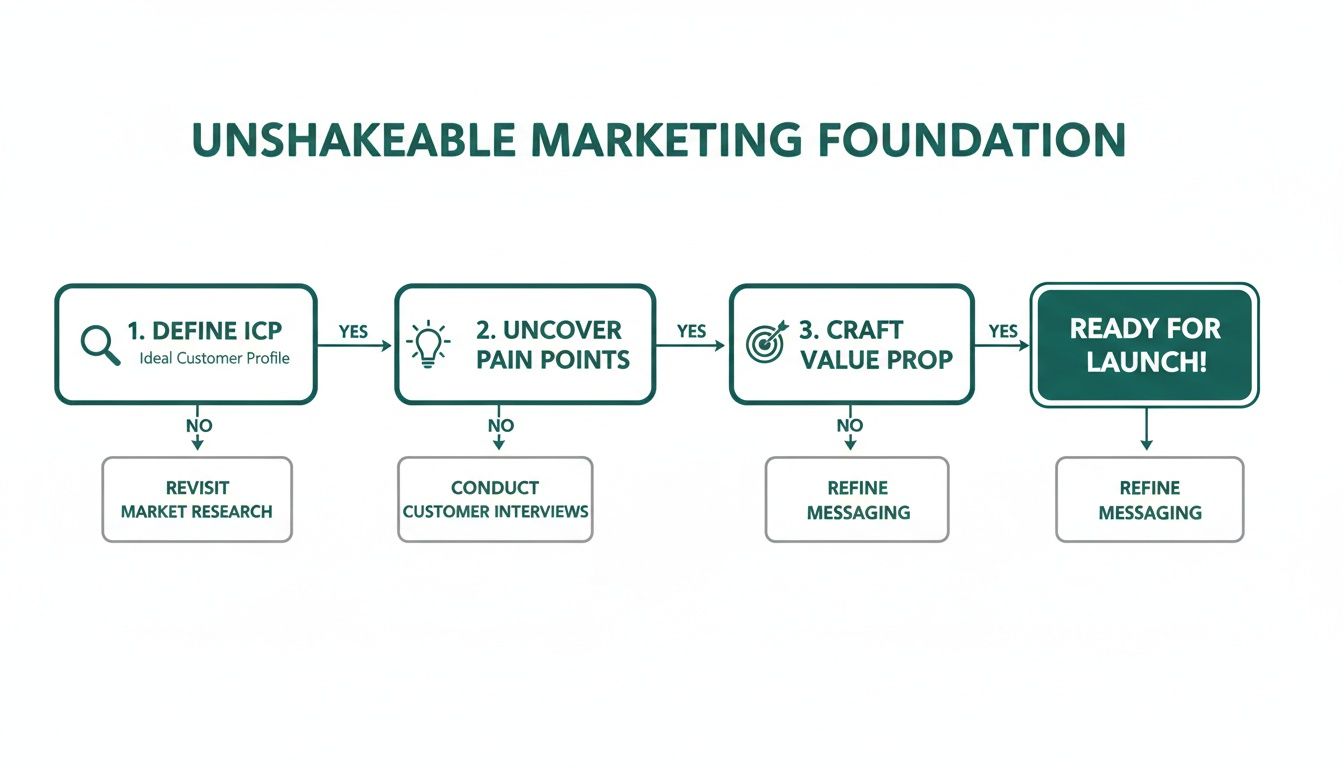
As you can see, every major strategic choice traces right back to knowing your customer inside and out. Your GTM motion is no exception.
In a product-led growth (PLG) motion, your product is the main engine for acquiring, converting, and expanding customer accounts. The whole idea is to let users experience your product's value directly, usually through a freemium plan or a free trial.
This approach works wonders when your product is intuitive, solves a very specific business problem, and can be adopted by an individual without needing a committee meeting or an implementation specialist. Think about tools like Calendly or Miro. You can sign up and get that "aha!" moment in minutes, and that value naturally spreads to the rest of the team.
PLG can be a massive advantage for B2B startups because it creates a low-friction way to get customers in the door. The catch? Your product experience has to be absolutely stellar. If the onboarding is clunky or the value is hard to find, users won't hesitate to close the tab.
In a PLG world, your product becomes your number one salesperson. Success hinges on making it incredibly easy for users to find, understand, and share your solution’s value all on their own.
On the other end of the spectrum is the sales-led growth motion, which relies on a direct sales team to hunt, nurture, and close deals. This is the traditional B2B playbook, and it’s essential for products that are complex, expensive, or require a heavy lift to implement.
If your solution has an average contract value (ACV) north of $10,000, involves navigating multiple departments, or needs a custom deployment, you're almost certainly going to need a sales team. You need skilled account executives who can handle procurement, build a compelling business case, and guide champions through a long, often political, buying process.
This motion is all about relationships. Marketing's job is to feed the sales team highly qualified leads (MQLs) and equip them with the ammo they need to win. The sales cycle is longer, but the contracts are much, much bigger.
Here’s the thing: many of the most successful B2B startups don't pick just one. They create a hybrid model that captures the best of both approaches.
A popular strategy is using a PLG motion to land a wide base of individual users or small teams. Then, once an account shows signs of life—real engagement, growing usage, hitting certain feature triggers—a sales team jumps in to work on expanding that account into a company-wide deal. This is often called "product-led sales."
Here's how it plays out:
This model gives you the massive reach of PLG combined with the high-value deals of a sales-led approach.
To help you figure out where you fit, here’s a quick breakdown of the three primary GTM motions.
Choosing the right motion is one of the most important decisions you'll make for building a repeatable, scalable revenue engine. For a deeper look at building out your complete plan, check out this guide on go-to-market strategy for startups.
Alright, you've laid the groundwork. You know who you're selling to, you've defined your value, and you've picked a go-to-market motion. Now it's time to build the machine that actually generates demand.
This isn't about throwing spaghetti at the wall. It’s about building a system—an engine—where every channel works in concert to bring in a predictable flow of qualified leads. This is the real heart of your startup's marketing strategy.
It's a strange time for new companies. The global digital marketing industry is worth over $667 billion, yet a shocking 47% of businesses don't have a formal digital strategy. The good news? That's changing fast. About 94% of small businesses are planning to spend more on digital marketing.
This is a massive opportunity if you get it right from day one. Companies that use an integrated approach see up to 50% higher ROI.
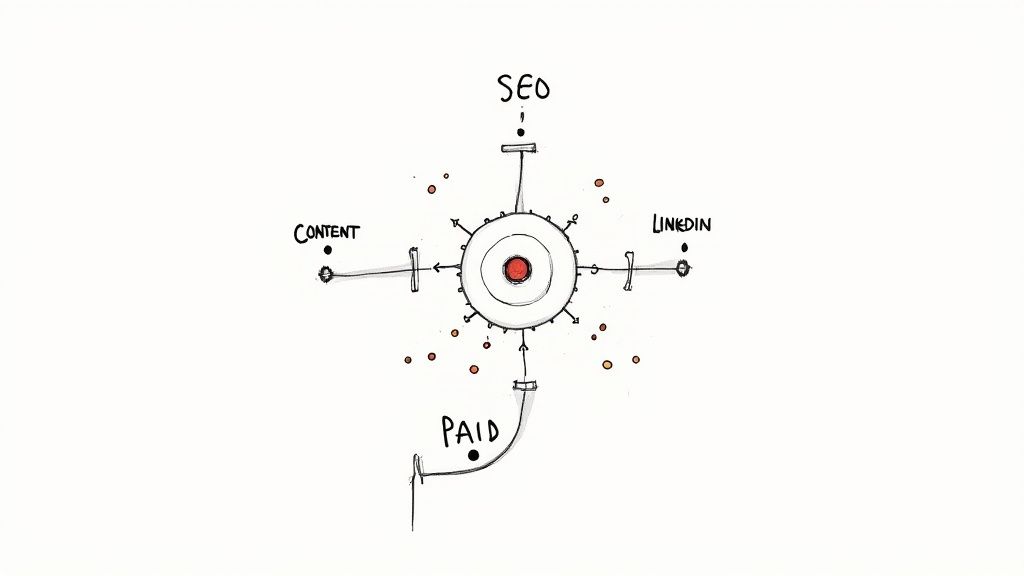
Your first move should be building a long-term asset: organic presence. SEO and content are the absolute bedrock of B2B demand gen. They work together to capture buyer intent and, more importantly, establish your company as an authority worth trusting.
The goal here isn't just to rank for keywords. It's to become the go-to resource for your Ideal Customer Profile. Think less about selling and more about teaching.
Start by mapping out the core business problems your ICP is trying to solve. Use keyword research to figure out exactly how they type those problems into Google. That becomes your content blueprint.
This isn't a quick fix, but it builds incredible trust. When they're finally ready to pull the trigger on a purchase, you'll be the first name that comes to mind because you've been genuinely helping them all along. For a deep dive into building that awareness and desire, check out this guide on Demand Generation Mastery: A Proven B2B SaaS Playbook.
For any B2B startup, LinkedIn is non-negotiable. It's not just another social network; it's your main artery for targeted outreach and brand building. This is where your ICP and the key decision-makers you need to reach actually spend their time.
But forget about those spammy, automated connection requests. A smart LinkedIn strategy is all about giving value before you ask for anything. Get your founders and key team members to build their personal brands by consistently sharing insights about your industry and your customers' pain points.
Your company page is for announcements. Your team's personal profiles are for conversations. Turn your experts into the face of your brand, and they'll build the authentic relationships that turn into real business.
When you have that active presence, your outreach feels completely different. A message is no longer coming from a faceless company logo but from a helpful expert they've already seen and respected in their feed.
Organic channels build long-term value, but paid media buys you speed and precision. For an early-stage B2B startup, the name of the game is strategy, not just blowing your budget on ads.
Paid channels like LinkedIn Ads and Google Search Ads are incredibly powerful because they let you get hyper-specific with who you target.
When to Use Paid Media
Think of paid media as an amplifier. It's there to boost your content and get your message in front of the right people, right now. It should work hand-in-glove with your other efforts, not in a silo. A well-rounded approach is what builds a sustainable system for growth. To get more granular, take a look at our guide on how to build a powerful demand gen strategy.
Content is the very heart of your demand generation engine. It’s the fuel that educates prospects, builds unshakable trust, and ultimately persuades them to act. But a real marketing strategy for a B2B startup goes way beyond just publishing random blog posts and hoping for the best.
Instead, you need to think of your content as a carefully curated journey. Every single piece—from a short video to an in-depth white paper—should have a specific job to do, guiding your ideal customer from initial awareness right through to a confident purchase. It’s all about quality and precision, making sure your message hits the right people at exactly the right moment.
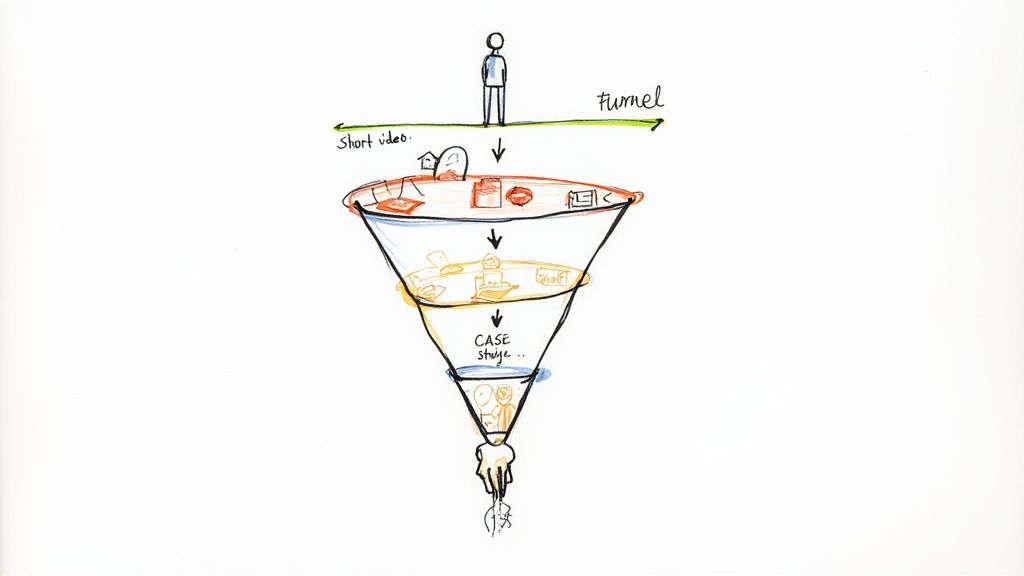
To create content that actually converts, you have to map your assets to the different stages of the B2B buyer's journey. Each stage requires a totally different type of content to meet the prospect's evolving needs and answer their pressing questions.
By aligning your content this way, you create a seamless experience that nurtures prospects from casual interest to closed-won. It’s a core piece of building an effective content marketing strategy, which you can dive into deeper in our comprehensive guide on the topic.
While blog posts are fantastic for building authority over time, cornerstone assets are your heavy hitters for lead generation. These are the substantial, high-value pieces of content that prospects are more than willing to trade their contact information for.
As a B2B startup, you should focus on just one or two of these to start:
The key is to promote these assets everywhere—from your website's homepage to your email signature—to maximize their lead-capturing power.
Let's be real: artificial intelligence has become a game-changer for content creation. It allows lean startup teams to punch well above their weight. This isn't about replacing human creativity, but about augmenting it to ramp up efficiency and output without letting quality slip.
AI tools are best used as a co-pilot, not an autopilot. Use them to brainstorm ideas, generate outlines, and polish first drafts, but always ensure your unique expertise and brand voice shine through in the final product.
The data backs this up. Content marketing is a cornerstone for startups, and in the B2B world, 49% see it as the most effective revenue driver. Today, a whopping 67% of small businesses are using AI for content marketing, with 68% reporting an increased ROI as a direct result. You can dive deeper into the data and discover more of these impactful content marketing statistics.
Ultimately, a strong content plan is about building a library of valuable, relevant assets that serve your audience at every turn. It builds trust, drives qualified leads, and establishes your startup as a true voice of authority in your space.
All that strategic planning? It’s just a blueprint until you launch. A great launch isn’t some big, explosive event. It's a carefully coordinated sequence of actions designed to build real momentum, turning your plans into actual results and setting the stage for everything that comes next.
Think of your launch as the first true test of everything you’ve built. The data you gather in those initial weeks is pure gold. It tells you what’s working, what isn’t, and where to immediately double down. This is where your strategy finally meets reality.
The biggest mistake I see B2B startups make is chasing vanity metrics. A spike in website traffic or a surge in social media followers might feel great, but those numbers don't pay the bills. You have to focus on the metrics that are direct signals of business health and future revenue.
These are the numbers that actually matter:
Zeroing in on these core indicators gives you a clear, honest picture of your marketing performance. If you're looking for a more detailed framework, our guide on how to measure marketing effectiveness goes a lot deeper.
A successful rollout is all about timing and preparation. A disorganized launch can kill your momentum before you even get out of the gate. While every startup’s timeline is a bit different, a structured approach ensures all your channels fire in unison for maximum impact.
Here’s a simplified four-week launch plan to get you started:
Your marketing budget shouldn't be a rigid, set-in-stone document. For an early-stage B2B startup, it needs to be a living, breathing tool that adapts as you learn what's working. Start with a baseline allocation, but be ready to shift funds to your highest-performing channels at a moment's notice.
As we move through 2025, digital marketing is still the heart of most startup strategies, and for good reason: its impact is measurable. The digital ad market is on track to hit nearly $843 billion, with startups finding huge wins in an integrated approach. For instance, combining SEO, content, and social media efforts has led to a 40% increase in organic traffic, a 60% improvement in customer retention, and a 53% rise in engagement. You can find more data on the power of digital marketing channels from Hostinger.
Your initial budget is just a hypothesis. The data you collect is the evidence that proves or disproves it. The real goal is to quickly reallocate resources from low-performing experiments to the high-impact winners.
This data-driven mindset is what allows you to scale efficiently. Instead of guessing, you’re making calculated decisions based on real performance. It ensures every dollar you invest is driving tangible growth and moving your startup toward a sustainable, repeatable model for success.
Founders are constantly swimming in a sea of tough questions, especially in the early days. But when it comes to marketing, figuring out where to point your limited time and money isn't just important—it's everything. Let's cut through the noise and get straight to the answers you actually need.
There's no magic number, but a solid benchmark for early-stage B2B startups is to earmark 10-20% of your projected annual revenue for marketing. If you're pre-revenue, you're usually looking at a percentage of the capital you've raised.
The most critical thing is to start lean. Your first dollars shouldn't go to a big, splashy ad campaign. Instead, invest in the foundational work that doesn’t scale right away but pays dividends forever—things like deep customer interviews and creating one or two truly exceptional cornerstone content pieces.
Once you have that foundation, carve out a small, controlled budget to test one or two acquisition channels that seem promising. As the data comes in, you can start to confidently double down on what’s working. Think of your marketing budget less like a fixed expense and more like a fluid investment, ready to shift to wherever you're seeing the best results.
The right time is the exact moment you and your co-founders can no longer keep up with the marketing tasks, and it's visibly slowing down growth. This usually happens right after you've found some early signs of product-market fit and the market is giving you clear buying signals.
Your first hire shouldn't be a VP of Marketing who sits in meetings and builds slide decks. You need a doer. A "marketing generalist" who can wear multiple hats and isn't afraid to get their hands dirty.
Look for someone who can roll up their sleeves and execute from day one. Ideally, they'll have a T-shaped skill set—broad knowledge across many areas, but deep, proven expertise in one or two disciplines that are absolutely critical to your go-to-market plan, like content creation for an inbound motion or demand gen for a sales-led one.
Hiring your first marketer isn't about offloading a task list; it's about bringing in a dedicated owner who can build and scale the marketing function. Their primary job is to turn your early traction into a repeatable, predictable engine for growth.
Most early-stage companies trip over the same marketing hurdles. Sidestepping them will put you on a much faster path to a strategy that actually works.
One of the biggest mistakes is trying to be everywhere at once. Spreading yourself across every social media platform and marketing channel is a surefire way to burn through your cash and make zero impact anywhere. Instead, get obsessed with mastering the one or two channels where your ICP actually lives and breathes.
Another classic blunder is skipping the foundational work. Jumping straight into tactics like running ads without a crystal-clear ICP and a value proposition that hits hard is like building a house on sand. Your messaging will be generic, your campaigns will fall flat, and you’ll fail to connect with anyone.
Finally, too many startups get mesmerized by vanity metrics like website traffic or social media likes. These numbers feel good, but they don't pay the bills. A winning strategy is laser-focused on metrics that actually signal business health. You should be obsessing over numbers like:
By avoiding these common traps and staying relentlessly focused, you'll build a marketing engine that doesn’t just make noise—it drives real, sustainable revenue.
At Big Moves Marketing, I help B2B SaaS and AI founders build and execute the positioning, sales tools, and launch strategies that drive real adoption and revenue. If you're ready to translate your product's features into a message that wins deals, let's connect. Learn more at https://www.bigmoves.marketing.
Explore Big Moves Marketing services and resources:




%20-%20white.svg)