%20png%20copy.avif)
Your B2B marketing strategy has to be built on a rock-solid foundation. And no, that foundation isn’t a list of tactics or channels. It’s a deep, almost obsessive understanding of your customer.
It all starts by defining exactly who you serve and the unique value you bring to their business. Get this right, and every dollar you spend, every campaign you launch, is aimed squarely at the right target.
Success in B2B marketing isn’t about being the loudest; it’s about being the clearest. Before you even whisper the words “LinkedIn ads” or “content calendar,” you have to lay the groundwork.
Without this, your marketing efforts will feel disconnected and just… flat. It’s like trying to build a skyscraper on sand. This isn't just a box-ticking exercise—it’s the compass that will guide every single decision you make from here on out.
Too many startups, buzzing with excitement to get leads in the door, jump straight into execution. They fire up ad campaigns and push out blog posts, just hoping something sticks. I’ve seen it time and time again, and it almost always leads to a bonfire of cash and painfully slow growth.
The alternative? A deliberate, research-driven process. First, you carve out your unique space in the market. Then, you identify the high-value clients you are perfectly built to serve.
This phase boils down to two critical pieces: your market positioning and your Ideal Customer Profile (ICP). Nailing these is the first real step toward a powerful B2B marketing machine.
Your market position is the specific, distinct space you occupy in your customers' minds. It’s what makes you different—and better—than all the other options they have. For a B2B SaaS or AI startup, this means taking a brutally honest look at the market and what you’re truly good at.
Start by asking the tough questions:
Answering these questions gives you clarity. It stops you from sounding like every other company pitching the same thing, and that clarity is your single greatest asset.
A strong market position acts as a filter. It tells you which opportunities to chase and, just as importantly, which ones to walk away from. This keeps your resources locked on what actually moves the needle.
Once you know your position, you need to know who you're positioning for. This is where your Ideal Customer Profile (ICP) comes in. An ICP is a detailed, living document that describes the perfect company to buy your product.
And I mean detailed. This goes way beyond basic firmographics like company size or industry.
A truly robust ICP for a B2B startup gets into the nitty-gritty that reveals real business pain and buying triggers. You need to understand their world. What clunky internal processes are they fighting? What pressure are they under from their boss or their own customers?
For example, a cybersecurity SaaS company’s ICP shouldn’t just be “mid-sized tech companies.” A much sharper ICP would be: “Series B to D tech companies with 200-1,000 employees, no dedicated security team, and getting pressured by enterprise clients to become SOC 2 compliant.” Now that’s an ICP you can build a campaign around.
To get started on this crucial step, you can explore this helpful ideal customer profile template. It provides a structured way to capture the insights that will shape your entire strategy.
To pull all this together, using a comprehensive B2B marketing plan template and guide can provide the roadmap you need. Without this solid foundation of positioning and customer understanding, even the most brilliant campaigns will miss the mark.
The path your B2B customers take from identifying a problem to purchasing a solution is almost never a straight line. It's a winding road, often involving months of internal research, countless stakeholder meetings, and dozens of interactions with your brand before you ever get a signed contract.
Understanding this messy, human process is the bedrock of any B2B marketing strategy that actually works. It's about shifting your mindset from "How do we sell our product?" to "How can we be the most helpful guide on their journey?"
Mapping this journey isn’t about building a rigid, linear funnel to force prospects through. It’s about anticipating their questions, understanding their pain points, and showing up with the right answer, on the right channel, at exactly the right time. Nail this, and you build the kind of trust that makes your solution feel like the only logical choice when they're finally ready to buy.
Your customer's journey begins long before they've ever heard of your company. It starts with an internal trigger—a process is broken, a team is missing its goals, or a new challenger is eating their lunch. At this stage, they aren’t searching for your product; they’re searching for answers.
Think about what a potential customer would type into Google in those early moments of frustration. If you’re an AI startup selling a contract analysis tool, they aren't searching for your brand name. They’re searching for things like "how to speed up legal review" or "common contract negotiation bottlenecks."
Your job here is to be the source of those answers. This is where educational, non-promotional content becomes your most powerful asset.

This initial research and customer profiling is what informs the entire journey map, ensuring your strategic goals are perfectly aligned with what your future customers actually need.
Once buyers can put a name to their problem, they shift into active solution-seeking mode. Now, they're evaluating different approaches, vendors, and technologies. Your content needs to pivot from diagnosing the problem to clearly demonstrating how your solution is the most effective way to solve it.
At this point, they're digging into feature comparisons, hunting for social proof, and trying to picture the real-world impact of choosing your product. Considering the average B2B deal involves over 62 touchpoints over more than six months, you need a consistent and strategic communication plan to stay top-of-mind.
The consideration phase is where trust is truly forged. Buyers are looking for proof that you not only understand their problem but have a credible and effective way to solve it. Case studies, testimonials, and detailed product comparisons become your most powerful assets.
To get a deeper understanding of this process, check out our detailed guide on the B2B customer journey.
In the final stage, the buying committee comes together. The economic buyer, the end-user, the technical stakeholder—they all need to be convinced. Your marketing must now shift from selling a solution to enabling an internal champion.
You need to arm your main point of contact with everything they need to build a compelling business case internally and get the deal across the finish line. Content here should be intensely practical, focusing on ROI, implementation, and security.
By thoughtfully mapping each stage, you transform your marketing from a collection of random tactics into a cohesive system that guides buyers, builds confidence, and ultimately drives predictable growth.
Once you have a crystal-clear picture of your customer's journey, it's time to actually show up where they are. This isn't about blasting your message from every rooftop; it's about making smart, strategic choices about where to engage and then building a machine to consistently deliver value. This is the moment your B2B marketing strategy stops being a document and starts being a living, breathing engine for trust and demand.
So many startups make the classic mistake of trying to be everywhere at once. They stretch themselves paper-thin across a dozen different platforms, and the result is mediocre content that makes zero impact anywhere. The real key is to focus your firepower on the handful of channels where your ideal customers are already looking for answers.
In the early days, quality absolutely smokes quantity. Instead of a scattergun approach, you need to identify the two or three channels that give you the most direct line to your ICP. Your buyer journey map should be pointing you exactly where to look.
For the vast majority of B2B SaaS and AI startups I've worked with, a winning combo usually involves:
The goal here is to go deep, not wide. Absolutely dominate your chosen channels. Become the go-to resource there before you even think about expanding. A focused attack builds momentum far more effectively than a diluted, multi-front war.
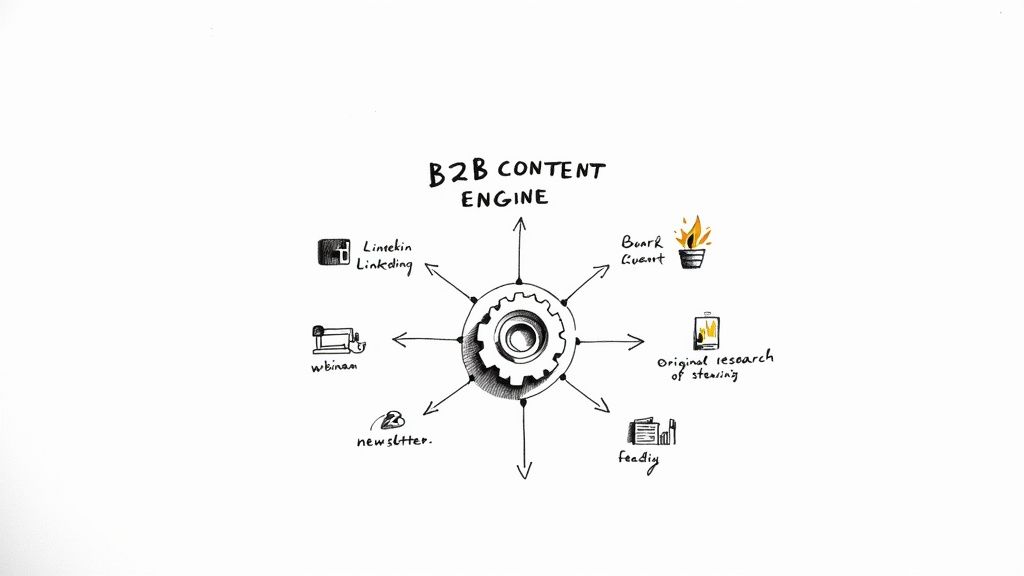
Okay, you've picked your channels. Now you need the fuel to power them. That's where a content engine comes in. A content engine is simply a system—a repeatable process—for consistently creating high-quality assets that solve your ICP's problems at every stage of their journey.
This isn't just about writing blog posts. A modern B2B content engine churns out a whole range of assets designed to educate, build trust, and ultimately drive action. Think of it as the central power plant for all your marketing.
Here’s a quick look at how you might match your content and channels to where your buyer is in their journey.
This matrix helps you move from random acts of content to a strategic plan where every asset has a clear purpose and a designated path to your audience.
Content marketing is still the bedrock of any solid B2B strategy. A mind-blowing 91% of marketers globally use it, and they're putting their money where their mouth is. Budgets are heavily focused on lead generation (36%), followed by brand building (30%) and demand generation (20%). These numbers prove just how essential a well-oiled content machine is to hitting your core business goals.
To build a system that doesn't burn you out, you have to think beyond one-off pieces. For a much deeper dive, check out our guide on how to create a content marketing strategy.
One of the most efficient ways to structure your content production is the "pillar-and-cluster" model. This approach lets you get maximum mileage out of your biggest content efforts.
This system lets you generate a massive amount of high-value content from one concentrated effort. Your channels will never run dry.
Building a content engine is about creating a system that turns your expertise into a scalable asset. It ensures you're not just creating content, but building a library of resources that consistently attracts, engages, and converts your ideal customers.
Generative AI can be a massive help here—it's great for brainstorming ideas, drafting outlines, and repurposing content. But it should only be an assistant, not the author. The human touch—your unique insights, your stories, your voice—is what will actually make your brand stand out and build a real connection with your audience.
Alright, your content engine is humming and your audience is starting to tune in. This is where we get to the good stuff—turning all that attention into actual business opportunities. It’s time to build the bridge between marketing activity and measurable revenue.
This phase is all about actively creating, capturing, and nurturing demand. I’m not just talking about generating a list of names; this is about building a system that delivers a steady stream of qualified, sales-ready conversations. This is how a tactical marketing strategy for b2b becomes a powerful growth engine.
At the same time, we have to empower your sales team to act on this new momentum. Without a tight connection between marketing and sales, even the best leads will fall through the cracks. The end goal is a seamless handoff where salespeople have the exact tools, messaging, and context they need to close deals with confidence.
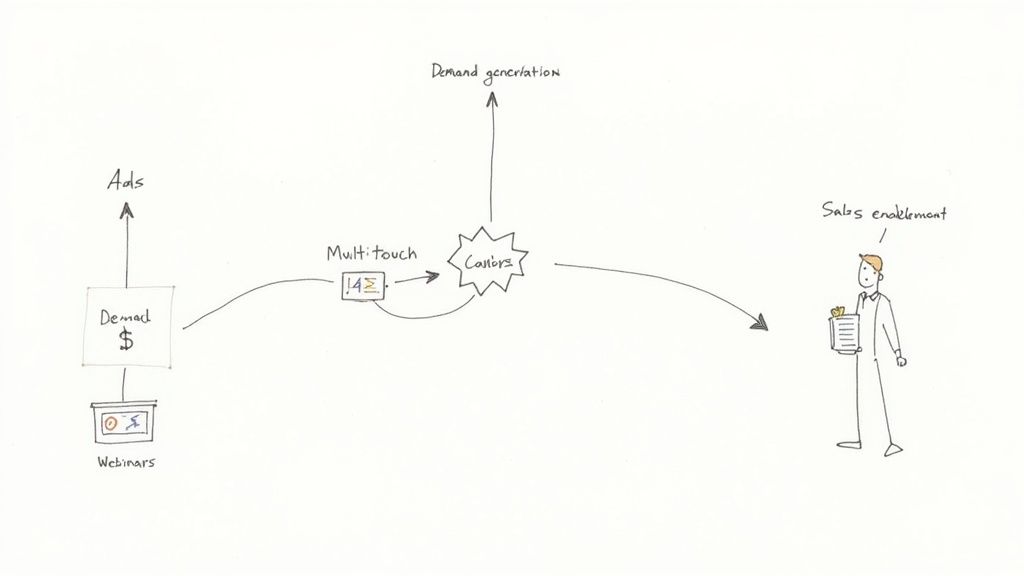
Let's get one thing straight: demand generation isn't just about getting someone to fill out a form. It's the proactive, multi-touch process of making your ideal customers genuinely interested in your product. It’s a holistic approach, blending inbound and outbound tactics into cohesive campaigns that educate buyers and gently guide them toward making a decision. A huge piece of this is knowing how to generate B2B leads, as this founder's guide breaks down really well.
Your campaigns should be built around a core asset—maybe a webinar, an in-depth report, or a free tool—and then promoted across all your chosen channels. This creates multiple pathways for your ICP to find and engage with you.
For example, a campaign for an AI analytics platform might look like this:
This integrated approach makes sure your message hits from different angles, building familiarity and trust over time.
A great demand generation campaign doesn't just ask for a demo. It offers so much value upfront that a prospect wants to learn more, making the eventual sales conversation a natural next step, not a cold interruption.
As you grow, trying to manage these multi-touch campaigns manually becomes a nightmare. This is where marketing automation and other tech tools become your best friends. They let you nurture leads at scale while still making every touchpoint feel personal.
The role of technology, especially AI, is exploding. Recent data shows 57% of B2B companies are already adopting generative AI tools to get more creative with their content and campaigns. In fact, 41% of B2B marketers are using AI to craft more innovative campaigns, and 35% are using it to gain a real market advantage.
These platforms are essential for a few key jobs:
Using technology smartly frees up your team to focus on high-impact strategic work instead of getting buried in repetitive tasks.
All the demand you generate is worthless if your sales team isn't equipped to handle it. Sales enablement is the critical process of giving your sales reps the resources they need to engage buyers effectively. This is where all that deep customer knowledge from marketing gets turned into revenue-generating tools.
This collaboration is so much more than just sending over a list of leads. It's about building a shared playbook for success.
Key Sales Enablement Assets
This alignment isn't just a nice-to-have; it's a non-negotiable part of a modern marketing strategy for b2b. When marketing and sales operate in sync, the entire customer experience improves, sales cycles get shorter, and win rates climb. To really nail this, you have to understand the core principles, which is why we've put together a guide on sales enablement best practices you can dive into.
A brilliant marketing strategy is just a hopeful guess until you can actually measure its impact. To drive real growth, you have to look past the vanity metrics and zero in on the Key Performance Indicators (KPIs) that connect your team's efforts directly to revenue. This isn't just about justifying your budget; it's how you make smart, data-backed decisions that steer the entire ship.
For any B2B SaaS or AI startup, the numbers that truly matter are never just likes or shares. Instead, they’re the hard metrics that tell a clear story about efficiency, profitability, and how marketing is influencing the sales pipeline. Nailing this analytics framework is the final—and most critical—piece of your strategy.
It's tempting to get caught up in metrics that look good in a slide deck but mean very little for the bottom line. Things like website traffic, follower counts, or email open rates can be encouraging, but they don't tell you if you're bringing in the right customers or if your marketing engine is actually profitable.
The real benefit comes from tracking KPIs that create a direct line between a marketing campaign and a business outcome. These are the numbers that get your CEO and board to sit up and listen, because you're finally speaking the language of growth.
Your marketing dashboard should give you a clear, immediate pulse on the health of your strategy. While you could track dozens of metrics, a few are absolutely non-negotiable for any B2B startup with serious growth ambitions.
Here are the big ones:
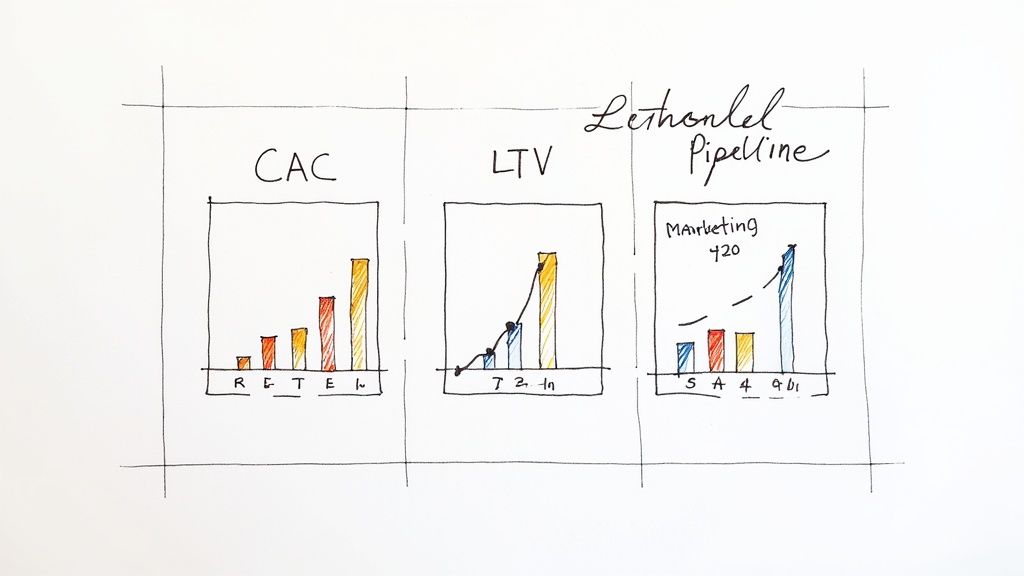
Customer Acquisition Cost (CAC): This is the total cost of your sales and marketing efforts to land one new customer. You calculate it by dividing your total sales and marketing spend over a given period by the number of new customers you won in that same timeframe. A consistently low or falling CAC is the sign of a well-oiled marketing machine.
Lifetime Value (LTV): This metric projects the total revenue you can expect from a single customer over the entire course of your relationship. For a SaaS company, this is everything—it’s a powerful indicator of both long-term profitability and how happy your customers are.
LTV to CAC Ratio: This is the magic number. It pits the value of a customer against what it cost you to get them. A healthy ratio (the benchmark is often 3:1 or better) proves you have a sustainable and profitable business model. If you’re spending more to acquire customers than they're worth, something in your strategy needs an urgent fix.
Your LTV to CAC ratio is the ultimate health check for your go-to-market strategy. It doesn't just tell you if your marketing is working; it tells you if your entire business is viable for the long haul.
Getting a handle on how to measure marketing effectiveness is a whole discipline, but focusing on these core metrics gives you a powerful place to start.
Beyond those core business metrics, it's absolutely crucial to show how your marketing activities are directly fueling the sales process. This is how you prove your team's value and build a much stronger, more collaborative relationship with sales.
Focus on tracking these pipeline-specific KPIs:
Marketing Qualified Leads (MQLs): This is the total number of leads your campaigns generate that meet the criteria to be handed over to sales. A steady flow of high-quality MQLs is the lifeblood of the sales team.
MQL to SQL Conversion Rate: This percentage reveals how many of your MQLs the sales team accepts and deems worthy of direct pursuit. A high conversion rate here is a massive win—it's a clear signal that marketing is attracting the right people.
Marketing-Influenced Pipeline: This is the total dollar value of every sales opportunity that had a meaningful touchpoint with a marketing campaign. This KPI is a game-changer because it shows marketing’s direct contribution to potential revenue, even on deals you didn't technically "source."
A great dashboard should tell a clear story at a glance. It needs to be easily scannable and, most importantly, show trends over time rather than just static, one-off numbers.
To get started, here's a quick look at the essential B2B marketing metrics you should be tracking and why each one is so important for making strategic decisions.
By keeping a close, consistent eye on these KPIs, you can stop reacting and start proactively shaping your company's growth trajectory. You'll gain the insights you need to double down on what’s working, fix what isn't, and prove once and for all that your marketing strategy isn't just an expense—it's one of the most powerful investments your business can make.
Navigating the world of B2B marketing can feel like a maze, especially when you're a startup trying to grow fast. I get asked a lot of the same questions, so I've put together some answers to help give you some clarity as you build and execute your own marketing strategy for B2B.
These aren't textbook answers—just practical, real-world advice I've seen work.
Patience is probably the hardest, but most important, virtue in B2B marketing. The time it takes to see real results depends heavily on your industry, how long your sales cycle is, and the specific channels you're using. It’s more like planting a garden than setting off a firework.
Long-term plays like SEO and content marketing are about building a foundational asset. These often take 6-12 months to gain any real traction and start delivering a consistent flow of organic leads.
On the other hand, a super-targeted paid advertising campaign on a platform like LinkedIn can start generating some initial interest—and maybe even book a few demos—within weeks.
Given that the average B2B deal involves multiple touchpoints over six or more months, it's realistic to expect a comprehensive strategy to show a significant impact on your sales pipeline and a clear return on investment within a 9 to 18-month timeframe.
The single most common—and costly—mistake I see is jumping straight into tactics without a deeply defined Ideal Customer Profile (ICP). Too many founders get excited about running ads or launching a blog before they have a crystal-clear picture of who they're actually trying to reach.
This misstep leads to generic messaging that just doesn’t land, content that misses the mark entirely, and ad spend that evaporates with almost nothing to show for it.
When you try to talk to everyone, you end up talking to no one. Every successful marketing strategy I've ever built started with a deep, almost obsessive, understanding of the customer, their specific pain points, and how they really make purchasing decisions.
There's no single magic number here, but a good rule of thumb for early-stage B2B startups is to set aside somewhere between 10% and 20% of your projected annual revenue for marketing. If you're in a high-growth phase or breaking into a totally new market, that number can and often should be higher.
The most important thing is to stop thinking about marketing as a cost center. It's an investment in growth, plain and simple.
Your budget shouldn't be rigid, either. It needs to be tied directly to performance. This allows you to double down and confidently scale your investment in the channels and campaigns that are actually delivering a positive, measurable return. This data-driven flexibility is what separates the good strategies from the great ones.
Ready to build a B2B marketing strategy that doesn't just generate noise, but drives real revenue? At Big Moves Marketing, I specialize in crafting the positioning, messaging, and sales tools that help SaaS and AI startups win their first customers and scale effectively. Let's build your growth engine together.
Explore Big Moves Marketing services and resources:





%20-%20white.svg)