%20png%20copy.avif)
So you’ve built a brilliant piece of B2B SaaS. You’ve poured everything into the code, the UI, and the core functionality. Now what?
Transforming that elegant solution into a market-leading business takes a very specific kind of marketing—one that’s fundamentally different from selling a simple consumer app. This guide is your blueprint for getting it right.
Forget the generic advice you’ve read elsewhere. Marketing B2B SaaS isn’t about chasing trends; it’s about translating complex features into clear, compelling business value for decision-makers with long-term goals.
It requires a deliberate, structured approach that connects your product to the real-world problems your customers face every single day.

This guide isn't theoretical. It’s built from the front lines of bringing over 70 products to market. Think of this less like a textbook and more like a direct conversation with a fractional CMO who’s obsessed with your success.
Our goal is to build a powerful marketing engine that consistently feeds your sales team a stream of high-quality, qualified leads. We’ll focus on the core pillars that drive a strong launch and create sustainable, long-term growth.
Together, we'll dig into how to:
This is about laying a rock-solid foundation. We're focused on crafting a launch that grabs attention, drives real adoption, and sets you up for market leadership for years to come.
Of course, turning ambition into results requires a structured plan. For a deeper dive into building out your strategy, our guide on using a Now-Next-Later roadmap can accelerate your B2B growth.
Ultimately, this blueprint is designed to give you clarity and confidence. And if you're looking for a steady stream of insights for scaling your SaaS, a dedicated resource like RebelGrowth's B2B SaaS Blog is a great place to continue learning.
Alright, let's get started.
The B2B SaaS world isn't just growing; it's exploding. We're not talking about a slow, predictable climb but a massive economic shift that's creating incredible potential for founders who know where to look. If you're building a marketing SaaS product, the very first step is to get your head around the sheer scale of this movement.
The numbers alone paint a pretty compelling picture. Businesses are funneling huge amounts of cash into tools that can give them an edge in customer acquisition and analytics. Think about this: by 2025, companies are on track to spend over $20 billion a year on marketing automation, CRM, and email marketing tools alone.
This isn't some stagnant market, either. This specific niche is growing at a healthy 15-20% clip every single year. Zoom out, and the entire global SaaS market—set to hit $390.5 billion in 2025—is projected to rocket to $793.1 billion by 2029. That's nearly double in just four years.
To give you a clearer snapshot, let's break down the core numbers.
The statistics below aren't just abstract figures; they represent the real-world pressures and priorities driving your potential customers to seek out new solutions.
These figures tell a clear story: the demand is real, the budgets are there, and the problems are only getting more complex.
This explosive growth isn't random. It’s a direct answer to a problem that practically every B2B company is wrestling with: complexity. The average business is now trying to manage a staggering 106 different applications just to keep the lights on.
This creates a chaotic mess of data silos, clunky workflows, and a desperate search for tools that can connect the dots and bring some order to the madness.
This is where you come in. Your marketing SaaS isn't just another app to add to their bloated tech stack. It's the solution to the stack.
For a B2B founder, this context is everything. It frames your marketing SaaS not as another piece of software, but as the essential tool businesses need to simplify, automate, and actually win in an increasingly complicated environment.
Understanding this reality completely changes how companies think about their budgets and priorities. To get a better feel for this, it's worth seeing how other B2B SaaS companies allocate their marketing spend and the strategic lessons you can learn from them.
The trick is to connect these big-picture trends to the day-to-day headaches of your ideal customer. They aren't just shopping for software; they're buying a more efficient, profitable, and less chaotic future for their business.
Here are the core drivers you need to plug into:
Your marketing SaaS is sitting right at the intersection of these needs. Once you truly grasp the scale of the market and the deep-seated problems fueling it, you can position your product as the indispensable bridge to your customer's success.
In the B2B SaaS marketing world, it's tempting to chase every shiny new channel. But that's a surefire recipe for a burned-out team and a torched budget. Real, lasting growth doesn't come from dabbling; it comes from building powerful, reliable engines that hum along, working for you day and night.
For most B2B SaaS companies, that foundation rests on two undisputed champions: content marketing and email marketing.
When you get them right, these aren't just "channels." They become core business assets. They forge a direct line to your ideal customers, feeding your sales team a steady diet of educated, high-intent leads who already get what you do and why it matters.
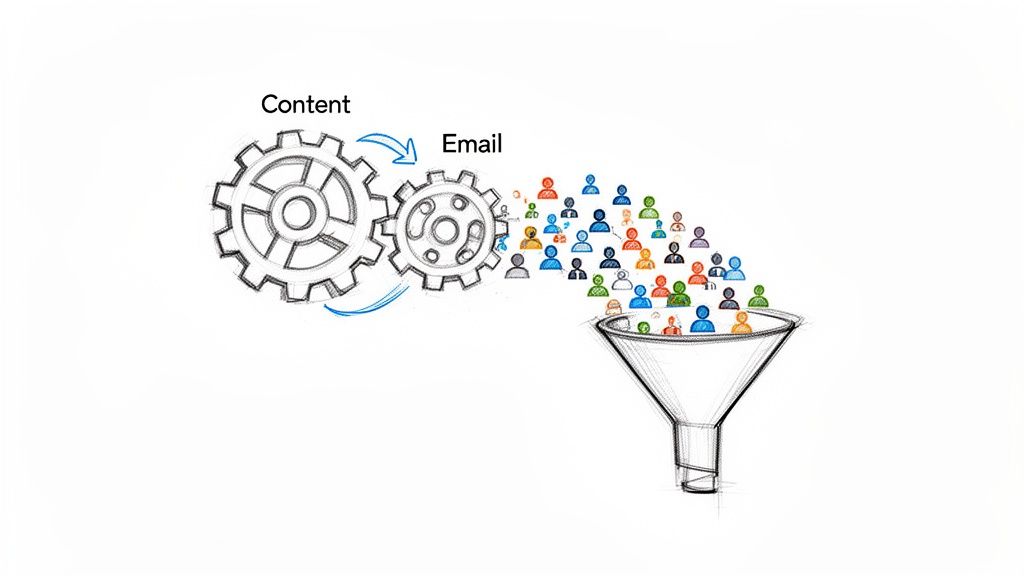
This isn't just a hunch; the numbers are screaming it from the rooftops. Email delivers an almost unbelievable $36 return for every $1 invested, making it a non-negotiable part of your stack. On the other side of the coin, strategic blogs are the engine behind 53% of all traffic for successful SaaS sites. It's no wonder that 71% of SaaS companies with over $5M in ARR now bring in outside help for content to pour gas on the fire. You can find more SaaS marketing statistics to inform your strategy on Citrusbug.com.
Stop thinking of your company blog as a publication. Start thinking of it as your most valuable marketing asset. It’s a powerful magnet, pulling in prospects who are actively googling the exact problems your SaaS was built to solve. Every article is a chance to prove your expertise and build trust, long before a sales demo ever hits the calendar.
A smart content plan isn't about endlessly talking about your product's features. It's about becoming the go-to authority in your space. When a potential customer has a question, your blog should be the first place they find the answer. This is the heart of modern marketing saas strategy—educate first, sell second.
Here’s how to build a content engine that actually works:
The real magic is creating a library of assets that works for you 24/7. An article you publish today can generate qualified leads for years to come, making it one of the most effective investments you can make in your company's future.
Building this content engine is a pillar of creating genuine, high-quality interest in what you're selling. For a deeper dive, understanding the fundamentals of B2B demand generation is a crucial next step.
If content is your magnet for attracting new prospects, email is the engine that turns that initial spark of interest into a real business relationship. It's how you nurture leads, educate them on your unique value, and get them ready for a real conversation with sales. The beauty of email lies in its directness and the power of automation.
A well-designed email sequence can literally double your conversion rates. This isn't about blasting your list with random promos. It's a calculated science—delivering the right message to the right person at exactly the right moment in their journey.
Here are a few automated sequences every B2B SaaS company needs to build:
By building these two engines—content for attraction and email for nurturing—you create a scalable system that doesn't just find customers. It creates educated fans for your brand.
Artificial Intelligence isn't some far-off concept on a product roadmap anymore. It's the engine actively rebuilding the B2B marketing SaaS world from the ground up.
For founders trying to carve out a real product advantage, this isn't optional reading—it's the new cost of entry. AI is drawing a sharp line in the sand between the tools that merely assist and those that anticipate, predict, and automate with startling intelligence.
This isn't just about bolting on a "smart" feature. We're talking about a fundamental change in how businesses operate and what they now expect from their software. The momentum is huge, and it's picking up speed fast.
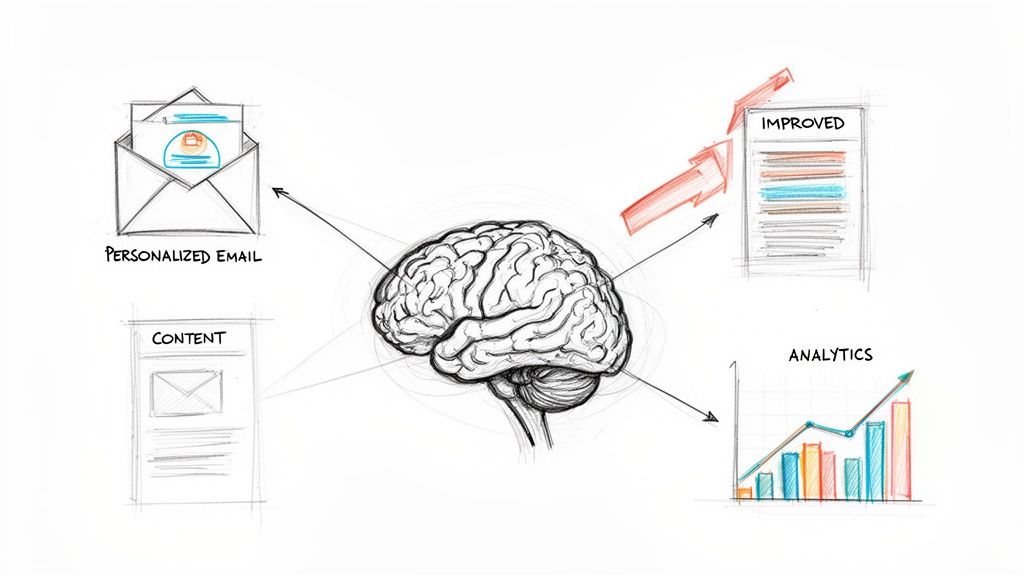
AI is quickly becoming the core intelligence layer for the next generation of marketing tools. It's a massive leap beyond simple automation, like scheduling a social media post, into the realm of genuinely augmenting a marketer's own abilities.
Think of it as giving every one of your users a team of data scientists, copywriters, and strategists working behind the scenes, 24/7.
This shift is happening at a blistering pace. The global AI SaaS market is on track to hit $101.73 billion in 2025, driven by a wild 39.4% compound annual growth rate. By that same year, 95% of organizations will be using AI-powered SaaS, and 70% of SaaS firms are already building or selling AI features. This isn't just hype; 68% of businesses see a better content marketing ROI after bringing AI into their workflow, as shown in these SaaS statistics from BetterCloud.
So, what does this actually look like for a B2B marketing SaaS product? It means embedding intelligence directly into the daily workflows your customers already rely on, making your tool absolutely essential.
Here are a few powerful examples:
The real opportunity isn't just making old tasks more efficient. It's unlocking completely new capabilities. AI gives your customers the power to achieve outcomes that were once impossible without a massive team and an even bigger budget.
Adding AI isn't just a technical problem; it's a strategic one. It demands a deep understanding of your customers' biggest headaches and a clear vision for how intelligent automation can solve them. For a detailed playbook, our practical AI implementation guide for B2B marketers breaks down the actionable steps.
To truly stand out, your AI shouldn't feel like just another feature. It should feel like the very soul of your product. It should be the reason your tool delivers a sharper marketing message and a smarter, more valuable experience for your users. In a crowded market, this is how you build a product that doesn’t just compete—it leads.
Let's be blunt: a brilliant product without a clear plan to reach customers is just a brilliant idea sitting on a server. For any B2B SaaS company, your Go-To-Market (GTM) strategy is the operational blueprint that gets your solution out of the code and into the market. It's the critical link between building something great and actually winning.
This isn't about just throwing a few marketing tactics at the wall and hoping something sticks. A powerful GTM strategy is a disciplined, interconnected framework built on three core pillars: Positioning, Messaging, and Sales Enablement. When these three are in sync, you create a clear, compelling story that connects with your ideal customers and gives your team the confidence to close deals.
First up is positioning. This is all about carving out a specific, undeniable spot for your product in your customer's mind. It answers the one question that matters most to a busy B2B buyer: "Why should I choose this over all the other options I have, including just doing nothing?"
Forget listing features. Your prospects don’t buy a list of functionalities; they buy solutions to expensive, painful problems that keep them up at night. Your positioning has to articulate a unique value proposition that targets a very specific audience dealing with a high-stakes challenge.
A rock-solid positioning statement makes it crystal clear:
Your position is your flag in the ground. It’s a declaration of who you are for, what you stand against, and why you are the undeniable best choice for a specific set of customers.
Once you’ve locked in your position, the next pillar is translating it into consistent messaging. Think of messaging as the practical application of your positioning—it's the actual words you use on your website, in your ads, and during sales calls. If your messaging is all over the place, you kill your credibility. Fast.
To keep everyone on the same page, the smartest B2B SaaS companies develop a messaging matrix. This document is your single source of truth for all communication. It’s a simple but powerful tool that maps your core value propositions to different buyer personas and their specific pain points.
This matrix ensures that every email, every ad, and every demo reinforces the same core story, creating a seamless and trustworthy experience for the buyer. It provides the foundational language for everything from your homepage headline to the talking points your sales team uses to handle objections.
The final, crucial pillar is sales enablement. This is the art and science of arming your sales team with the content, tools, and training they need to communicate your value and actually win deals. Marketing’s job doesn't end when a lead comes in; it extends all the way to helping sales turn that lead into revenue.
This is where you turn your powerful positioning and crisp messaging into practical, battle-ready assets. Without these tools, you’re asking even the best sales reps to fly blind. If you want to go deeper on this, check out our complete guide on how to build a Go-To-Market strategy for SaaS.
To get your team ready for launch, you need a core set of sales enablement materials. The table below breaks down the absolute essentials every B2B SaaS team needs from day one.
Here’s a breakdown of the critical tools your sales team needs to effectively communicate value and close deals for your new SaaS product.
These assets aren't just "nice-to-haves"; they are the tangible expression of your strategy.
By systematically building out these three pillars—positioning, messaging, and sales enablement—you create a GTM strategy that does more than just launch a product. You build a repeatable, scalable engine for growth that aligns your entire organization around a single, winning mission.
In the high-stakes world of B2B SaaS, what you measure is what you get. Chasing vanity metrics like website visits or social media likes is like admiring the paint job on a car with no engine. It looks impressive, but it’s not actually going anywhere.
Real growth in marketing SaaS comes from obsessing over the key performance indicators (KPIs) that directly signal the health and scalability of your business. These are the numbers that empower smart decisions and prove your marketing efforts are actually profitable. Think of them as your diagnostic tools, helping you spot trouble early and confidently show marketing's impact on the bottom line.
It's time to cut through the noise and measure what truly matters.
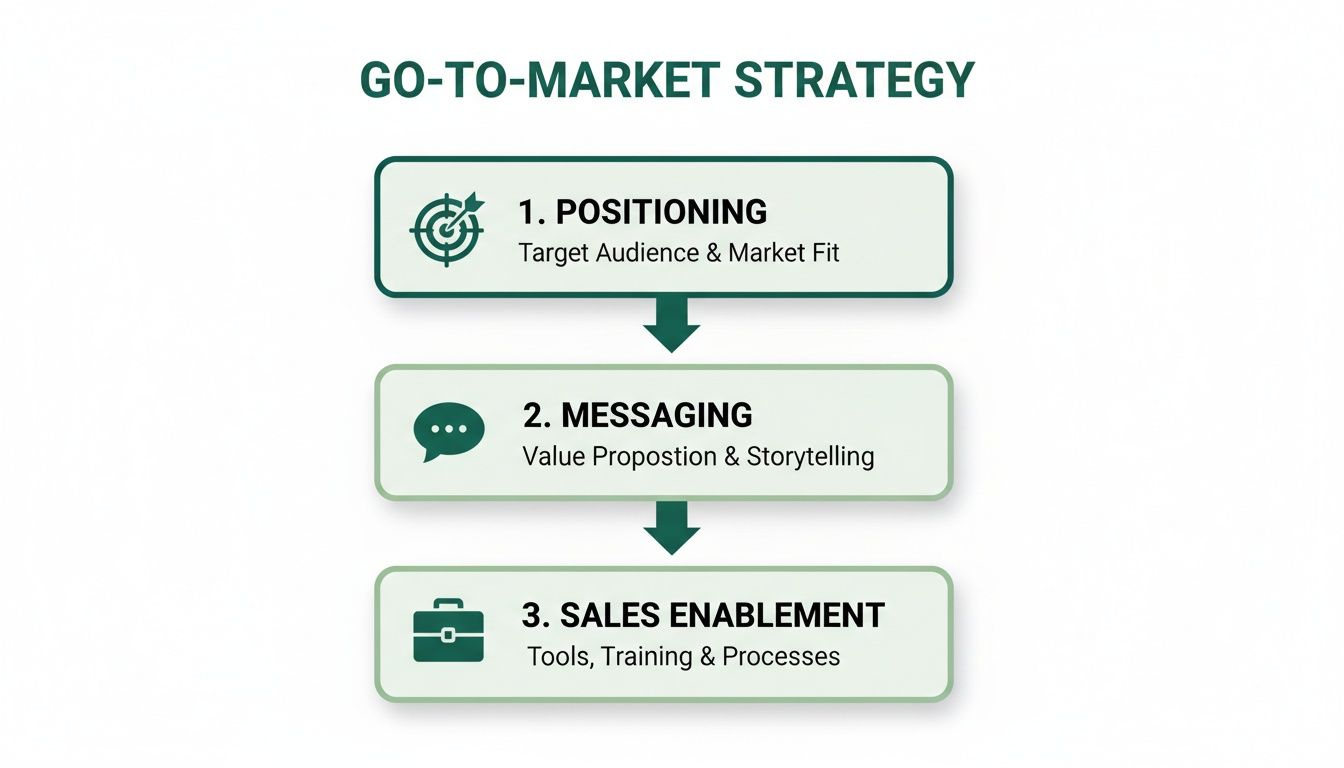
This flowchart gets to the heart of it: strong metrics don't just happen. They're the result of a solid go-to-market plan that starts with nailing your positioning and messaging long before you try to sell anything.
Three metrics form the absolute bedrock of a healthy B2B SaaS model. Getting a handle on how they interact isn't just a good idea—it's non-negotiable for building a business that lasts.
Customer Acquisition Cost (CAC): This is the total price tag for all your sales and marketing efforts to land one new customer. The math is simple: just divide your total sales and marketing spend over a set period by the number of new customers you signed in that same window.
Customer Lifetime Value (LTV): This metric tells you the total revenue you can realistically expect from a single customer over their entire relationship with your company. A high LTV is a fantastic sign that your product is sticky and solves a real, ongoing problem for them.
The LTV:CAC Ratio: This is the big one. It’s the ultimate reality check, comparing what a customer is worth to you versus what it cost to get them. A healthy B2B SaaS business should be aiming for an LTV:CAC ratio of at least 3:1. This means a customer's value is at least three times the cost of acquiring them.
If your LTV:CAC is scraping by at less than 3:1, you’re almost certainly overspending to acquire customers who aren't sticking around long enough to turn a profit. On the flip side, if it’s way higher—say, 5:1 or more—it might be a signal that you're underinvesting in growth and could be scaling much faster.
Beyond that core growth ratio, a couple of other metrics give you a constant pulse check on the financial health of your subscription business. They tell you if you're growing, stagnating, or heading for trouble.
Monthly Recurring Revenue (MRR) & Annual Recurring Revenue (ARR): MRR is the predictable revenue your business can count on every single month. ARR is simply your MRR multiplied by 12. Tracking these is fundamental to understanding your growth trajectory and making financial forecasts that aren't just wishful thinking.
Churn Rate: This is the percentage of your customers who cancel their subscriptions in a given period. For a B2B SaaS company, a high churn rate is a five-alarm fire. It’s a screaming signal that something is seriously wrong with your product, onboarding, or customer support, and it will systematically destroy your LTV.
Mastering these numbers gives you the clarity to make confident, strategic moves. They aren't just figures for a dashboard; they are the language of sustainable B2B SaaS success, telling you exactly where your business stands and where you need to focus your energy next.
Jumping into the world of B2B SaaS marketing can feel like you're trying to learn a new language on the fly. You're not alone if you have questions—the challenges of building and selling complex software to other businesses are unique.
This section cuts right to the chase, tackling the most common questions I hear from founders and marketing leaders. The goal here is to give you direct, practical answers you can run with.
The most common trap, without a doubt, is an obsessive focus on product features instead of customer problems. Founders are rightly proud of the incredible tech they've built, but B2B buyers don't actually buy features—they buy solutions to painful, expensive business challenges.
A winning marketing strategy always, always starts with a deep, almost forensic understanding of your target customer's daily struggles. It’s about framing your SaaS as the clearest, most direct path out of their mess, not just rattling off a list of its technical specs.
A close second—and equally critical—mistake is neglecting sales enablement. Your marketing is only as effective as your sales team's ability to communicate its value. Marketing absolutely must create the tools, like sharp pitch decks and battlecards, that translate your value proposition into closed deals.
This customer-first mindset is the bedrock of every effective marketing saas campaign.
Look, content marketing is a long-term play. It's about building a valuable business asset, not just a short-term tactic for a quick traffic bump. While you might see a few glimmers of life early on, it realistically takes 6 to 9 months of consistent, high-quality work to see significant, sustainable results.
Think of it like planting a tree. The initial effort feels substantial, but the rewards compound over time. The articles and guides you publish today will keep pulling in organic traffic, generating qualified leads, and building your domain authority for years. This is especially true in B2B, where long sales cycles require content that nurtures leads through their entire decision-making journey.
This isn't an either/or question. The most successful B2B SaaS companies don't choose—they build a smart strategy that blends the strengths of both. Relying on just one approach means you're leaving a massive amount of growth on the table.
Here’s how to think about them working together:
Ultimately, the right mix depends on your target audience, average deal size, and stage of growth. A balanced strategy that uses inbound to attract and outbound to target creates a powerful, resilient growth model.
At Big Moves Marketing, I help B2B SaaS and AI founders build the positioning, messaging, and sales tools that turn brilliant products into market-leading businesses. If you're ready to create a launch strategy that drives adoption and revenue, let's connect at https://www.bigmoves.marketing.
Explore Big Moves Marketing services and resources:

%20-%20white.svg)