%20png%20copy.avif)
Launching a B2B SaaS or AI product can feel like yelling into the wind. The right marketing channels aren't just megaphones; they're direct lines to your ideal customers. A scattergun approach burns through cash and time, while a strategy built around your specific audience is the engine that drives adoption and, ultimately, revenue.
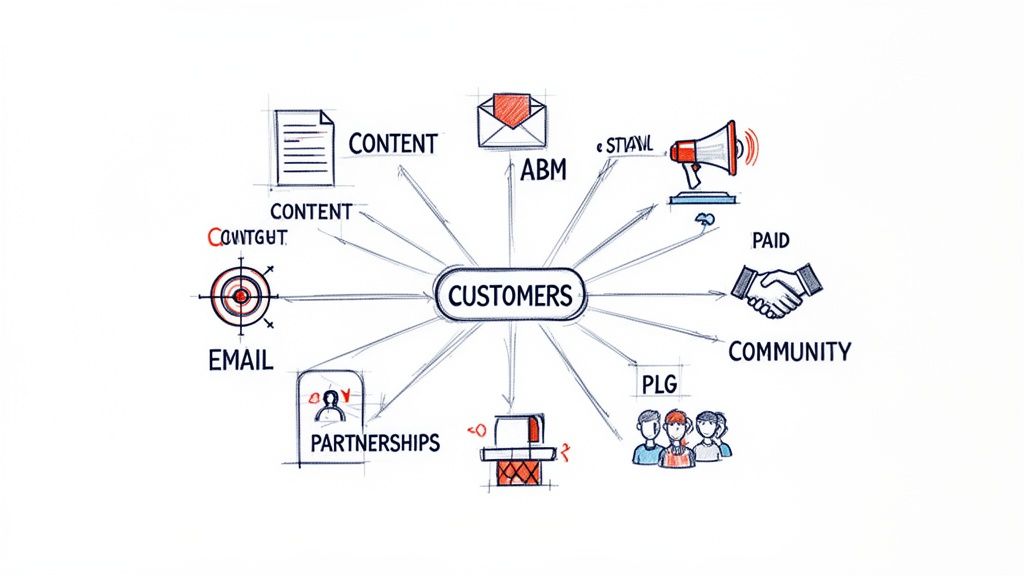
Choosing your marketing channels isn't about ticking boxes. It's about assembling a toolkit where every tool has a very specific job. You wouldn't use a hammer on a screw or a wrench on a nail. Each channel serves a unique function in building a solid go-to-market plan.
This guide goes beyond surface-level definitions to give founders and marketers a real blueprint for what works today. We’ll demystify the core channels that truly matter for B2B tech companies, showing you how they connect and work together to build real momentum.
Your goal is to build a marketing engine that doesn't just grab attention but guides prospects on their journey from "who are you?" to becoming loyal advocates. These are the essential components of that engine:
Together, these channels form a powerful system. The key isn't to use all of them at once. It’s about picking the right combination that aligns with your product, audience, and business goals. A solid plan here is a critical piece of any effective marketing strategy for startups trying to make a real impact. This guide will give you the framework to make those choices with confidence.
Understanding the major B2B marketing channels is like learning the roles of players on a championship team. Each one has a distinct strength and purpose, but they win when they work together. Let's break down the eight core channels that drive real growth for today's B2B SaaS and AI companies.
Content and Search Engine Optimization (SEO) are the absolute bedrock of modern B2B marketing. This isn't just about churning out blog posts. It's about becoming the definitive, trusted answer to your ideal customer's most pressing professional questions. Think of it as building an incredible library of expertise that works for you 24/7.
When a potential buyer googles a solution to a problem your product solves, good SEO makes sure your content shows up. High-quality articles, in-depth guides, and useful tools build massive credibility long before a sales conversation ever happens. This approach naturally attracts prospects who are already trying to solve a problem, making them highly qualified from the start. As you explore these channels, taking a deeper dive into specific strategies can be invaluable. For a really thorough look, check out this comprehensive guide to content and digital marketing.
If content and SEO is casting a wide net, Account-Based Marketing (ABM) is spear-fishing. It completely flips the traditional marketing funnel on its head. Instead of marketing to a massive audience hoping to generate tons of leads, you hand-pick a list of high-value target accounts and treat each one like its own market.
This hyper-focused strategy means creating highly personalized campaigns for key decision-makers within those specific companies. The goal is to surround the account with relevant messaging across multiple touchpoints, proving you deeply understand their unique challenges. ABM is a game-changer for companies with big contracts and long sales cycles.
Key Insight: ABM isn't just a marketing tactic; it's a strategic union between marketing and sales. Success hinges on shared goals and a unified, laser-focused effort to engage those target accounts.
Believe it or not, email marketing is still one of the most powerful and direct channels in the B2B world. Its real strength isn't in blasting out messages, but in building and nurturing professional relationships at scale. It’s the connective tissue that holds all your other marketing efforts together.
With smart segmentation and automated email sequences, you can deliver the perfect message to the right person at exactly the right time. Whether it's a welcome series for a new subscriber, a nurture campaign for a lead who downloaded a whitepaper, or updates for existing customers, email keeps the conversation moving and guides prospects along their journey.
In a digital-first world, nothing beats a real connection. In-person events, trade shows, and virtual webinars give you a unique chance to create memorable experiences and engage with your business audience directly. They put a human face on your brand and allow for real-time interaction that builds strong, lasting connections.
Both formats position your company as a thought leader and provide a platform to answer questions directly, which dramatically accelerates trust and consideration.
Paid advertising on platforms like LinkedIn, Google, and industry-specific sites gives you the power to reach your ideal customer with surgical precision. It’s the accelerator for your marketing engine, letting you get your message in front of the right people, right now.
This channel is perfect for promoting a high-value piece of content, driving webinar sign-ups, or targeting decision-makers at specific companies as part of an ABM campaign. While organic channels build momentum over time, paid ads deliver immediate visibility and predictable traffic. Many businesses now use specialized B2B marketing AI tools to fine-tune ad spend and targeting for maximum impact.
Why build an audience from scratch when you can tap into one? Partnerships allow you to reach entirely new audiences by collaborating with non-competing companies that serve a similar customer base. This could be a co-marketing campaign with a complementary software provider, a referral program, or a strategic integration. By joining forces, you gain credibility and access to an established network, amplifying your reach exponentially.
Product-Led Growth (PLG) is a strategy where the product itself does the heavy lifting for customer acquisition, conversion, and expansion. It usually relies on a freemium or free trial model that lets users experience the product's value firsthand before they ever have to pull out a credit card.
This channel completely turns the traditional B2B sales model on its head by letting a user's positive experience with the product do all the selling. For B2B SaaS and AI, this is an incredibly powerful way to slash customer acquisition costs and dramatically shorten sales cycles.
Finally, community building is about creating a dedicated space where your customers, users, and biggest fans can connect with each other and your team. This could be a Slack group, a dedicated forum, or a series of user meetups. A thriving professional community fosters incredible loyalty, reduces churn, and turns your best customers into your most passionate advocates. It also provides an invaluable, real-time feedback loop for making your product even better.
Using the right marketing channels in B2B is like speaking the right language to the right person. A brilliant message delivered at the wrong moment—or in the wrong place—just falls flat. To build real momentum for your launch, you have to align your channel strategy with the natural flow of your B2B buyer's journey, from that first flicker of curiosity to the final purchase order.
This isn't just about ticking boxes. Strategically mapping your channels ensures your efforts meet buyers exactly where they are, giving them the right information at the perfect time. It’s the difference between a series of disconnected, tactical shots in the dark and a cohesive system that actually guides prospects forward.
The concept map below shows how core B2B channels like content, email, and account-based marketing all weave together.
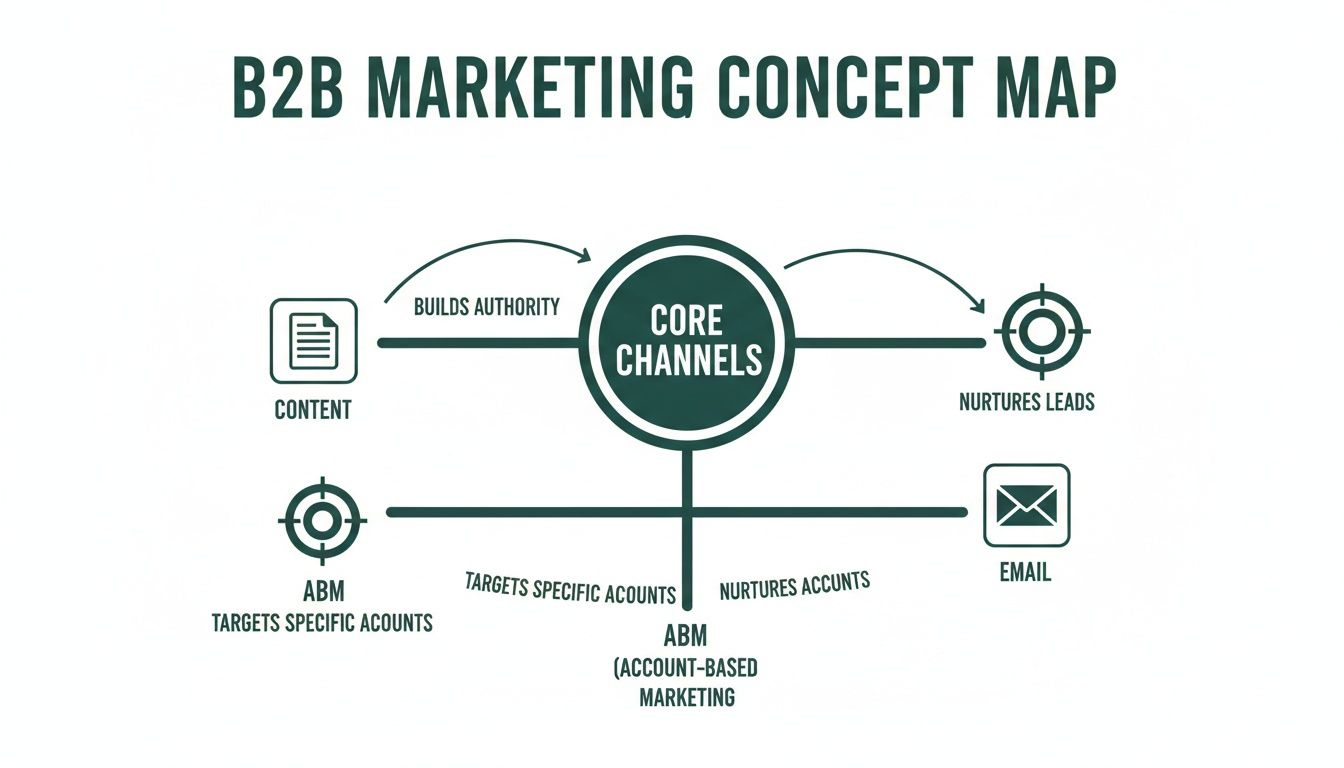
As you can see, no channel is an island. They all need to work in concert to move a potential customer from "Who are you?" to "Where do I sign?"
To help you visualize this, we’ve broken down how specific channels map to each stage of the buying process. This table provides a high-level overview before we dive into the details of each stage.
This framework isn't rigid, but it gives you a solid starting point for allocating your resources where they’ll make the biggest impact at the right time.
In the Awareness stage, your prospect has just realized they have a problem or an opportunity. They might not even have a name for it yet, and they almost certainly don’t know you exist. Your primary goal here is education and discovery.
You need channels that are great at casting a wide, intelligent net to capture the interest of your ideal customer profile (ICP).
The key here is to resist the hard sell. Your focus should be on being the most helpful, insightful resource they find. Build that initial trust, and they'll remember you.
Once a prospect knows who you are, they move into the Consideration stage. Now, they're actively digging in, comparing different ways to solve their problem. Your job is to build a deeper relationship, flex your expertise, and show them why your approach is the smartest one.
This is where channels that foster real engagement shine:
This stage is all about proving your value and building confidence in your solution. For a detailed walkthrough on structuring this process, explore our complete guide to creating a B2B customer journey map.
We're at the final stage. Your prospect is ready to pull the trigger. They’ve whittled down their options and are looking for that last piece of validation to make a confident choice. Your marketing needs to get more direct, more personal, and laser-focused on conversion.
At this point, the conversation shifts from "what is the best solution?" to "is this the right partner for us?" Your channels must reinforce that the answer is a resounding "yes."
Highly focused, high-touch channels are what you need to seal the deal:
It’s one thing to know the B2B marketing channels in theory, but the real magic happens when you see them applied in the real world. A channel strategy isn’t just a list; it’s a living plan that adapts to your company’s unique DNA—your budget, your goals, and your market.
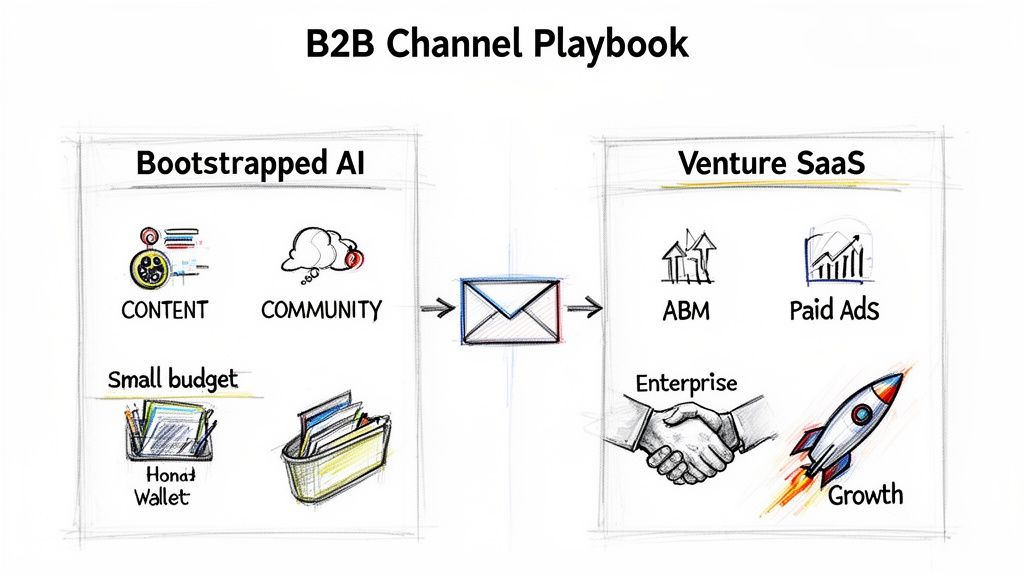
Let’s move past theory and jump into two classic B2B launch scenarios: the scrappy, bootstrapped startup and the powerhouse, venture-backed company. These examples show it’s never about using every channel, but about picking the right tools for the job.
Picture a small, self-funded AI startup rolling out a niche automation tool for data analysts. Their bank account is lean, the team is tiny, and the main goal is simple: get early traction and prove the product works without spending a fortune on ads. Efficiency and organic growth are everything.
Their playbook is all about building authority and attracting a loyal user base that grows over time.
This strategy is a slow burn, but it builds a rock-solid, defensible foundation. Every article becomes an asset that works 24/7, and the community provides priceless feedback and social proof.
Now, let's flip the script. Imagine a VC-backed SaaS company launching a heavy-duty, enterprise-grade project management platform. They’ve got serious funding, a hungry sales team, and a mission to capture market share fast by landing huge enterprise logos. Their strategy needs to be precise, scalable, and built for speed.
Their playbook would zero in on channels designed for direct outreach and high-impact engagement with specific, high-value targets.
This high-touch, high-investment strategy is engineered to compress the sales cycle for big contracts. It laser-focuses marketing and sales on the accounts that truly move the needle, ensuring not a single dollar or hour is wasted.
No matter which playbook you run—bootstrapped or venture-backed—one channel acts as the central nervous system for everything else: email marketing. It’s the engine that nurtures every lead, guiding them from a flicker of interest to a real sales conversation.
For our AI startup, email turns blog subscribers into active product users. For the enterprise SaaS company, it keeps prospects at target accounts warm and engaged between sales calls.
Email is the undisputed workhorse in B2B. In fact, 79% of B2B marketers call it their most successful channel for content distribution. With a staggering return of $36 for every $1 spent, it delivers an efficiency that's impossible to ignore, especially when every launch dollar counts.
These playbooks make one thing clear: the best B2B marketing channels aren’t universal—they’re contextual. The right mix depends entirely on your resources, your audience, and your ultimate goals. For a deeper look at how these pieces fit together, check out our guide on B2B channel marketing.
You’ve seen the channels and how they line up with the buyer’s journey. Now for the fun part: building your own, unique marketing engine. This isn’t about ripping a page from another company’s playbook. It’s about creating a plan that’s a perfect reflection of your business, your audience, and your ambition.
A powerful marketing mix isn't built on guesswork or by chasing every shiny new channel. It’s built with intention. Spreading your budget and team too thin is a classic startup mistake. Real momentum comes from making a few smart, focused bets.
To build a mix that actually wins, you need to filter your options through a framework of four critical questions. Answering these honestly will bring immediate clarity and point you straight toward the right combination of channels for your specific situation.
Answering these questions acts as your compass. A complex, high-ticket AI platform sold to enterprise CTOs demands a completely different mix than a simple, low-cost tool for marketing managers. The first might lean heavily on ABM and executive events, while the second would crush it with Product-Led Growth and community building.
Once you have clarity on those core factors, it's time to get focused. Think of your channels in tiers. Start by picking one primary channel and one or two supporting channels. This disciplined approach ensures you can achieve excellence in a few areas instead of being mediocre in many.
For example, a startup targeting developers might choose content and SEO as their primary channel, pumping out deep, technical tutorials that solve real problems. Their supporting channels could be community engagement in developer forums and a simple email newsletter to keep subscribers in the loop. It's a tight, effective system.
As another example, for B2B companies targeting decision-makers, LinkedIn has cemented its dominance. An incredible 80% of social media leads for B2B come directly from the platform. Data shows that 4 out of 5 social leads in major markets trace back to LinkedIn, making it a non-negotiable channel for many B2B launches. Learn more about the latest B2B marketing statistics on seoprofy.com.
This focused approach lets you truly master a channel, build a repeatable process that gets results, and then strategically expand your efforts as you grow.
Your marketing mix is not set in stone. It is a living strategy that should evolve as your company grows, your market changes, and you gather more data on what truly moves the needle for your business.
The goal here is to create a plan that’s balanced, effective, and scalable—one that lines up perfectly with your business goals. By asking the right questions and prioritizing with discipline, you can build a marketing engine that doesn’t just make noise but drives real, sustainable growth. For a more detailed walkthrough, explore our guide on choosing the right B2B channel mix for growth.
Alright, you've made it this far. You’ve seen the channels, you’ve got the frameworks—this isn’t just some theoretical list of B2B marketing tactics. Think of it as a blueprint for building a marketing engine that actually drives sustainable growth for your new SaaS or AI product.
Your next move isn’t to try and boil the ocean. Don’t do everything at once. The goal is to take what you’ve learned here and make your first confident, calculated step.
Choosing your marketing channels isn't a one-and-done decision you can set and forget. It's a living, breathing process. The best B2B marketers I know aren't just great at executing campaigns; they're strategic thinkers who are constantly testing, learning, and tweaking their channel mix based on hard data.
Think of your initial launch strategy as a hypothesis. Your first channel selections are the first experiment you'll run.
This loop—launch, measure, iterate—is what separates a fleeting campaign from a company that achieves real market leadership. Each cycle makes your marketing engine smarter, more efficient, and a hell of a lot more powerful.
This is your moment. The road from a brilliant idea to a market-defining product is paved with intentional, strategic action. You have the tools and the insight to build a plan that's both ambitious in its vision and completely achievable in its execution.
So, move forward. Not just with a strategy, but with the conviction that you're building something remarkable. Launch with the confidence that your approach isn't a shot in the dark, but the first of many smart, deliberate steps toward making a lasting impact.
Your journey starts now.
When you’re deep in the trenches of launching a new B2B product, a lot of questions pop up about marketing. It’s totally normal. Here are some of the most common ones we hear from founders and marketers, along with some straight-up advice to help you build a smarter plan.
When you’re just starting out and every dollar feels precious, you have to play the long game. Forget the flashy stuff. Your first move should be a one-two punch that builds a real asset for your company: Content & SEO.
Think about it. Every time you publish a truly helpful guide or a deep-dive blog post that solves a real problem for your customer, you’re creating a salesperson that works for you 24/7, for free. It’s a slow burn, for sure, but the traffic it brings in is the best kind—people who are actively searching for your solution.
At the same time, you need to be where your buyers are. For most B2B SaaS, that’s LinkedIn. This doesn’t mean just broadcasting company updates. It means getting into the conversation—joining niche groups, dropping insightful comments on other people’s posts, and making genuine connections with folks who fit your ideal customer profile. It's the most effective, low-cost way to build authority and start generating real leads.
Start where your customers are already asking questions. Become the best, most helpful answer through great content and authentic engagement, and you’ll build a foundation that pays off for years.
Don't fall into the "we need to be everywhere" trap. It's a classic startup mistake. Trying to be mediocre on five different channels is the fastest way to burn through your budget and have nothing to show for it.
For a new launch, master one or two channels. That’s it.
Pick your primary channel—the one place where your audience absolutely lives and breathes (like LinkedIn for enterprise software). Then, choose a secondary, supporting channel that naturally complements it. For example, you could use email marketing to build relationships with the connections you're making on LinkedIn.
Only after you’ve created a proven, repeatable process on those two channels—and you’re seeing real, measurable results—should you even think about adding a third. In the beginning, the golden rule is depth over breadth. Always.
Think of paid advertising as gasoline, not a spark. You only pour fuel on a fire that’s already burning. Before you spend a single dollar on LinkedIn Ads or Google Ads, you need two things locked down:
Paid channels are for scaling what’s already working organically. Using them too early is just an expensive way to search for a business model you haven't found yet. It's one of the most common ways startups waste precious capital.
Ready to build a go-to-market strategy that drives real adoption and revenue? Big Moves Marketing specializes in helping B2B SaaS and AI startups launch with confidence. Let's create the positioning, sales tools, and launch plan that helps you win your market. Schedule a consultation today.
Explore Big Moves Marketing services and resources:


%20-%20white.svg)