%20png%20copy.avif)

B2B market segments are specific, identifiable groups of business customers who share similar traits and needs. The point is to slice a massive, diverse business market into smaller, more manageable pieces. Doing this lets you tailor your marketing, sales, and product roadmap with precision, connecting you with the clients who will truly move your business forward.
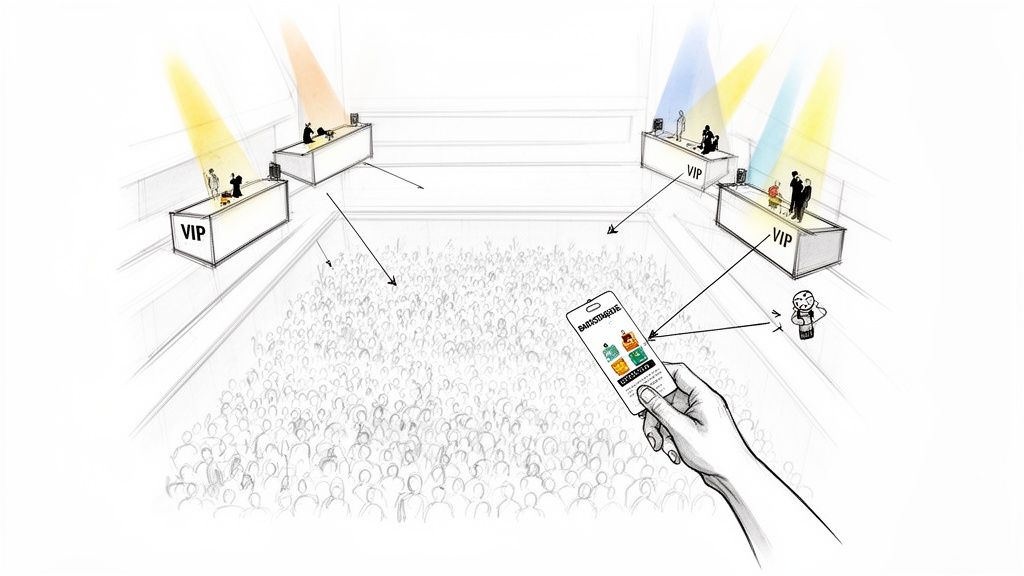
Picture your total addressable market as a giant, chaotic concert hall. You could get on stage, grab the mic, and yell your message, hoping the right people hear you over the noise. But honestly, most of that effort would be wasted on a crowd that isn’t paying attention. This is what marketing without segmentation feels like: inefficient and exhausting.
Now, think of B2B market segments as your backstage passes to a few exclusive VIP lounges. In these smaller, quieter rooms, your ideal customers are gathered together, ready to have a real conversation. That’s the heart of segmentation. It’s not about shrinking your audience; it’s about finding the right rooms where your message will be heard and valued.
For ambitious SaaS and AI startups, segmentation is much more than a marketing task on a checklist. It’s the foundational strategy that should guide every major decision your company makes. It turns ambiguity into focus, giving you a powerful lens to see your entire business operation more clearly. Without it, you’re flying blind.
Effective segmentation acts as your company’s true north. It ensures that your product development, sales messaging, and go-to-market execution are all aligned to serve the customers who will fuel your growth.
When you define your B2B market segments, you unlock a cascade of benefits that build unstoppable momentum. Getting this clarity is non-negotiable, and our guide on how to identify target markets in B2B dives even deeper into this process.
Think about the immediate impact of sharp segmentation:
This kind of strategic focus is how you find your footing, rack up early wins, and build a scalable business that's ready for its next big move.
In a market flooded with noise, trying to be everything to everyone is a surefire way to be nothing to anyone. Precise segmentation isn't about shrinking your potential; it's about multiplying your impact. This strategic focus is how you stop competing on a crowded field and start creating your own game, with rules tilted in your favor.
That clarity ripples through your entire operation. It empowers you to concentrate your most precious and finite resources—time, money, and talent—on the handful of activities with the highest probability of success. Instead of spreading your budget thin across a dozen channels, you can go all-in on the one or two that matter most to your ideal customer.
Without a clear target, marketing messages become a laundry list of features. You end up talking about what your product does, but you fail to connect with what your customer truly needs. This is the critical difference between a nice-to-have tool and an absolutely indispensable solution.
Well-defined B2B market segments arm you with the deep insights needed to craft messaging that feels personal and hyper-relevant. You can speak directly to the specific pains, goals, and even the language of a particular industry or company size. A generic pitch sharpens into a compelling narrative that proves you understand their world better than anyone else.
This level of focus is your distinct advantage. It turns your sales team from generic vendors into trusted advisors, armed with insights that build credibility and accelerate deals.
This focused approach also empowers your sales team to have far more effective conversations. They walk into meetings with sharper pitch decks and a crystal-clear understanding of the customer's context, which naturally leads to shorter sales cycles and higher close rates.
For a startup, early momentum is everything. Securing those first crucial wins validates your product, energizes your team, and catches the attention of investors. Precise segmentation is the most reliable path to get there. By targeting a niche group of customers who feel your solution was built just for them, you create passionate early adopters.
These initial champions become your most powerful marketing asset. Their success stories and testimonials provide the social proof you need to expand into adjacent B2B market segments. This methodical, segment-by-segment growth is far more sustainable than a scattergun approach that leaves you spread thin.
Of course, to get started on this path, you must first define exactly who that ideal customer is. Building a detailed profile is the essential first step, and you can begin that process with our comprehensive ideal customer profile template.
This targeted strategy delivers powerful results by aligning your entire organization around a common goal:
Ultimately, precise segmentation isn't just another marketing tactic. It's a core business discipline that provides the focus and clarity required to navigate uncertainty, secure critical early victories, and build a resilient, high-growth company.
To build a segmentation strategy that actually works, you need a strong, reliable foundation. Think of this foundation as being supported by four distinct pillars. Each one gives you a different lens to view your potential customers, and when you combine them, they create a rich, multi-dimensional picture of your ideal B2B market segments.
These pillars are Firmographic, Geographic, Behavioral, and Needs-Based segmentation. Let's break down what each one tells you.
Firmographic segmentation is almost always the first step. Why? Because it uses clear, objective, and easy-to-find company data. This pillar helps you answer the most basic questions about the businesses you're targeting: "Who are they?" and "What do they look like on paper?" It’s the quickest way to start narrowing your focus.
The core of firmographic data includes:
Using firmographics helps you disqualify poor-fit companies right out of the gate, making sure your sales and marketing teams aren't wasting energy. For instance, a SaaS company selling complex logistics software might target manufacturing firms with over $100 million in revenue, knowing that smaller businesses simply won't have the operational scale to justify the solution.
The diagram below shows how these pillars—firmographic, geographic, and behavioral—form the essential layers of a solid B2B segmentation model.
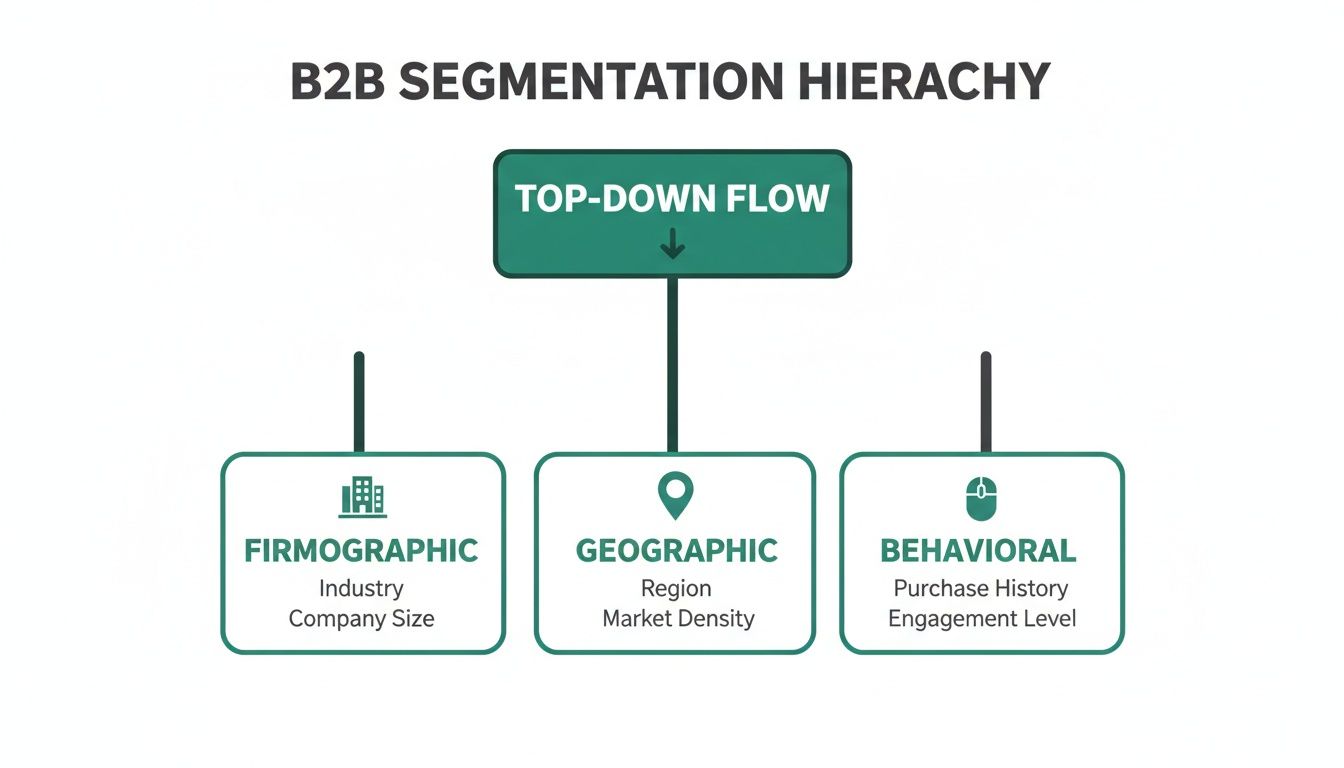
This hierarchy makes a critical point: effective segmentation starts with broad, observable traits and gets progressively more granular, digging into the nuanced actions and motivations of your customers.
The second pillar, geographic segmentation, is all about location. While it feels like the world has gotten smaller, where a business operates still matters—a lot. Location can influence everything from local market regulations and cultural norms to simple logistics.
Geographic criteria can be as broad or as specific as you need:
This pillar is especially critical if your business has a physical product, a field sales team, or services that are affected by regional laws. Getting this right often requires dedicated research. To learn more, explore the different methodologies behind effective B2B market research to uncover those hidden, location-based opportunities.
This is where things get interesting. Behavioral segmentation moves past static data to focus on how a company acts. This pillar gives you dynamic insights into a company’s purchasing habits, technology usage, and engagement with products like yours. It helps answer the question, "How do they actually operate and make decisions?"
Key behavioral factors include:
Behavioral insights are your window into a prospect's true intentions. A company might fit your firmographic profile perfectly, but their behavior reveals whether they are genuinely ready and willing to buy.
For example, a cybersecurity firm might prioritize companies that recently downloaded their whitepaper on data breaches. That single action signals a recognized need and an active interest in finding a solution, making them a much warmer lead.
Finally, we arrive at what is arguably the most powerful pillar: needs-based segmentation. This one gets to the core of a customer's motivation—the "why." Instead of focusing on external traits, it groups businesses based on the specific problems they're trying to solve or the outcomes they desperately want to achieve.
This approach is rooted in the "Jobs to Be Done" framework. It forces you to ask, "What specific job is the customer hiring our product to do?"
Segments here might be defined by:
When you understand the "why," you can align your messaging and value proposition directly with a customer's most urgent needs. This creates a pitch that doesn't just describe your product, but solves their problem.
To bring it all together, here's a quick breakdown of the four segmentation models we've covered, what they measure, and when they're most useful for a B2B startup.
Each model provides a unique layer of insight. Starting with broad firmographics and layering on geographic, behavioral, and needs-based data allows you to build a sophisticated and highly effective segmentation strategy that drives real results.
Alright, let's get down to business. Defining your B2B market segments is where all the theory gets real. It’s the moment you stop thinking about concepts and start building the actual blueprint that will drive your company's growth.
Think of it as a journey of discovery. You'll start with the goldmine of data you already have—your current customers—and then work your way outward to test your ideas and uncover new opportunities. This isn't some complex academic drill; it's a practical, repeatable process designed to give you clarity and confidence in who you're selling to.
Follow these steps, and you’ll build segments that don’t just look good on a whiteboard but are ready to make a real impact on your bottom line.
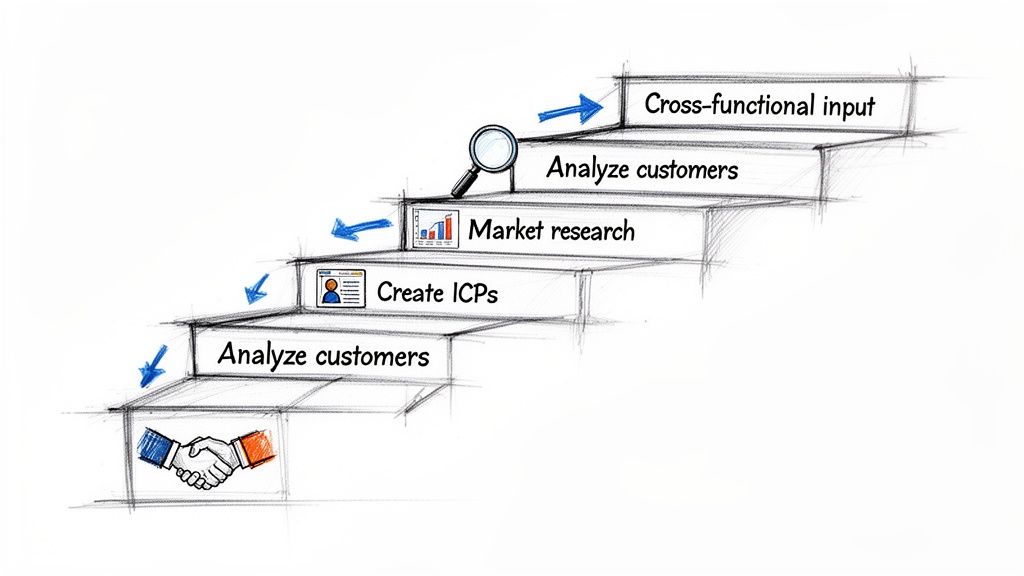
The best clues for finding your next great customer are hiding in plain sight: within your current customer base. The journey begins by looking inward, at the clients who already see the most value in what you do.
We’re talking about the businesses that stick around, sing your praises, and fully embrace your solution. These are your true fans.
Start by pulling together a list of your top 10-20 customers. Don't just pick the ones with the biggest checks; look for a mix of qualities like how easy they were to close, how deeply they’ve adopted your product, and the overall health of the partnership. Once you have that list, it’s time to play detective and find the common threads.
The goal here is to form a hypothesis. You're searching for patterns in their firmographics, behaviors, and needs that signal a successful partnership with your company.
This internal deep dive is your foundation. Hunt for similarities across:
Documenting these patterns will give you the first solid sketch of your most promising B2B market segments.
Your internal analysis gives you a strong starting hypothesis, but it's based on a pretty small sample size. The next critical step is to look outside your own four walls and see if that hypothesis holds up in the real world.
This is where you confirm whether the segment you've identified is big enough to be worth your time and where you might spot new opportunities you hadn’t considered.
The shift to digital has been a massive tailwind for focused B2B companies. The global B2B eCommerce market has skyrocketed to an estimated $32.11 trillion in 2025, a huge leap from $13.29 trillion back in 2019. This explosion shows a fundamental change in how businesses in sectors like advanced manufacturing, healthcare, and professional services are buying solutions.
Your external research should cover a few key areas:
This validation step is your reality check. It provides the proof you need to stop guessing and start moving forward with conviction.
With your research locked in, it’s time to bring your top one to three segments to life by creating detailed Ideal Customer Profiles (ICPs). An ICP is much more than just basic company info; it's a vivid, detailed portrait of the perfect company for you to target.
Think of it as a living document that captures the soul of a segment. If you're looking for more ways to think about identifying and classifying your audience, there are some great customer segmentation strategies that can offer more context.
For each target segment, your ICP should nail down:
Segmentation isn't just a marketing project; it's a company-wide strategy. The final, and arguably most important, step is making sure everyone is on the same page. Without alignment, even the most brilliantly defined segments will go nowhere.
Get leaders from sales, product, and customer success in a room. Walk them through your research, the ICPs, and the strategic "why" behind your choices. This isn't about you telling them how it's going to be; it's a collaborative session to make sure the plan is practical from every angle.
Ask the hard questions:
This cross-functional buy-in is what holds your entire segmentation strategy together. It gets the whole company aimed at the same target, creating a powerful and sustainable engine for growth.
Defining your B2B market segments is a huge step, but honestly, it’s just the starting line. The real magic happens when you bring those carefully crafted Ideal Customer Profiles (ICPs) to life. This is where your segmentation strategy goes from being a theoretical document to the engine powering your entire go-to-market motion.
Activation is all about turning deep customer insights into tangible actions across your marketing, sales, and even product teams. It’s how you build a cohesive, intentional customer journey that speaks directly to the unique world of each segment, ultimately accelerating sales cycles and driving predictable growth.
The first and most immediate way to use your segments is in your messaging. Let's be real: a generic, one-size-fits-all pitch just doesn't cut it anymore. Your segmentation work gives you the ammunition to craft hyper-relevant value propositions that truly resonate.
Imagine you're selling project management software. Your pitch deck for a mid-market manufacturing firm should look worlds apart from one targeting an enterprise healthcare provider.
For the Manufacturer: Your messaging would zero in on supply chain visibility, production timelines, and inventory management. You’d use case studies featuring similar industrial companies and speak their language of efficiency and operational uptime.
For the Healthcare Provider: The focus shifts entirely. Here, you'd highlight HIPAA compliance, patient data security, and coordinating cross-departmental care teams. The case studies would feature hospital networks, and the language would center on patient outcomes and regulatory adherence.
This tailored approach proves you understand your customer's world, instantly building credibility and setting you apart from other companies who are still shouting a single, generic message at everyone. Once your segments are clear, knowing how to implement a proven B2B content marketing strategy is the next step to effectively engage them.
Your segmentation data is also your treasure map for choosing the right marketing channels. Instead of spreading your budget thin across every platform hoping something sticks, you can make focused investments where your ideal customers actually spend their time. This is how you stop wasting money and start generating high-quality leads.
If your research shows your top segment—say, VPs of Engineering at Series B tech startups—are highly active on LinkedIn and regularly attend industry-specific webinars, your path forward is crystal clear. You can confidently double down on those channels.
A well-defined segmentation strategy is the antidote to random acts of marketing. It ensures every dollar and every hour is spent with intention, targeting the channels that offer the highest probability of success.
This precision is more important than ever. The B2B marketing industry is projected to hit a $20.44 billion valuation in 2025 and is expected to grow to $30.79 billion by 2030. This growth isn't random; it's driven by smart channel selection. For instance, marketing pros rank in-person events (52% effectiveness) and webinars (51% effectiveness) as top performers for reaching decision-makers.
The impact of activation extends far beyond marketing. It gives your sales team the exact tools they need to close deals faster. When reps are armed with segment-specific battlecards, case studies, and talk tracks, they can have far more meaningful and persuasive conversations.
This focused approach also creates a powerful feedback loop. As your sales team engages with specific segments, they gather invaluable on-the-ground intelligence. This feedback can then flow directly into your product roadmap, ensuring you're building features that solve the most urgent problems for your most valuable customers.
Ultimately, activating your segments is about creating alignment across your entire organization. It’s the final, critical step in turning market research into market leadership. For a deeper dive into building this cohesive plan, check out our guide on creating a go-to-market strategy framework for B2B.
When you first dive into segmentation, it’s completely normal to feel like you're uncovering more questions than answers. That initial uncertainty is part of the process. Pushing through it is what separates the high-growth, focused companies from the ones that stay stuck.
Let’s tackle some of the most common hurdles that come up.
A big one I hear from founders is the fear that by focusing on a few B2B market segments, they’re shrinking their market and walking away from potential deals. In practice, the exact opposite happens. Getting specific allows you to dominate a smaller pond, which creates the proof and the momentum you need to expand later. A laser-focused strategy on a few stable, high-potential segments is the single best way to manage your costs and drive real growth, especially when the market gets shaky.
Another classic hang-up is getting stuck in "analysis paralysis," endlessly gathering data to build the perfect segmentation model.
The goal here isn’t perfection; it’s clarity. You're looking for a model that is directionally correct—one that gives your team the confidence to make smarter, more focused bets. You can, and absolutely should, refine it over time as you learn more from the market.
"So, how many segments should we actually target?" For most early-stage startups, the answer is brutally simple: one to three. That's it.
Trying to be everything to everyone stretches your already limited resources way too thin. Remember, each segment needs its own tailored messaging, its own content, and sometimes even its own sales motion. You just can't do that well across five or six different groups at the start.
It's far more powerful to become the undisputed champion in one or two key B2B market segments than to barely make a ripple across half a dozen. Once you’ve established that strong foothold and built a playbook that works, you can confidently expand into adjacent segments. This disciplined approach ensures every new market you enter is built on a solid foundation of past success.
At Big Moves Marketing, we turn these complex strategic challenges into clear, actionable go-to-market plans. If you're ready to define the B2B market segments that will actually fuel your growth, see how we build launch strategies that win.
Explore Big Moves Marketing services and resources:
May 25, 2026


%20-%20white.svg)