Your B2B Customer acquisition Strategy Guide
A solid B2B customer acquisition strategy is more than just a list of tactics. It's a detailed, repeatable plan for finding and winning over other businesses, turning them into loyal customers. It replaces random acts of marketing with a systematic process built on data-backed profiles, specific channels, and clear messaging—the real drivers of predictable growth for any SaaS or AI startup.
Building Your B2B Acquisition Foundation
Before you spend a single dollar on ads or write your first line of content, you have to get the foundation right. This initial work is the most critical part of the entire strategy. It forces you to get crystal clear on who you're selling to, why they should care, and what makes your solution their only real choice.
I've seen too many startups rush this stage, and it always ends the same way: wasted budgets and campaigns that completely miss the mark.
This isn't about creating those fluffy, generic personas you see in marketing textbooks. It’s about building a data-backed Ideal Customer Profile (ICP) that represents your absolute best-fit customers. These are the companies that get the most value from your product, stick around the longest, and become your loudest champions.
A well-defined ICP is your north star. It guides every single decision—from the features you build and the channels you invest in, to the sales messages you craft. Without it, you’re just flying blind.
Define Your Ideal Customer Profile
Think of your ICP as a living document, not a one-and-done exercise. It's a detailed snapshot of the company that is a perfect fit for what you offer. To build a useful one, you need to focus on firmographic data that helps you pinpoint these companies with precision.
Start by asking the hard questions:
- Industry or Vertical: Which specific sectors feel the pain you solve most acutely? Get specific (e.g., FinTech, Healthcare IT, E-commerce Logistics).
- Company Size: Are you targeting SMBs with 50-200 employees or sprawling enterprise organizations with over 5,000? This changes everything.
- Geographic Location: Where are these companies physically located? (e.g., North America, EMEA).
- Tech Stack: What software do they already use? Knowing they're a Salesforce or HubSpot shop can be a huge signal if you integrate well.
- Annual Revenue: What’s the typical revenue range for a company that can actually afford and benefit from your product?
Once you have a clear picture of the company, you need to map out the key people inside. This means identifying the buying committee—all the different roles that have a say in the purchase. We have a full guide on this, so for a deeper dive, check out our article on how to identify target markets for B2B businesses. This step is crucial for making sure your message hits everyone from the person using your tool daily to the CFO signing the check.
Craft a Value Proposition That Resonates
With your ICP locked in, the next step is to craft a value proposition that speaks their language. This statement has one job: to clearly and powerfully articulate the unique value your SaaS or AI solution delivers. It’s the direct answer to your prospect’s single most important question: “What’s in it for me?”
A powerful value prop connects your product's features to tangible business outcomes. Nobody buys features; they buy results. Frame your solution in terms of what it helps them achieve.
For example, don't just say, "Our AI-powered software automates data entry." That’s a feature.
Instead, frame it from their perspective: "Eliminate 20 hours of manual data entry per week so your team can focus on closing deals, not paperwork." See the difference? That shift from what it is to what it does for me is what makes a message stick.
Your value proposition needs to be sharp, concise, and laser-focused on the one big benefit only you can deliver. This is what sets you apart from the noise and gives your sales and marketing teams a unified, powerful message to take to market. This foundational clarity is the launchpad for every successful acquisition campaign you'll ever run.
Choosing Your High-Impact Acquisition Channels
Now that you've got your foundation set, it’s time to decide where you'll actually go to find customers. A B2B acquisition strategy lives or dies by the channels you choose. Spreading your budget too thin across a dozen different platforms is a classic rookie mistake and a surefire way to get zero traction. Real growth comes from mastering a select few channels that put you directly in front of your ideal customer.
The goal isn't to be everywhere; it's to be impactful where it actually matters. For most SaaS and AI startups, that means building your strategy on three core pillars: creating genuinely valuable content, running surgically precise paid campaigns, and building powerful partnerships. It's this mix that creates a resilient, high-performance engine for bringing in new business.
Before we dive in, this is a simple way to visualize how every solid B2B strategy comes together.
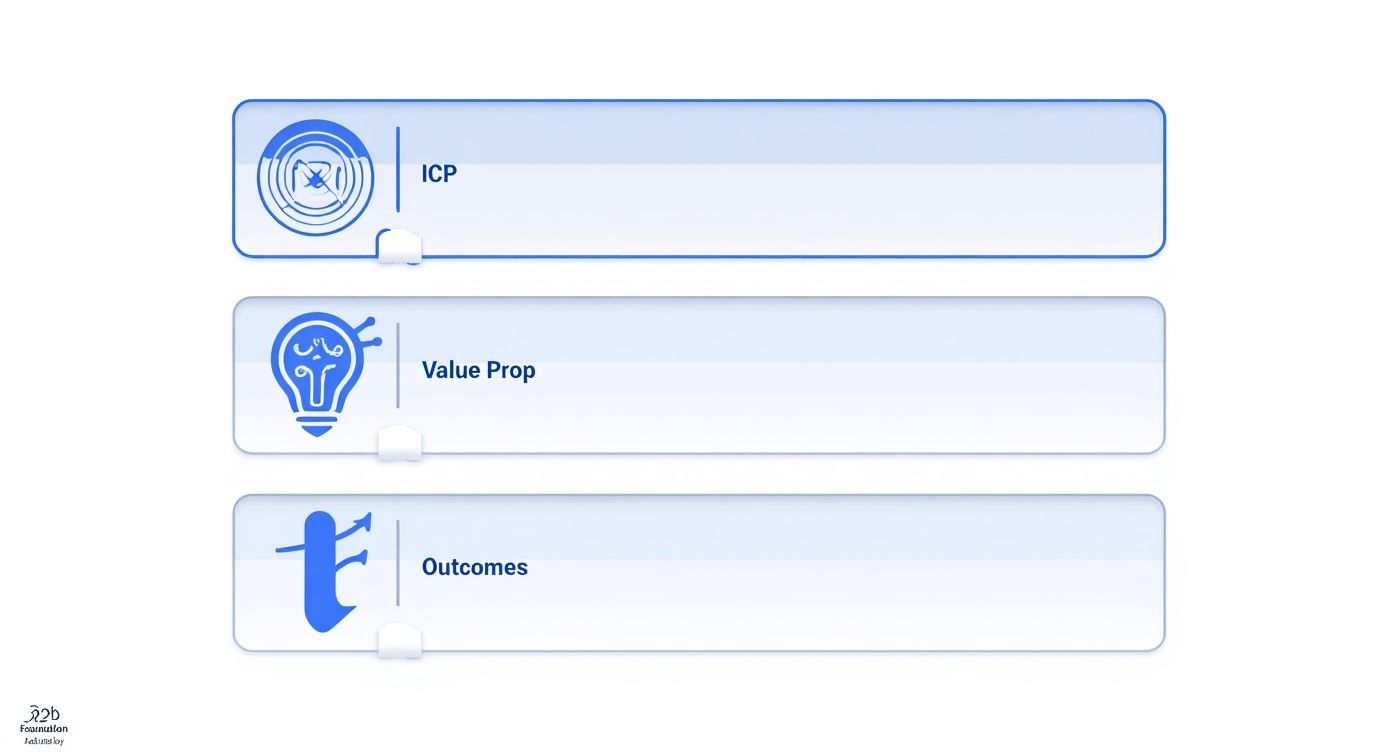
It all starts with a deep understanding of your ICP. From there, you craft a value proposition that hits home, and you frame everything around the business outcomes they're trying to achieve. Get this sequence right, and your channel strategy will actually work.
Build A Content Engine That Attracts Buyers
Content marketing is the ultimate long-game investment in B2B. It’s how you become the go-to resource for your ideal customers long before they even think about buying something. When you do it right, you’re not interrupting their day with an ad—you’re giving them the exact answer they were already searching for.
This approach builds a level of trust and authority that paid ads just can't buy. And the data backs this up. SEO-driven content strategies see an average close rate of nearly 15%, which is a world away from the dismal 2% close rate you get from old-school cold outreach. On top of that, a whopping 74% of B2B marketers say content brings in more leads than any other channel.
Your content needs to be obsessed with educating, informing, and solving your customer's problems.
- Blog Posts: Write deep-dive articles that tackle your ICP’s biggest headaches. Forget about your product for a minute and focus entirely on their world.
- Webinars: Host live, practical sessions that offer real advice and let your team's expertise shine.
- Case Studies: Don't just list features. Tell compelling stories about how real customers got incredible results with your solution.
The most powerful B2B content strategy is one built on empathy. It starts by deeply understanding your customer's pain and ends by guiding them toward a solution, establishing your brand as a trusted partner along the way.
Execute Precise Paid Acquisition Campaigns
While content is your long-term foundation, paid acquisition gets you immediate, targeted reach. It’s the fastest way to put your message in front of specific decision-makers and get real-time feedback on your value proposition. But for B2B, not all paid platforms are created equal.
The name of the game is surgical precision. Forget the broad "spray and pray" approach. You need to focus your budget on platforms where you can target prospects by job title, company size, industry, and even the tech they use.
For instance, if you're promoting a cybersecurity tool for CFOs, you can run a campaign that only shows ads to people with "Chief Financial Officer" in their title at financial services companies with over 500 employees. This kind of focus stops you from wasting money and makes sure your message lands with the right people.
Here's where most B2B startups find success with paid ads:
- LinkedIn Ads: This is the undisputed king of B2B targeting. It’s perfect for getting in front of specific roles within your target accounts.
- Google Ads: This is where you capture high-intent search traffic. You'll want to focus on long-tail keywords that signal someone is actively looking for a solution like yours (e.g., "AI-powered contract review software for legal teams").
- Retargeting: Don't let interested visitors slip away. Retargeting lets you re-engage people who checked out your site but didn't convert, keeping your brand top-of-mind while they make their decision.
To help you weigh your options, here's a quick comparison of the most common channels.
B2B Acquisition Channel Comparison
Each channel has its place, and the right mix depends entirely on your specific goals, audience, and budget. The key is to start focused, measure everything, and then expand based on what the data tells you.
Uncover Growth Through Strategic Partnerships
Last but not least, don't sleep on the massive potential of strategic partnerships. This is all about collaborating with other, non-competing companies that serve the same ICP you do. It’s a hugely effective way to tap into an existing, trusted audience and gain instant credibility by association.
Think about it: a project management SaaS could team up with a time-tracking software company. Their products are complementary, and their customers are almost certainly the same people.
Partnerships can take a bunch of different forms:
- Integration Partnerships: Build a technical link between your products to add value for both of your customer bases.
- Co-Marketing: Host a joint webinar, write an ebook together, or guest post on each other's blogs. This gets your brand in front of a whole new, highly relevant audience.
- Referral Programs: Set up a formal system where partners get rewarded for sending qualified leads your way.
Ultimately, building a well-rounded B2B acquisition strategy means you're never reliant on a single source of leads. By exploring a variety of proven B2B marketing channels, you can find the right mix for your startup. This diversified approach makes your business far more stable and predictable—if one channel slows down, the others are there to keep the growth engine running.
Running an Account-Based Marketing Program
For high-value B2B deals, casting a wide net is like trying to catch a whale with a fishing line. It’s a massive waste of energy and rarely works.
A far more effective approach is to focus all your firepower on the specific accounts that can truly move the needle for your business. This is the whole idea behind Account-Based Marketing (ABM), a non-negotiable part of any modern B2B acquisition strategy.
ABM flips the traditional marketing funnel on its head. Instead of chasing a high volume of leads and just hoping a few are a good fit, you start by identifying your most valuable potential customers first. From there, you treat each of these companies as a market of one, crafting hyper-personalized campaigns to win them over.

This focused, resource-intensive method isn't for every lead; it's reserved for the game-changers.
Identifying and Prioritizing High-Value Accounts
The first step in any real ABM program is deciding exactly who to target. This isn't a guessing game. It requires a data-driven process that combines what you already know about your best customers with real-time signals from the market. Your goal is to build a "target account list" of companies that are a perfect match for your Ideal Customer Profile (ICP).
Start by looking at your current customer base. Who are your happiest, most profitable clients? Dig into their firmographic data to find the common threads:
- Industry and Niche: Are they all concentrated in specific verticals like MedTech or B2B FinTech?
- Company Size: Do they typically have 100-500 employees, or are they larger enterprises?
- Technology Stack: Do they all use complementary software that integrates well with your solution?
Once you've built this profile, use it to find similar companies out in the wild. But don't stop there.
The next layer is intent data, which helps you spot companies that are actively researching solutions like yours right now. Certain tools can track signals like which topics companies are researching online or which competitors they're evaluating. This information is gold because it tells you who is in-market and ready to have a conversation.
An ABM strategy without clear account selection is just personalized spam. The magic happens when you combine a perfect ICP fit with real-time buying intent. This allows you to focus your expensive marketing and sales efforts only on accounts that are actually ready to listen.
Creating Deeply Personalized Campaigns
With your target accounts identified, the real work begins. The goal is to create a seamless, compelling experience for the key decision-makers within each company. This is about moving way beyond generic messaging and showing them you’ve done your homework. You need to prove you understand their specific challenges and have a solution designed for them.
For anyone running an ABM program, understanding the best practices for account engagement is crucial for success. Your campaigns should be multi-channel and tightly orchestrated between your marketing and sales teams.
A few effective ABM tactics I've seen work wonders include:
- Custom Landing Pages: Build website pages that greet visitors from a target account by name and feature content, case studies, and testimonials directly relevant to their industry.
- Personalized Ad Campaigns: Run LinkedIn ad campaigns that target employees at specific companies with messaging that speaks directly to their role and known pain points.
- Tailored Sales Materials: Arm your sales team with bespoke pitch decks and one-pagers that reference the target company's own goals, challenges, or even recent news announcements.
This hyper-personalized approach shows prospects you see them as future partners, not just another number in your CRM. The results from this kind of strategic focus are significant. According to recent industry data, 64% of organizations using ABM report a much higher return on investment, and 58% of B2B marketers see a notable increase in average deal value.
By dedicating your best resources to your best-fit prospects, ABM turns customer acquisition from a numbers game into a strategic partnership-building exercise. For a comprehensive look at how this can impact your bottom line, you can maximize your ROI with Account-Based Marketing by following a structured plan.
Using AI for Smarter Customer Acquisition
Let's be clear: artificial intelligence isn't some far-off concept anymore. It's a real, practical tool you can plug into your B2B customer acquisition strategy today. The goal isn't to replace your team, but to supercharge them—automating the grunt work and digging up insights that are simply impossible to find manually.
This shift is about moving from broad, hope-for-the-best campaigns to laser-focused, personalized interactions. And you can do it at a scale that was unthinkable just a few years ago. It’s the key to making smarter decisions, faster.

Go Beyond Basic Segmentation with AI
Traditional B2B segmentation is pretty rigid. We've all used firmographics like company size or industry, but this approach is static and often misses the subtle clues of actual buying intent. AI completely flips the script by enabling dynamic, predictive segmentation.
Instead of static lists, these tools analyze thousands of data points in real-time. They track everything from a prospect’s website activity and content downloads to their social media chatter and intent signals from all over the web. This creates fluid audience segments based on who is most likely to buy right now, not just who fits a dusty, predefined profile.
Imagine an AI platform flagging a cluster of mid-sized tech companies that just started researching "data integration APIs." You can spin up a highly relevant campaign targeting this specific, emerging need before your competitors even know what’s happening.
Implement Predictive Lead Scoring
One of the most powerful ways to use AI in customer acquisition is predictive lead scoring. We've all dealt with old-school scoring models based on simple actions (opened an email = +5 points), which are often wildly inaccurate.
AI models are different. They analyze the historical data of all your past customers—both the wins and the losses—to find the complex patterns and subtle traits that truly correlate with a successful sale. The model then scores new leads with a much higher degree of accuracy based on their actual likelihood to convert.
This isn't just about efficiency; it's a massive strategic advantage. It makes sure your sales team spends their time on the leads with the highest probability of closing, which dramatically boosts their productivity and shortens the entire sales cycle.
This intense focus on quality over quantity is what an intelligent acquisition strategy is all about. In fact, smart, AI-powered personalization can lift revenues by up to 15% and boost marketing ROI by as much as 30%. By automating tasks and delivering truly tailored experiences, AI gives you a much clearer path to your best customers.
Optimize Content and Messaging at Scale
AI is also changing the game for how B2B marketers create and optimize content. No, this isn't about letting a robot write your blog posts. It's about using AI to make sure the content you do create is perfectly aligned with what your ideal customers are actually looking for.
Modern AI tools can give your team some serious superpowers:
- Identify High-Intent Keywords: Go beyond the obvious search terms. AI can uncover the long-tail keywords and specific questions your audience is asking, helping you create content that solves their exact problems.
- Analyze Competitor Content: AI can instantly break down top-ranking articles for any topic, identifying the common themes, structures, and semantic keywords you need to include to even have a chance at competing.
- Personalize Website Experiences: Some platforms use AI to dynamically change website headlines, CTAs, or case studies based on a visitor's industry or browsing behavior. This creates a more relevant, compelling journey for every single prospect.
When you start integrating these capabilities, you stop guessing and start building a data-informed content strategy. You create assets that don't just attract traffic, but attract the right traffic. To dig deeper into putting this into practice, check out our guide on using AI in B2B marketing to gain a competitive advantage. This is how you build an acquisition engine that gets smarter and more effective over time.
Measuring Success and Optimizing Your Funnel
Let's be honest: a strategy without measurement is just a guess. An inspired plan for customer acquisition is useless unless you have a clear, data-driven way to know what's working and what isn’t. This is where you stop guessing and start making intelligent decisions, building a system that doesn’t just run on its own but actually gets smarter over time.
The real power of a B2B customer acquisition strategy lies in its ability to adapt. By setting up the right metrics, you create a feedback loop that fuels continuous optimization. Every campaign, every dollar spent, becomes a learning opportunity that sharpens your approach.
Moving Beyond Vanity Metrics
First things first: you need to track metrics that actually signal business health, not just online activity. Website traffic and social media likes might feel good, but they don't pay the bills. Your dashboard should be built around the critical handoffs between marketing and sales—that's where the real action happens.
For any serious SaaS or AI startup, these metrics are non-negotiable:
- Marketing Qualified Leads (MQLs): This is the total number of leads your marketing team generates that meet a minimum set of criteria, indicating they’re a potentially good fit.
- Sales Qualified Leads (SQLs): This is the number of MQLs the sales team has vetted and accepted. They’ve confirmed these are legitimate opportunities worth a salesperson's valuable time.
- Stage-by-Stage Conversion Rates: This tracks the percentage of leads that successfully move from one stage of your funnel to the next (e.g., the MQL to SQL conversion rate).
Monitoring these numbers gives you a real-time diagnostic of your funnel's health. For instance, a high number of MQLs but a painfully low SQL rate is a massive red flag. It almost always points to a misalignment between marketing’s targeting and what sales actually considers a viable lead.
Connecting Acquisition to Business Impact
While funnel metrics show you the flow of leads, you need two final metrics to understand the financial performance of your strategy. The ultimate arbiters of your success boil down to two numbers: Customer Acquisition Cost (CAC) and Lifetime Value (LTV).
Your entire acquisition engine comes down to one simple question: Are you spending less to acquire a customer than the value they bring to your business over time? If the answer is no, your model is fundamentally broken.
- Customer Acquisition Cost (CAC): This is the total cost of your sales and marketing efforts—think salaries, ad spend, tools, the works—divided by the number of new customers you acquired in a specific period.
- Lifetime Value (LTV): This is the total revenue you can reasonably expect from a single customer account throughout their entire relationship with your company.
For a B2B SaaS company, a healthy LTV-to-CAC ratio is generally considered to be 3:1 or higher. If you’re hovering at 1:1, you’re losing money on every new customer. If it’s below 3:1, it’s a warning sign that you’re either spending too much to acquire customers or you're attracting the wrong kind of customers who churn too quickly.
Building a Systematic Testing Plan
With your core metrics in place, you can now build a system for continuous improvement. Optimization isn't about making random changes and hoping for the best; it's about methodical, disciplined testing. Your goal is to isolate variables and run controlled experiments to see what actually moves the needle.
This testing plan shouldn't be a one-off project; it should be an active, ongoing part of your B2B customer acquisition strategy.
- Formulate a Hypothesis: Start with a clear, testable idea. Something specific, like, "Changing our ad headline from feature-focused to benefit-focused will increase click-through rates by 15%."
- Isolate One Variable: This is critical. Only change one thing at a time. If you test a new headline and a new image simultaneously, you'll have no idea which element was responsible for the change in performance.
- Run the Experiment: Use A/B testing tools for everything—ad copy, landing pages, email subject lines. And be patient. Let the test run long enough to gather statistically significant data before you call it.
- Analyze and Iterate: Did the change produce the result you wanted? Whether it succeeded or failed, document the learning. Use that insight to inform your next hypothesis.
This relentless cycle of measuring, testing, and iterating is what separates good acquisition strategies from great ones. It ensures your engine is always being tuned for better performance, turning your initial plan into a dynamic system that consistently drives growth.
Your B2B Acquisition Questions, Answered
Building a B2B acquisition strategy from the ground up is full of tough calls and critical decisions. Let's wrap up by tackling some of the most common questions I hear from SaaS and AI founders. My goal here is to give you direct, actionable advice to help you move from planning to powerful execution.
How Do I Choose the Right Acquisition Channels?
This is a big one, but the answer is simpler than you think. Don't start with channels—start with your customer. The best channels are always where your Ideal Customer Profile (ICP) already spends their time.
Ask yourself: Where do they go to research new tools? Who do they ask for advice? What communities or publications do they trust for industry trends? That's your starting point.
If you're targeting a deeply technical audience, like DevOps engineers, you’ll likely find them in developer communities or searching for solutions to specific technical problems. That means SEO-driven content and genuine participation in those communities will probably crush it. On the other hand, if you’re going after C-suite executives, a focused Account-Based Marketing (ABM) program paired with hyper-targeted LinkedIn ads is almost always a better bet.
My advice? Start with just two or three channels where you have the highest confidence. Pour your energy into mastering them. Measure everything—especially lead quality and your Customer Acquisition Cost (CAC). Be ready to double down on what works and be ruthless about cutting what doesn't deliver a positive return within a reasonable timeframe, like three to six months.
What's a Realistic Budget for a B2B Customer Acquisition Strategy?
There’s no magic number, but a smart, data-driven approach is a lot better than pulling a number out of thin air. Your budget should be tied directly to your revenue goals and your target CAC. The key is to work backward from the business outcomes you want.
First, figure out your target LTV-to-CAC ratio. For a healthy, sustainable business, a 3:1 ratio is a great goal to shoot for.
Let's walk through a quick example. If your average customer Lifetime Value (LTV) is $15,000, your target CAC should be no more than $5,000. If your goal is to land 10 new customers this quarter, you now have a defensible budget of up to $50,000 for acquisition. Early-stage startups often peg this to revenue, dedicating a percentage (say, 20-40% of ARR) to growth until they've locked in product-market fit.
When Should I Focus on Paid Acquisition Versus Organic Content?
This isn't an "either/or" situation; it's a question of timing and how the two work together. The two work together beautifully when sequenced correctly.
In the very early stages, your primary focus should be on organic content. This is how you build a long-term, defensible asset that attracts high-intent prospects while you’re still refining your messaging and getting to know your market. It's your foundation.
Once you have a crystal-clear ICP and a conversion funnel that reliably turns visitors into leads, it's time to bring in paid acquisition. Think of paid channels as the accelerator. Use them to put gas on your best-performing organic content, drive traffic to high-converting landing pages, and surgically target key accounts within your ABM strategy.
Think of it this way: Organic builds the foundational trust and authority that makes your brand credible. Paid provides the scalable fuel to get that credible message in front of the right people, right now.
How Can I Align My Sales and Marketing Teams?
Misalignment between sales and marketing is one of the most common—and costly—killers of a B2B acquisition strategy. I've seen it sink otherwise brilliant plans.
True alignment starts with shared goals and a common language. Both teams absolutely must agree on the precise, objective criteria for what makes a Marketing Qualified Lead (MQL) and a Sales Qualified Lead (SQL). Without this, you're just setting everyone up for frustration and finger-pointing.
Get a weekly or bi-weekly meeting on the calendar where both teams review funnel performance, talk openly about lead quality, and share real-time insights from customer conversations. For more on this, our guide on how to get B2B leads digs deeper into collaborative strategies.
Finally, create a formal Service Level Agreement (SLA). This isn't just corporate bureaucracy; it's a pact. The document should clearly define marketing's commitment to lead volume and quality, and sales' commitment to follow-up speed and the number of contact attempts. This creates mutual accountability and ensures everyone is rowing in the same direction: winning more customers.
At Big Moves Marketing, I help B2B SaaS and AI startups build and execute the precise launch and acquisition strategies needed to win early customers and drive revenue. If you're ready to turn your plan into predictable growth, let's connect. Learn more at bigmoves.marketing.
%20png%20copy.png)


%20-%20white.svg)