%20png%20copy.avif)
A Fractional CMO is not a cheaper version of a full-time executive. It's a fundamentally different model: senior go-to-market leadership, embedded on a part-time basis, to solve the specific growth problems that stall early-stage B2B SaaS companies. It’s a capital-efficient way to install a strategic operating system when a full-time hire is a premature and expensive mistake.
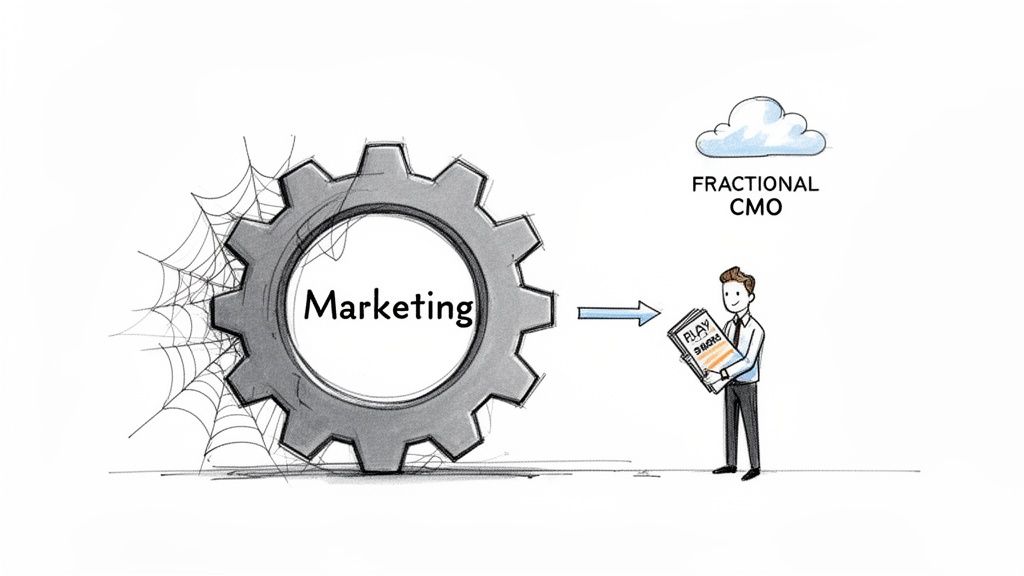
The product is solid. Early customers see real value. But growth has flatlined. The founder-led hustle that secured your first users is now the primary bottleneck, and the "marketing" you've tried is a series of disconnected tactics, not a coherent engine.
This is a classic inflection point for B2B SaaS companies, typically between Seed and Series A. The reflexive response from founders and boards is to hire a full-time Chief Marketing Officer.
This is almost always a catastrophic mistake.
Hiring a full-time CMO too early burns precious capital and time by solving the wrong problem. You don't have a marketing leadership problem; you have a go-to-market validation problem. A senior CMO, conditioned to manage large teams and seven-figure budgets, is fundamentally misaligned with the hands-on, validation-centric work this stage demands.
They are hired to be a strategist—a force multiplier for an existing team. When they find no team and no proven playbook, one of two outcomes is inevitable:
Either way, six to nine months pass. You've burned over $200,000 in salary and equity with little to show for it beyond a complex slide deck. The core issues—unclear positioning, a fuzzy ICP, and no repeatable demand engine—remain unsolved.
The problem isn't a lack of marketing activity. It's the absence of a clear, executable strategy built on a foundation of validated market insights. Before you need a full-time executive to scale a department, you need an operator to build the initial go-to-market architecture.
This is precisely the gap a Fractional CMO is designed to fill. They are not just an advisor; they are an embedded leader who both architects the strategy and oversees its initial implementation. For founders struggling past initial traction, the challenge is building that foundation in the first place. Many are still figuring out how to find their first 10 B2B customers without a marketing team.
A Fractional CMO brings the strategic rigor of a seasoned executive but applies it with the execution-focused mindset required at the early stage. Their job is to de-risk your go-to-market, build a repeatable growth engine, and install the marketing function so a future full-time leader can succeed.
Let's be direct. A Fractional CMO isn't a consultant who delivers a 100-page strategy deck and vanishes. Nor are they a glorified freelancer hired to manage social media. These are the two most common misconceptions that lead founders to make bad hires.
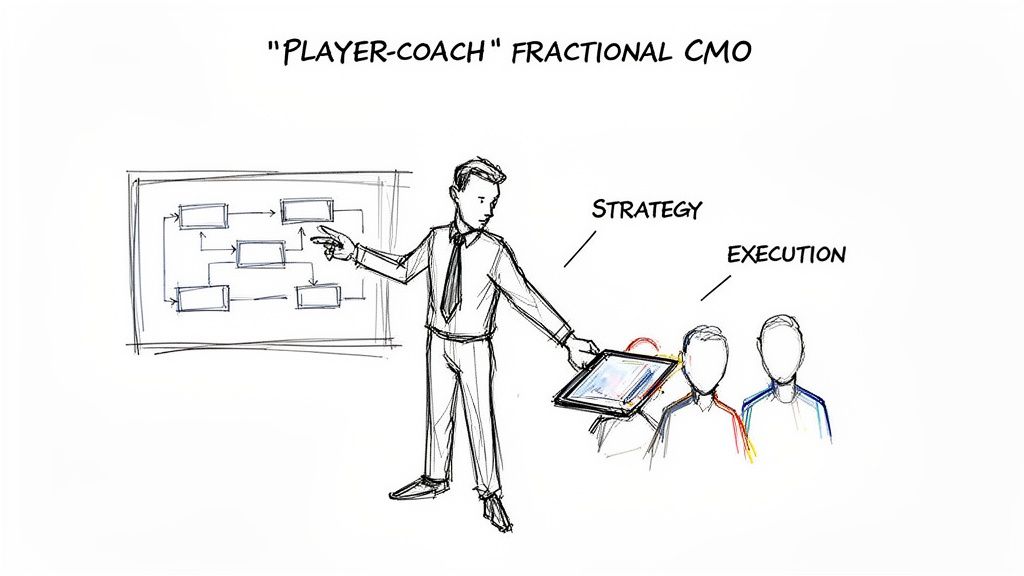
A true Fractional CMO is an experienced marketing executive embedded in your leadership team on a part-time basis. They operate as a player-coach, taking direct ownership of your go-to-market strategy and its critical early execution. They are accountable for results, not just for delivering a plan.
This distinction is critical. Their job is not to give you advice; it is to build the foundational marketing engine your company lacks. They design the system, then get in the trenches to prove it works.
Early-stage SaaS does not need another high-level theorist. It needs an operator who can connect big ideas to the messy reality of acquiring customers. This is where the player-coach model excels.
The "player" side means they get their hands dirty with the work that matters now:
Simultaneously, the "coach" side builds the infrastructure for a scalable marketing function. They don't just do the work; they design the systems, define the KPIs, and often hire the first junior marketers who will eventually run the playbook they create. You can dive deeper into their specific responsibilities by exploring what a fractional cmo does.
A Fractional CMO is brought in to install a go-to-market operating system, not just to run campaigns. Their success is measured by the repeatable growth engine they leave behind.
Founders often get stuck choosing between a junior marketer, a full-time CMO, or an agency. Each solves a different problem. A Fractional CMO fills a specific, strategic gap the other options cannot.
An agency is an external vendor hired to execute defined tasks, like SEO or paid ads. They are effective at running tactics but rarely own the overarching strategy or sit in leadership meetings to ensure marketing is aligned with sales and product. They are outsourced hands, not an integrated brain.
A junior marketer, while enthusiastic, lacks the pattern recognition to build a winning strategy from scratch. They can execute a playbook you give them, but they cannot architect one in a complex B2B market.
A good Fractional CMO in SaaS brings deep expertise in the areas that matter most early on. This includes helping founders understand core concepts like what is demand generation marketing and then building the system to make it happen.
This table clarifies the functional differences for founders making the decision.
A Fractional CMO provides the senior strategic mind a junior marketer lacks and the dedicated, integrated leadership an agency cannot offer. They are the right tool for a specific, high-stakes job: taking a SaaS company from founder-led sales to a scalable, repeatable growth machine.
Most founders see "Fractional CMO" and think "cost savings." This is true, but it misses the point. The real value is not just about spending less; it's about smarter capital allocation to survive the journey to product-market fit.
A premature full-time CMO hire is a strategic blunder—a capital allocation error that diverts cash from what actually matters at this stage: engineering, product, or a first sales hire.
Founders consistently underestimate the true cash burn of a senior executive. A seasoned B2B SaaS CMO with a real track record commands a serious package:
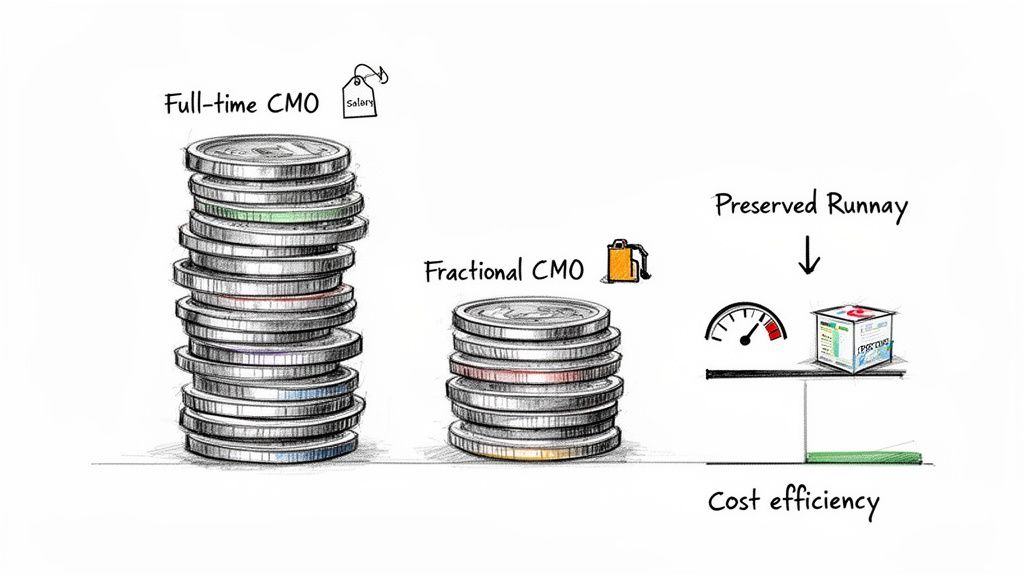
The first-year cash hit for a full-time CMO can easily exceed $350,000, excluding the long-term cost of equity. For an early-stage company, this is a massive gamble on one person who may be the wrong fit for the hands-on work required.
A Fractional CMO flips this financial script. A massive, fixed overhead cost becomes a variable, results-focused expense. This provides immense strategic leverage.
A full-time CMO can burn over $300,000 a year in cash compensation alone. A fractional expert typically works on a retainer between $5,000 and $20,000 per month. This can translate to a 67% reduction in first-year leadership costs when accounting for recruitment fees and benefits.
This isn't about trimming fat; it's about reallocating resources to fuel growth. Budget shifts from a high-cost salary to the very marketing programs that leader is there to build and validate.
The real benefit is not saving money. It's buying time and runway to find what works. A Fractional CMO preserves capital that can be reinvested into validating the go-to-market strategy they help create.
This preserved cash is a strategic war chest. It's the budget for demand generation experiments to uncover profitable acquisition channels. It's the funding for content that establishes authority. It’s the cash that enables you to hire a junior marketer to run the playbook your Fractional CMO builds.
This model allows you to scale marketing spend after the strategy is proven, not before. Getting unit economics right is paramount, which is why mastering your customer acquisition cost formula is critical for ROI. Hiring a Fractional CMO is a disciplined financial decision that aligns leadership investment with your stage of growth, turning marketing from a potential cash drain into a lean, milestone-driven growth engine.
Theory is cheap. Founders are tired of expensive advisors who deliver beautifully designed slide decks that gather dust.
The value of a high-impact Fractional CMO is not in abstract strategy, but in creating tangible, operational assets that solve your most urgent go-to-market problems. They are hired to build the machine, not just draw the blueprint.
Within the first 90–180 days, you should see a specific set of deliverables that give your business clarity, focus, and the tools to execute. This is about systematically installing a GTM operating system into your startup.
A Fractional CMO’s first job is to stop random acts of marketing and install a coherent strategy. This begins by building foundational assets that align the entire company.
Key deliverables include:
These assets are version 1.0 of your GTM playbook, built to be tested and validated in the market.
With the strategic foundation in place, the focus shifts to execution. A Fractional CMO’s job is to build the initial systems that generate predictable pipeline. One of their most critical functions is implementing effective lead generation strategies for SaaS companies to ensure the sales team has a healthy pipeline.
This activation phase produces two core outputs:
A Fractional CMO's deliverable is not a document. It's a functioning system. The messaging framework is useless until it's live on your website and used in sales calls. The demand gen map is worthless until the first leads are generated.
By setting up these core systems, a Fractional CMO builds the infrastructure for repeatable growth. They provide the tools and initial momentum, setting the stage for a more permanent marketing function. To understand the impact, you must learn how to measure marketing effectiveness from the start.
A high-impact Fractional CMO delivers control. They replace chaos with a clear plan, confusion with sharp messaging, and guesswork with a data-informed process for winning customers.
Timing is the most critical variable. Get it right, and a Fractional CMO provides incredible leverage. Get it wrong, and it’s a sophisticated way to burn cash. It’s about recognizing specific moments when senior go-to-market leadership becomes the primary bottleneck to growth.
These patterns are clear signals that you’re ready for this level of strategic help.
This decision tree illustrates how a Fractional CMO fixes these problems, moving a company from planning to sustainable growth.
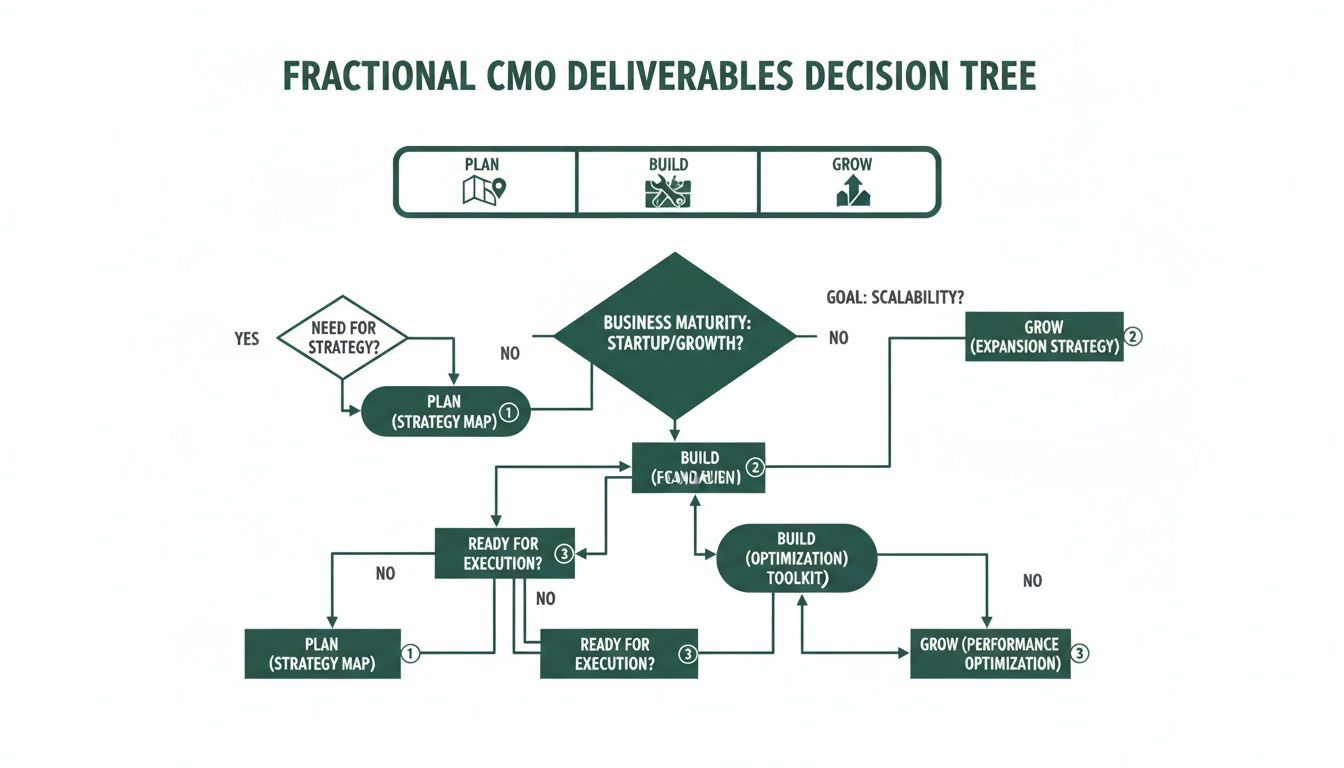
The process starts with architecting the strategy (Plan), moves to creating GTM assets (Build), and then focuses on activating the growth engine (Grow).
Knowing when not to hire a Fractional CMO is just as important. They are a specific tool for a specific job.
A Fractional CMO is a strategist you rent, not a junior marketer you outsource. If you’re trying to solve a task-level problem with a strategy-level hire, you will fail.
Avoid hiring a Fractional CMO if your situation is this:
This model is growing for good reason. The fractional CMO market is projected to hit $1.27 billion by 2026, with demand surging 68% year-over-year. As you consider joining the 35% of companies expected to adopt this model, it’s crucial to diagnose your situation accurately. For more on the numbers, see the latest fractional CMO statistics.
Hiring a Fractional CMO is not a magic fix. It’s a high-leverage partnership, and its success depends on the conditions you create. The value you get is a direct reflection of how you engage them. Treat them like a task-oriented vendor, and you’ll get vendor-level results. Treat them as a member of your leadership team, and you’ll unlock the strategic value you hired them for.
The most common reason these engagements fail is when founders keep their Fractional CMO at arm's length. They cannot diagnose your go-to-market problems without deep, unfiltered access to your business. Gatekeeping is poison to a successful partnership.
This means they need access to:
Withholding access forces them to work with assumptions instead of reality, crippling their ability to connect the dots between product, sales, and marketing.
A great engagement starts with a clear definition of success. Before any work begins, you and your Fractional CMO must align on a handful of critical outcomes for the first 90 days. This is a short list of meaningful business objectives, not a laundry list of tasks.
Common objectives include:
Once you’ve agreed on these goals, get out of the way. Empower the Fractional CMO to make the decisions needed to hit them. Micromanaging their approach undermines their expertise. You hired a strategist for their pattern recognition; let them apply it.
The goal is to agree on the destination, then trust your expert partner to navigate the terrain. If you feel the need to dictate every turn, you’ve either hired the wrong person or you’re not ready to delegate.
This is the second most common failure point. A strategy without a budget is a wish. Your Fractional CMO is there to design the engine and start it, but that engine needs fuel.
If you approve a plan but refuse to fund the required programs, you guarantee failure.
Before signing the retainer, have a frank conversation about the execution budget required. Be prepared to invest in the necessary tools, contractors, or ad spend the strategy depends on. Without this commitment, you’re paying for a plan you have no intention of implementing. Aligning from the start is critical, something our guide on creating effective marketing brief templates can help with.
A Fractional CMO engagement is a two-way street. They bring expertise and an execution mindset. You bring deep business context, open access, and necessary resources. When both sides deliver, you get a repeatable growth engine that can change the trajectory of your business.
Most engagements with early-stage B2B SaaS companies last 6 to 12 months. This is the typical timeframe required to implement a sound strategy, build foundational marketing assets, hire key junior roles, and measurably improve core KPIs.
The objective is never to create long-term dependency. A good Fractional CMO works to make themselves redundant. We build a self-sufficient marketing engine that can be handed off to a full-time leader, leaving you in a stronger position.
It comes down to one word: ownership.
A consultant analyzes a specific problem, delivers recommendations in a slide deck, and their work is done. Accountability ends with the report.
A Fractional CMO is an embedded operator. We take ownership of executing the strategy and the business results it produces. We join your leadership team, manage resources, and are held accountable for hitting pipeline and revenue targets—not just for writing a plan. We are in the game with you, not coaching from the sidelines.
This is a critical question. A strategist with no budget to execute is hamstrung.
While the exact number depends on the go-to-market strategy we build, a good rule of thumb is to plan for an execution budget of at least 1-2x the Fractional CMO's monthly retainer.
This ensures you have resources for the necessary tools, contractors, or initial ad spend to validate the identified channels. A good Fractional CMO will work with you at the outset to build a realistic, milestone-based marketing budget tied to your growth goals. Without that investment, the most brilliant strategy is just a document.
At Big Moves Marketing, we build the go-to-market clarity and execution frameworks that turn promising SaaS products into market leaders. If you need to translate your vision into a repeatable growth engine, let's connect. Learn more about our approach.
Explore Big Moves Marketing services and resources:





%20-%20white.svg)