10 B2B Marketing Strategies for Startups That Actually Drive Revenue

10 B2B Marketing Strategies for Startups That Actually Drive Revenue

The internet is saturated with 'growth hacks' that promise predictable revenue but deliver predictable disappointment. Most early-stage B2B SaaS marketing fails not from a lack of effort, but from a fundamental misunderstanding of leverage. Founders are pressured to 'do more marketing'—launching blogs, running ads, posting on social—without first answering the critical question: what is the single most effective way to connect our specific product to our ideal buyer, right now?

This scattergun approach burns cash, demotivates teams, and delays product-market fit. The most effective marketing strategies for startups are not about volume; they are about precision, sequence, and building a system where one activity directly enables the next. To stop chasing tactics and build a growth engine, you must have a clear understanding marketing sales and how they must operate as a single, unified system from day one.

This is not another list of tactics to test. It is a prioritized framework for building a deliberate, capital-efficient growth engine that scales. Forget the noise. These are the strategic levers that work in the real world of B2B SaaS.

1. Positioning & Messaging Framework

Most startups fail at marketing not because their tactics are wrong, but because their foundation is broken. A brilliant ads campaign driving traffic to a confusing value proposition is just a faster way to burn cash. Among all potential marketing strategies for startups, a clear Positioning & Messaging Framework is the non-negotiable prerequisite for efficient growth. It is the source code for your entire go-to-market motion.

Positioning is not a tagline; it's a strategic decision about a specific market you intend to win. It answers: Who is our ideal customer? What critical problem do we solve for them? How are we uniquely equipped to solve it better than any alternative?

Your product is not your positioning. Your positioning is the context you create in the buyer's mind, making your product the obvious choice.

Why It Works

A strong framework creates leverage. It ensures your product, marketing, and sales teams tell the same story, which builds trust and reduces friction in the buying cycle. It moves the conversation from features to a clear, compelling outcome. This is how you escape the commodity trap.

How to Implement It

This is not a one-day branding exercise. It is a rigorous process, often guided by GTM advisors or specialized firms like Big Moves Marketing.

  1. Start with Your Best Customers: Interview your highest-value, most satisfied customers. Uncover the real-world language they use to describe their pain points and the value they derive from your solution.
  2. Define Competitive Alternatives: What would customers do if you didn’t exist? The answer is rarely a direct competitor. It is often a manual process, a spreadsheet, or an internal build. This is your true competition.
  3. Isolate Differentiating Attributes: What capabilities do you have that the alternatives lack? Connect these features to a tangible value or outcome for the customer.
  4. Create a Positioning One-Pager: Codify your work into a simple, shareable document. This internal guide aligns everyone from engineering to sales on who you are, who you serve, and why you win.

Example Snippet from a Positioning One-Pager:

  • For: B2B SaaS revenue operations leaders (Target Audience)
  • Who Struggle With: Inaccurate pipeline forecasting due to disconnected GTM data (Problem)
  • Our Product Is: A revenue data platform (Product Category)
  • That Provides: A unified, real-time view of the entire customer lifecycle (Core Value)
  • Unlike: Stitching together BI tools and spreadsheets (Competitive Alternative)
  • We Offer: Native integrations that automate data hygiene and deliver trustworthy forecasts. (Key Differentiator)

2. Sales Enablement & Pitch Deck Strategy

Even the most precise positioning is useless if it doesn't survive first contact with a buyer. Too many startups treat sales enablement as a downstream task, handing marketing-approved slides to a sales team and expecting them to translate brand into revenue. This disconnect creates a fatal gap where compelling positioning dies, turning smart strategy into generic, feature-led sales calls.

Sales enablement is not about creating pretty slides; it's the operational bridge between your marketing promise and your sales reality. It is the system that arms your revenue team with the exact messaging, tools, and competitive intelligence needed to execute your positioning framework in every customer interaction.

A pitch deck is not a product tour. It's a structured argument designed to change a buyer's perspective on their problem and your unique ability to solve it.

Why It Works

A disciplined sales enablement strategy ensures your hard-won positioning is consistently and compellingly delivered. It shortens sales cycles by equipping reps to handle objections, reframe a buyer’s thinking, and clearly articulate value. This consistency builds a predictable revenue engine, turning every sales conversation into a data point that sharpens your GTM motion.

How to Implement It

Building effective sales materials is a collaborative process, not a marketing monologue. It requires deep partnership between marketing, sales, and product, and is a core focus for GTM specialists like Big Moves Marketing who translate strategy into sales-ready assets.

  1. Build with Sales, Not for Sales: Involve your top-performing sales reps from day one. They are on the front lines, hearing the real objections and buying signals. Co-create the core pitch deck and battlecards to ensure the tools are built for the reality of a sales cycle.
  2. Lead with the Buyer’s Problem: Structure your core pitch deck around the customer’s world, not your product’s features. Start with the problem, agitate the pain of their current state, and then introduce your solution as the inevitable answer. The first three slides should be all about them.
  3. Create Persona-Specific Decks: A CTO cares about integration and security, while a CFO is focused on ROI. Create modular, persona-specific versions of your master deck. A single, one-size-fits-all deck is a sign of lazy marketing.
  4. Codify Objection Handling: Listen to sales call recordings to identify the top 5-10 objections. For each, create a battlecard with a concise, approved response that realigns the conversation to your core value proposition. This turns common roadblocks into opportunities to reinforce your positioning.

Example Snippet from a Competitive Battlecard:

  • Competitor: Legacy BI Platform (e.g., Tableau)
  • Their Claim: "We provide complete data flexibility."
  • Customer Objection: "We already have Tableau, why do we need you?"
  • Our Reframe: "Tableau is a powerful general-purpose tool, but it wasn't built for the complexities of SaaS GTM data. Teams spend hundreds of hours stitching together disconnected sources, leading to stale reports and untrustworthy forecasts."
  • Our Differentiator: "We offer native integrations for your entire GTM stack, giving you a unified, real-time view of revenue health out of the box, not in six months."

3. Positioning & Messaging Framework

Most startups fail at marketing not because their tactics are wrong, but because their foundation is weak. A brilliant ads campaign driving traffic to a confusing value proposition is just a faster way to burn cash. Among all the potential marketing strategies for startups, a clear Positioning & Messaging Framework is the non-negotiable prerequisite for efficient growth. It’s the source code for your entire go-to-market motion.

Positioning isn’t a tagline; it's a strategic decision about a specific market you intend to win. It answers: Who is our ideal customer? What critical problem do we solve for them? How are we uniquely equipped to solve it better than any other alternative?

Your product is not your positioning. Your positioning is the context you create in the buyer's mind, making your product the obvious choice.

Why It Works

A strong framework provides leverage. It ensures your product, marketing, and sales teams are telling the same story, which builds trust and reduces friction in the buying cycle. This strategic alignment moves you from selling features to selling a clear, compelling outcome that commands a premium. It is the most direct path to escaping the commodity trap.

How to Implement It

This isn’t a one-day branding exercise. It’s a rigorous process, often guided by experts like April Dunford, author of Obviously Awesome, or specialized firms like Big Moves Marketing.

  1. Start with Your Best Customers: Forget your product roadmap. Interview your highest-value, most satisfied customers. Uncover the real-world language they use to describe their pain points and the value they derive from your solution.
  2. Define Competitive Alternatives: What would customers do if you didn’t exist? The answer is rarely a direct competitor. It’s often a manual process, a spreadsheet, or an internal build. This is your true competition.
  3. Isolate Differentiating Attributes: What capabilities do you have that the alternatives lack? Connect these features to a tangible value or outcome for the customer.
  4. Create a Positioning One-Pager: Codify your work into a simple, shareable document. This internal guide aligns everyone from engineering to sales on who you are, who you serve, and why you win.

Example Snippet from a Positioning One-Pager:

  • For: B2B SaaS revenue operations leaders (Target Audience)
  • Who Struggle With: Inaccurate pipeline forecasting due to disconnected GTM data (Problem)
  • Our Product Is: A revenue data platform (Product Category)
  • That Provides: A unified, real-time view of the entire customer lifecycle (Core Value)
  • Unlike: Stitching together BI tools and spreadsheets (Competitive Alternative)
  • We Offer: Native integrations that automate data hygiene and deliver trustworthy forecasts. (Key Differentiator)

4. Content Marketing & Thought Leadership

Tactics-driven marketing is a trap. Startups jump to paid ads or cold outreach seeking immediate results, only to find the cost per lead is unsustainable without a foundation of trust. Content marketing is not about blogging; it's about systematically creating intellectual property that educates your market, builds authority, and creates a gravitational pull for your brand. It is one of the few marketing strategies for startups that builds a durable, compounding asset.

This strategy shifts the dynamic from chasing prospects to attracting buyers who are already looking for your expertise. It is the difference between interrupting a conversation and being the reason the conversation started.

Your content is not a sales pitch. It's the curriculum for your ideal customer’s education, positioning your company as the indispensable teacher.

Why It Works

Thought leadership builds trust at scale. It pre-sells your company’s point of view long before a prospect talks to sales, shortening sales cycles and increasing win rates. By solving informational problems for free, you become the default choice when a prospect is ready to solve a commercial problem with a paid solution. This is how brands like Gong built their categories, not on ads, but on being the definitive source of expertise.

How to Implement It

Executing this requires a long-term commitment and a disciplined process, not sporadic blog posts.

  1. Map Buyer Problems, Not Keywords: Start with the core problems your Ideal Customer Profile (ICP) has at each stage of their journey. Use keyword research to understand their language, but let their pain points dictate your content roadmap.
  2. Establish a Core Point of View: What is your unique, defensible perspective on the market? This is the central theme that runs through all your content. For Gong, it's "revenue intelligence." For Drift, it was "conversational marketing."
  3. Build a Content "Pillar": Create a substantial, data-rich asset like a comprehensive guide, an original research report, or a webinar series. This becomes your central piece of thought leadership for a quarter.
  4. Atomize and Distribute: Don't just publish the pillar and wait. Repurpose it into dozens of smaller "atomic" assets: blog posts, LinkedIn carousels, video clips, and email nurture sequences. This maximizes the reach of your core idea.

Example Snippet from a Content Pillar Plan:

  • Pillar Asset: "The State of AI in B2B Sales Forecasting" (Original Research Report)
  • Target Audience: VP of Sales, RevOps Leaders
  • Key Insight: Current forecasting models are broken; AI-driven analysis provides a 30% accuracy lift.
  • Blog Post: "3 Hidden Data Points Wrecking Your Sales Forecast"
  • LinkedIn Post: Founder-penned post on the counterintuitive findings.
  • Webinar: "From Guesswork to Science: A Framework for AI-Powered Forecasting"
  • Email Drip: 5-day series sharing one key statistic and insight from the report each day.

5. Account-Based Marketing (ABM)

Broad-net demand generation is an expensive way to find a needle in a haystack. Early-stage startups targeting high-value accounts burn capital marketing to thousands of people to influence a few dozen decision-makers. Account-Based Marketing (ABM) inverts this model. Instead of marketing to a wide audience and hoping the right accounts respond, you treat each target account as a market of one.
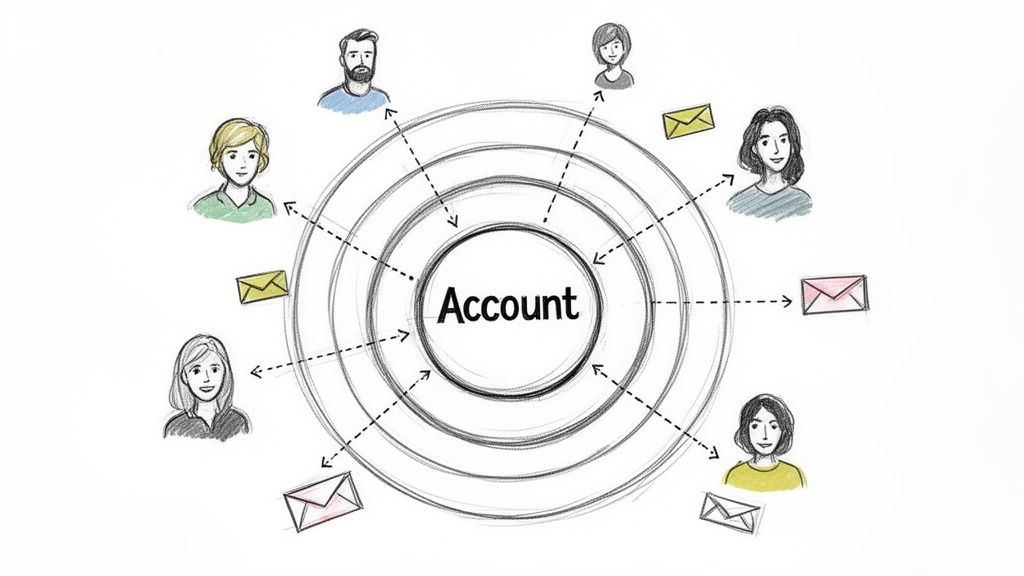
An account at the center of concentric circles, interacting with six diverse users via messages.

ABM is a focused strategy where marketing and sales collaborate to land a defined set of high-value customers. It replaces generic messaging with hyper-personalized outreach, coordinated across multiple channels and stakeholders. For startups with long sales cycles and high average contract values (ACVs), this is one of the most capital-efficient marketing strategies for startups available.

ABM isn't just for enterprises. It’s a discipline of focus that forces a startup to deeply understand and deliver value to its most important future customers.

Why It Works

ABM eliminates waste by concentrating resources where they have the highest probability of generating revenue. This alignment between marketing and sales creates a seamless, high-touch buyer experience, building trust with key decision-makers and accelerating complex deals. It’s the difference between shouting into a crowd and having a strategic conversation with the right person.

How to Implement It

Successful ABM is a cross-functional motion, not a tool. Platforms like 6sense and Demandbase offer powerful technology, but the strategy must come first. For startups without a dedicated team, this approach is often more effective than a broad Product-Led Growth (PLG) motion when targeting enterprise buyers.

  1. Build a Hyper-Specific Target Account List: Start with 10-20 "dream" accounts, not 100. Base this list on your Ideal Customer Profile (ICP), derived from your best closed-won deals and market analysis.
  2. Map the Buying Committee: For each account, identify the key stakeholders: the economic buyer, the champion, the technical evaluator, and potential blockers. Use LinkedIn Sales Navigator to map titles and reporting structures.
  3. Create Account-Specific Value Propositions: Research each company’s strategic initiatives and challenges. Craft personalized messaging that connects your solution directly to their business goals. This is not a mail merge; it’s a bespoke pitch.
  4. Execute a Multi-Channel, Multi-Threaded Campaign: Coordinate outreach across channels. Sales can use personalized email and warm introductions, while marketing runs targeted LinkedIn ads to the buying committee. Track engagement at the account level, not the lead level.

6. Community Building & User Communities

Most B2B SaaS startups focus on acquiring customers, not connecting them. This transactional mindset overlooks one of the most durable marketing strategies for startups: building a community. A community isn't a support forum or a marketing channel; it’s a strategic asset that creates a powerful moat around your business by fostering connection, loyalty, and a sense of shared identity.

![A colorful hand-drawn diagram illustrating a collaborative network with a central heart, people, documents, and ideas.](https of community and network effects, and Notion's massive user base on Discord, which creates templates and drives adoption from the ground up.

Your product solves a problem. Your community makes customers feel like part of the solution.

Why It Works

A vibrant community generates a powerful flywheel effect. It reduces support costs as users help each other, provides a direct line to your most engaged customers for product feedback, and creates deep emotional investment that lowers churn. It becomes a source of authentic, high-trust, word-of-mouth marketing that paid channels can never replicate. This is how you build a brand that people rally behind, not just use.

How to Implement It

Building a community is a long-term investment in relationships, not a short-term lead generation tactic.

  1. Define the "Why": Why should your ideal customers gather? The reason must transcend your product. It should be centered on a shared challenge, profession, or goal (e.g., "advancing the craft of revenue operations").
  2. Choose the Right Venue: Start lean. A dedicated Slack or Discord channel is more effective than building custom forum software. Go where your audience already is and make it easy to connect.
  3. Seed and Moderate Relentlessly: Initially, your team must be the most active members, starting conversations and encouraging participation. Establish clear guidelines and moderate proactively to protect the space from noise.
  4. Empower Your Champions: Identify your most passionate users and give them a platform. Feature their work, give them moderator roles, and offer exclusive access to your team. These champions become your most powerful advocates and co-builders of the community.

Example Snippet from a Community Charter:

  • For: Early-stage FinTech product managers (Target Audience)
  • Who Struggle With: Navigating complex compliance requirements while building user-centric products (Shared Problem)
  • This Community Is: A private Slack group (The "Campfire")
  • That Provides: A trusted space for peer-to-peer advice on compliance, roadmap prioritization, and go-to-market strategy (Core Value)
  • Unlike: Generic product management forums on Reddit (Competitive Alternative)
  • We Offer: Curated Q&A sessions with compliance experts and direct access to our product team for roadmap input. (Key Differentiator)

7. Strategic Partnerships & Channel Sales

Most startups view their market as a solo mission: build a great product, find customers, and scale. This is a slow and capital-intensive path. Strategic partnerships offer a non-linear growth curve by borrowing the trust, access, and distribution that others have already built. This is not about slapping logos on a website; it’s about engineering go-to-market leverage.

A partnership strategy allows you to reach qualified buyers where they already are, through channels they already trust. Whether it's a technology integration or a co-marketing campaign with a complementary brand, partnerships turn a one-to-one sales motion into a one-to-many distribution engine.

Partnerships are not a sales channel. They are a trust accelerant. You are borrowing the credibility an established player has spent years building.

Why It Works

Direct acquisition channels are increasingly saturated and expensive. A well-designed partnership strategy creates a defensible moat by embedding your product into a broader ecosystem. It provides warm introductions, builds social proof, and can dramatically lower your customer acquisition cost (CAC). A deep integration with a major platform like Salesforce or Shopify doesn't just add a feature; it turns their marketplace into your lead source.

How to Implement It

A successful program requires focus and discipline. Avoid "random acts of partnering" and instead treat it like a product launch.

  1. Identify Ecosystem Overlap: Map your ideal customer profile (ICP). What tools do they already use? Who are the key influencers or service providers they trust? This is your target partner list. Start with 2-3 high-potential partners.
  2. Define the "Win-Win-Win": A partnership must benefit you, your partner, and the end customer. Articulate the joint value proposition clearly. How does the combined offering solve a more significant problem for the customer?
  3. Create a Simple Referral Program: Start with a lightweight referral agreement. Offer a clear incentive (e.g., 20% of first-year ACV) for qualified introductions that close. Platforms like PartnerStack can manage tracking, but a spreadsheet is enough to begin.
  4. Invest in Partner Enablement: Do not expect partners to sell for you. Equip them with the tools they need: a one-pager on the joint value prop, co-branded slide decks, demo accounts, and clear rules of engagement. This is critical for scaling.

8. Paid Advertising & Performance Marketing

Organic growth is the long-term goal, but startups rarely have the luxury of time. Paid advertising is not just about "buying traffic"; it's a tool for controlled experimentation and market validation. It allows you to force-feed your positioning to a specific audience and get immediate, quantitative feedback. This is one of the fastest marketing strategies for startups to learn what resonates before scaling.

Performance marketing is a ruthless focus on measurable outcomes like cost per lead (CPL) and customer acquisition cost (CAC). You are buying data and pipeline, not just clicks.

Paid channels are not a strategy; they are an accelerant. They amplify what's already working (a clear message to a specific audience) or expose what isn't.

Why It Works

Paid advertising provides speed, predictability, and control. While you build your long-term organic engine, paid channels can generate initial pipeline, test value propositions in real-time, and create a predictable cost model for acquiring customers. It allows you to target ideal customer profiles with a precision that organic channels cannot match.

How to Implement It

Success here is about discipline, not budget. Start small, measure obsessively, and only scale what proves efficient.

  1. Start with High-Intent Channels: Begin with Google Ads, targeting "bottom-of-funnel" keywords that signal commercial intent (e.g., "[competitor] alternative," "revenue forecasting software"). This captures demand that already exists.
  2. Align Ad and Landing Page: Your ad copy and landing page headline must be nearly identical. Any disconnect in messaging creates friction and kills conversion rates. The landing page should be purpose-built for one offer, not your homepage.
  3. Implement Ruthless Tracking: Install your LinkedIn Insight Tag and Google Ads pixel immediately. Set up conversion tracking for every meaningful action (demo request, trial signup, lead form submission). You cannot optimize what you do not measure.
  4. Isolate and Test Variables: Create separate campaigns for distinct buyer personas or messaging angles. Use A/B testing on ad copy to quickly learn which value propositions connect with your audience.
  5. Track CAC per Channel: Maintain a simple dashboard that tracks spend, leads, and new customers for each channel. If a channel's CAC is unsustainable, cut it without emotion and reallocate the budget.

9. Event Marketing, Virtual Conferences & Expert Partnerships

For early-stage startups, borrowed trust is more powerful than earned trust. You do not have years of case studies, but industry experts do. Combining events with strategic expert partnerships is one of the most effective marketing strategies for startups to short-circuit the long process of building authority from scratch. This is not about renting an audience; it's about co-creating value that elevates both your brand and your partner's.

Events, especially virtual ones like webinars, create a focused, high-intent environment. When you bring a respected industry voice into that environment, you're not just attracting their followers; you are inheriting a piece of their credibility.

Your goal isn't just to host an event. It's to create a platform for an industry-critical conversation that your product happens to facilitate.

Why It Works

This strategy combines the high-engagement format of live events with the powerful third-party validation of an expert. It manufactures authority and demand simultaneously. A well-executed expert webinar can generate more qualified pipeline in 60 minutes than months of cold outreach because attendees arrive pre-framed with trust and a desire to learn.

How to Implement It

Success here is less about the event platform and more about partnership and promotion discipline.

  1. Start with Webinars: Identify a niche, painful problem your ICP faces and find a credible expert who speaks on it. A single, high-value webinar is the perfect low-cost, high-ROI starting point.
  2. Co-Create a Compelling Topic: Collaborate on a topic that serves both your audience and theirs. The best topics sit at the intersection of your product’s value and the expert’s core message.
  3. Aggressively Promote (Together): The partnership extends to promotion. Create a shared promotion kit with email copy and social posts. Leverage both your channels and your partner's to maximize registrations.
  4. Repurpose Relentlessly: The live event is just the beginning. Record the session and turn it into a lead-gated asset. Carve it up into short video clips for social media, a summary blog post, and even fodder for future ad campaigns. One event can fuel your content calendar for a month.

Example Webinar Partnership Plan:

  • Target Partner: A known consultant in the sales operations space with 20k+ LinkedIn followers.
  • Co-Created Topic: "The Ops Leader's Playbook: How to Build a Forecast Your CEO Actually Trusts."
  • Value Exchange: The consultant gets exposure to your audience and a professionally produced piece of content. You get their credibility and access to their audience.
  • Promotion Plan: Joint email blasts, a coordinated LinkedIn promotion schedule, and a small ad budget targeting the consultant's followers.
  • Post-Event Follow-Up: Immediate email to all registrants with the recording, followed by a sales sequence for high-fit attendees.

10. Founder-Led Sales & Personal Brand

In the earliest stages, your most potent sales asset is the founder. Founder-Led Sales is a disciplined approach where the founder personally drives the first 50-100 customer conversations. It is not just about closing deals; it’s about decoding the market, refining messaging in real-time, and embedding the customer’s voice into the company’s DNA. This is a non-scalable strategy that lays the foundation for all scalable growth that follows.

This is paired with building the founder’s personal brand, using their expertise to establish credibility and attract early believers. Your first customers and key hires are not buying a product; they are buying into your conviction.

Your first sales hire cannot sell a product the founder cannot sell first. Founder-led sales is the ultimate acid test for product-market fit.

Why It Works

No one can match a founder's passion and product knowledge. This authenticity builds a level of trust and urgency a hired salesperson cannot replicate. Each conversation is a high-fidelity feedback session that directly informs product, positioning, and GTM strategy. A strong founder brand de-risks the venture for early customers and investors.

How to Implement It

This is a temporary, but mission-critical, role. The goal is to build a repeatable sales motion that can be handed off.

  1. Time-Block "Founder Sales" Hours: Treat customer outreach as sacred. Block two days a week exclusively for talking to prospects. Defend this time against all internal meetings.
  2. Personally Target the First 100: Forget automation. The founder should personally research and write outreach emails to the first 50-100 ideal prospects. The goal is learning, not volume.
  3. Build a Public Narrative: Consistently share insights on LinkedIn or other relevant platforms. Frame your company’s mission within a larger industry trend. The founder's voice should become synonymous with the problem you solve.
  4. Record and Systematize Everything: Record every sales call. This raw material is the gold used to train your future sales team, refine your messaging, and validate your ICP. It’s the source code for your first sales playbook.

Example Snippet from a Founder’s GTM Plan:

  • For: CTOs at mid-market fintech companies (Target Audience)
  • Who Struggle With: Maintaining SOC 2 compliance without slowing down developer velocity (Problem)
  • My Personal Brand Focus: The intersection of agile development and enterprise security (Thought Leadership Niche)
  • That I Will Communicate Via: A weekly LinkedIn post analyzing a recent B2B security breach (Content & Channel)
  • Unlike: Generic security vendors pushing FUD (Fear, Uncertainty, and Doubt) (Competitive Alternative)
  • I Offer: A direct line to the founding team to shape a security product built for developers, not against them. (Key Differentiator)

Top 10 Startup Marketing Strategies Comparison

StrategyImplementation Complexity 🔄Resource Requirements ⚡Expected Outcomes 📊⭐Ideal Use Cases 💡Key Advantages ⭐
Product-Led Growth (PLG)🔄 Medium — product UX, in-app flows & analytics required⚡ Low–Medium — investment in product dev & analytics; low sales headcount📊 Fast user acquisition and viral growth; ⭐⭐–⭐⭐⭐ depending on conversionB2B SaaS with intuitive UX and self-serve buyersLower CAC, viral expansion, rapid feedback loops
Sales Enablement & Pitch Deck Strategy🔄 Medium — create materials + ongoing training⚡ Medium — sales ops, content, coaching time📊 Higher win rates and faster ramp for reps; ⭐⭐⭐ for mid/enterprise dealsSales-led startups closing mid-market/enterpriseConsistent messaging, improved close rates, faster onboarding
Positioning & Messaging Framework🔄 Medium — upfront research and cross-functional alignment⚡ Low–Medium — time from leadership, marketing, sales input📊 Clearer market differentiation and faster content/pitch creation; ⭐⭐⭐All B2B startups, especially competitive launchesAligns teams, differentiates, speeds GTM execution
Content Marketing & Thought Leadership🔄 Medium — consistent production and SEO discipline⚡ Medium — writers, SEO, distribution; time-heavy📊 Long-term organic traffic and authority (6–12+ months); ⭐⭐–⭐⭐⭐Startups with longer sales cycles seeking brand authoritySustainable inbound leads, repurposable assets, credibility
Account-Based Marketing (ABM)🔄 High — account personalization & sales-marketing sync⚡ High — data, tools, bespoke content, sales time📊 Higher conversion rates and larger ACV for targeted accounts; ⭐⭐⭐Targeting mid-market or enterprise high-value accountsFocused ROI, predictable pipeline, multi-stakeholder engagement
Community Building & User Communities🔄 Medium — moderation, content, events required⚡ Low–Medium — community manager, events, engagement resources📊 Increased retention, advocacy, and product feedback over time; ⭐⭐–⭐⭐⭐Product-led and developer-focused tools with passionate usersHigh engagement, peer support, lower churn, organic advocacy
Strategic Partnerships & Channel Sales🔄 Medium — partner sourcing, agreements, enablement⚡ Medium — partner ops, co-marketing, legal, enablement📊 Expanded reach and lower CAC via partner channels; ⭐⭐–⭐⭐⭐Companies with complementary solutions seeking distributionAccess to new segments, partner credibility, faster penetration
Paid Advertising & Performance Marketing🔄 Medium — campaign setup, tracking, optimization⚡ High — budget and ad ops expertise; scalable spend📊 Fast, measurable lead generation; clear CAC control; ⭐⭐–⭐⭐⭐Post-PMF startups with clear ICP and high-intent keywordsQuick acquisition, testable messaging, easily scalable volume
Event Marketing & Expert Partnerships🔄 High — production, promotion, and coordination⚡ High — budget, time, and expert sponsorship costs📊 High-engagement leads and credibility; reusable assets; ⭐⭐⭐ for enterprise positioningEstablished PMF targeting enterprise or thought leadershipLive demos, third‑party credibility, deep engagement
Founder-Led Sales & Personal Brand🔄 Low–Medium — founder time and outreach routines⚡ Low budget, high founder time & network investment📊 Very high early-stage conversion and direct feedback; ⭐⭐⭐Pre-PMF or very early-stage startups (first 10–50 customers)Fast learning, high trust, low initial CAC, investor credibility

From Strategy to Execution: The Final Decision

These strategies are not a buffet. Founders fall into the trap of tactical promiscuity, sampling a bit of everything: a dash of PLG, a sprinkle of ABM, a few paid ads. This approach guarantees mediocrity. It splits focus, drains resources, and ensures no single channel reaches critical mass. The real work is not in knowing what these marketing strategies for startups are, but in deciding which one to commit to, and which nine to deliberately ignore for the next two quarters.

Your go-to-market motion is a system, not a checklist. Each component interacts. Strong positioning makes content resonate. Founder-led sales provides the raw material for your ABM playbook. Choosing a strategy is about identifying the single greatest point of leverage for your specific stage, market, and product. It’s a ruthless act of prioritization.

The Illusion of "More"

Early-stage B2B SaaS is a battle against time and obscurity. The pressure to "do more marketing" is immense. But more activity rarely translates to more pipeline. In most cases, it just creates more noise. The most successful founders we advise are not the ones running the most campaigns; they are the ones who achieve profound clarity on one or two core motions and execute them with relentless consistency.

They understand the trade-offs:

  • Content & Thought Leadership: This is a long-term asset play. It builds a moat and lowers acquisition costs over years, not months. The trade-off is immediate lead flow. If you have less than six months of runway, this is not your primary lever.
  • Paid Acquisition: This is a short-term tool for generating signal. It can deliver leads quickly, validating ICP assumptions and testing messaging. The trade-off is its addictive nature. Over-reliance on paid channels masks a weak value proposition.
  • Founder-Led Sales: This is a non-negotiable discovery phase. It's how you internalize the customer’s pain. The trade-off is scalability. The goal is to create a repeatable process that can be handed off, not to make the founder the permanent bottleneck.

Your Mandate: Choose Your Weapon

Your task now is not to build a complex marketing machine. It is to make a single, high-conviction bet. Look at your product, your market’s maturity, and your ideal customer’s buying process. Where is the most significant friction? Awareness? Consideration? Activation? The answer dictates your primary strategy.

If no one knows a solution like yours exists, thought leadership and category creation are your weapons. If buyers are comparing you against three established competitors, a razor-sharp positioning and sales enablement strategy is your imperative. If your product can deliver value in minutes, a focused PLG motion is your path.

Ultimately, the most effective marketing strategies for startups are less about tactical execution and more about strategic courage. The courage to say no. The courage to focus on a single channel until it breaks or scales. The courage to build a coherent GTM system from the ground up, starting with a message that matters. Stop chasing trends and commit to the hard work of building a durable advantage.


Conflicting advice and tactical clutter are the biggest threats to early-stage growth. If you are a B2B SaaS founder or leader struggling to find clarity, Big Moves Marketing helps you design the GTM strategy that provides the most leverage. We help you move from scattered tactics to a focused, defensible growth model.