%20png%20copy.avif)

82% of businesses now view generative AI as a main lever for reinvention, and 60% of US B2B marketers are increasing their AI tool investments in 2025. This isn't future-gazing—this is your present reality. The question isn't whether AI will impact your website strategy, but whether you'll be proactive or reactive when it does.
Here's something that should keep you up at night: your buyers are increasingly bypassing your website altogether during their initial research phase. Instead of Googling your product category and clicking through to your carefully crafted landing pages, they're asking ChatGPT, Perplexity, or Gemini for recommendations.
ChatGPT alone now receives more than 10 million queries per day—and that's just one platform. When someone asks an AI tool "What's the best marketing automation platform for mid-sized SaaS companies?", will your brand be mentioned in the response? Because if not, you've just lost a potential customer before they even knew you existed.
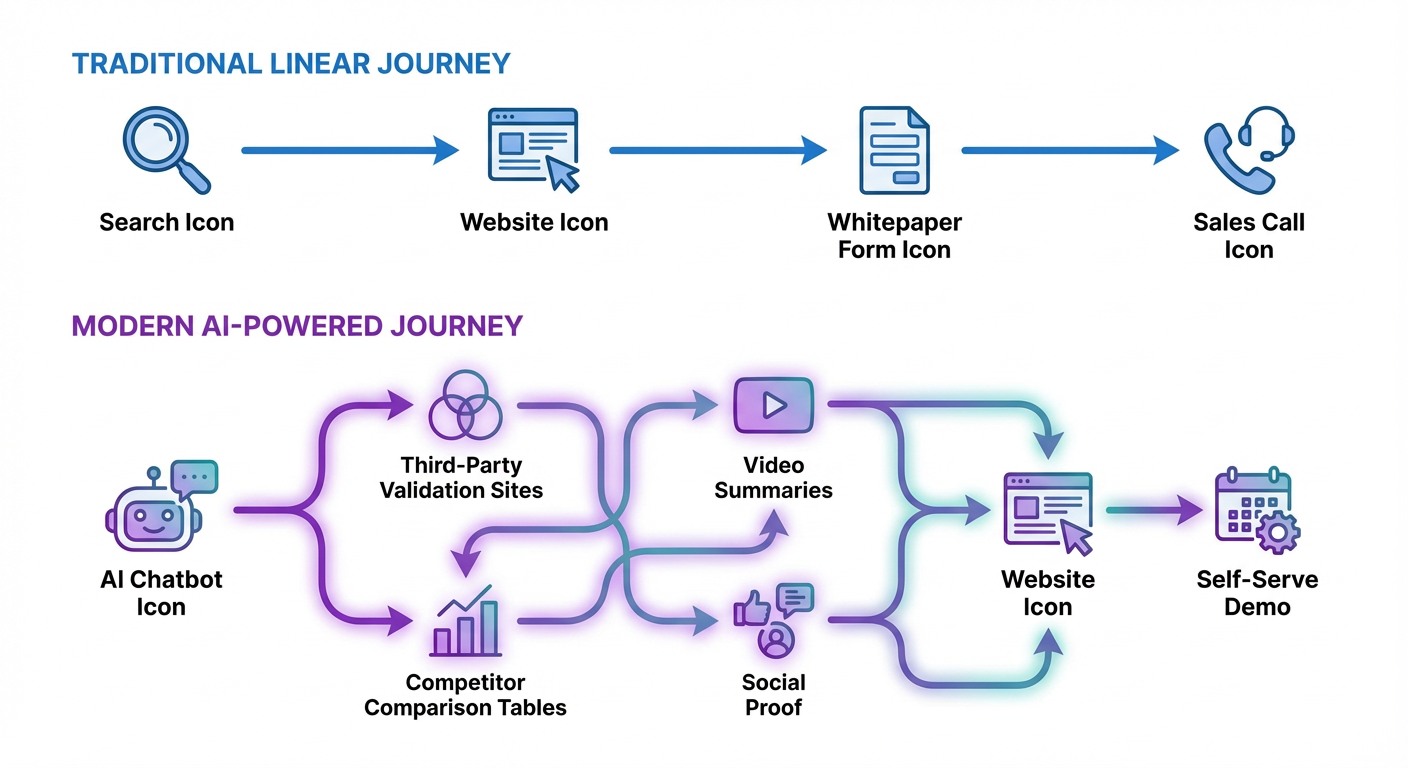
The data backs this up. Over 12.8% of all search volume now triggers AI Overviews in Google alone, fundamentally changing what it means to "rank well." And it's not just early adopters—nine out of ten B2B buyers are already using generative AI tools in their purchasing decisions.
During a recent B2B Marketing roundtable I participated in alongside WP Engine, one marketing leader shared that they experienced a 30% reduction in organic traffic. But here's the interesting part: when they pivoted to focus on Generative Engine Optimization (GEO), they not only recovered that traffic but saw an uptick in lead quality.
Generative Engine Optimization (GEO) is the practice of optimizing your content so AI platforms cite your brand when generating answers. Think of it as SEO's evolution for the AI era. While traditional SEO helps you rank in search results, GEO ensures your expertise is woven into the confident, synthesized answers that AI delivers.
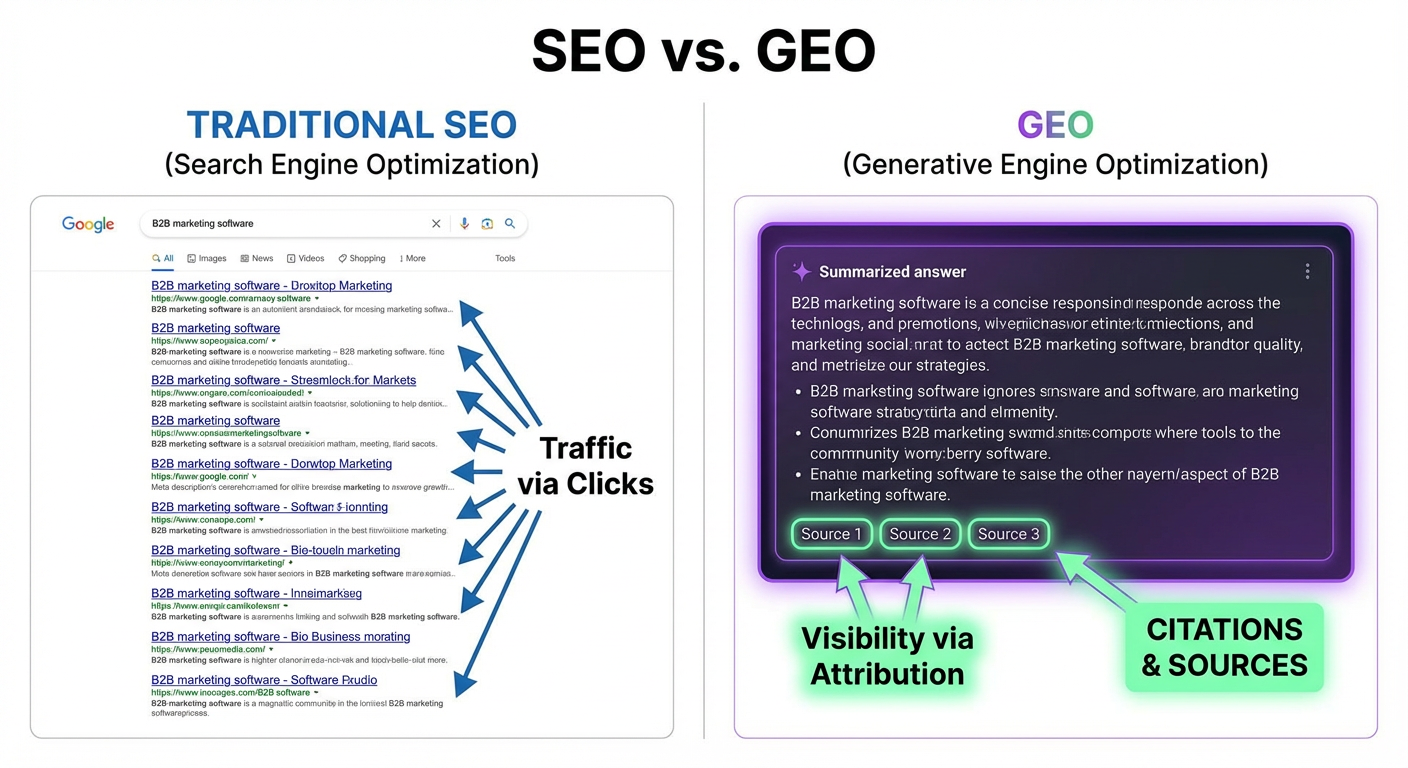
The difference matters because discovery patterns have fundamentally shifted. Your prospects aren't just looking for lists of vendors anymore—they're asking complex questions and expecting comprehensive, trustworthy answers. If AI tools don't know about your solution or can't easily extract and cite your expertise, you're invisible in this new discovery paradigm.
Early adopters are already seeing results. Research shows that content optimized for GEO is discovered up to 10× faster by generative engines compared to relying on organic SEO alone. Some companies are seeing up to 40% boosts in visibility and 100% growth in AI-driven inquiries.
But here's the thing that too many marketers miss: GEO doesn't replace SEO. It extends it. The brands showing up in AI-generated answers are usually the same ones dominating organic search. They haven't abandoned traditional optimization—they've learned to make their authority legible to a new kind of reader.
Let's talk about what this means for your website strategy. One insight from our roundtable discussion stuck with me: multiple marketing leaders noted that while AI might be contributing to lower overall traffic, the quality of traffic matters more than ever.
Think about it. If you have high-quality, high-intent traffic landing on your website and the user experience is excellent, those visitors will be better informed and further along in their buying process. 75% of B2B buyers now prefer a sales experience that doesn't involve sales reps, at least during their initial research phase. They want to educate themselves first, and AI tools are helping them do exactly that.
This shift demands a fundamental rethinking of how we measure success. Vanity metrics like total traffic and page views matter less than engagement depth, content consumption patterns, and ultimately, pipeline contribution. You need to be asking: Are the visitors coming to our site ready to have meaningful conversations? Are they spending time with our best content? Do they understand our value proposition before they ever talk to sales?
The good news? You probably already have most of the content you need. The challenge is making it accessible and useful for AI systems. Based on my experience and the latest GEO best practices research, here's what works:
AI systems reward clarity over clever copy. Start every important page with a 40-80 word "quick answer" that directly addresses the core query. No fluff, no marketing speak—just a clear, concise answer to what someone is actually asking.
For example, instead of opening your product page with "Revolutionizing the way modern enterprises approach digital transformation," start with: "Our platform helps mid-market companies automate their lead scoring process, reducing time-to-qualification by 60% while improving lead quality by 35%."
Use semantic HTML properly. H1 tags for main topics, H2s for major sections, H3s for subsections. It sounds basic, but AI engines rely on this structure to understand your content hierarchy and extract meaningful information.
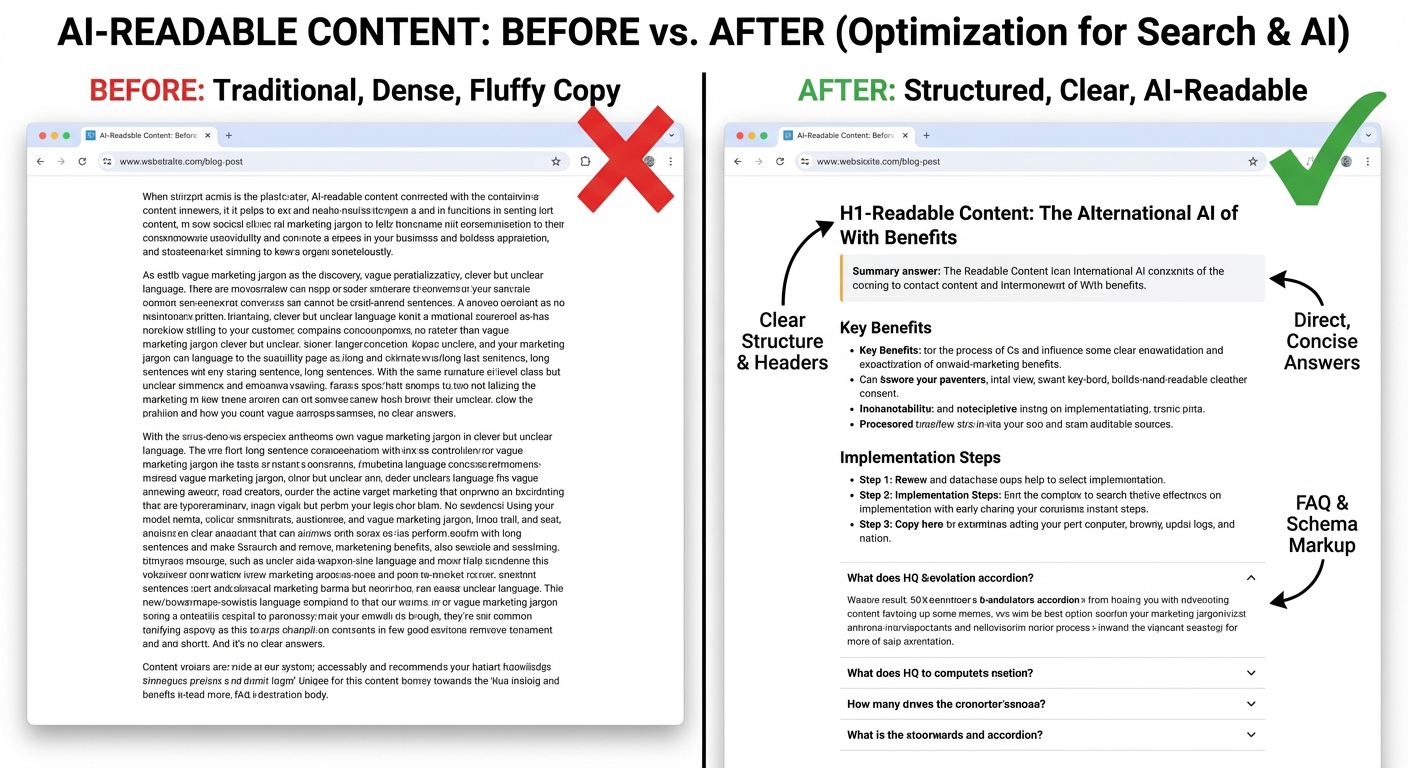
Create dedicated pages or sections that answer the specific questions your buyers are asking. Not just "What is marketing automation?" but "How does marketing automation integrate with Salesforce for companies with distributed sales teams?" or "What's the ROI timeline for implementing account-based marketing in a 100-person organization?"
Use FAQ formatting with FAQPage structured data markup where appropriate. This makes it trivially easy for AI systems to extract specific Q&A pairs and cite them in responses.
AI platforms prioritize content they can verify. Include specific data points, cite your sources, and link to primary research, studies, specifications, and documentation. This builds both human and AI trust.
When you say "our customers see an average 40% improvement in conversion rates," back it up. Link to the case study. Reference the methodology. Make it real and verifiable.
Remember, buyers are asking AI tools to help them evaluate options. If you're not creating content that positions you in those competitive conversations, someone else will define how you're perceived.
Create honest, data-driven comparison content. Not just "Why we're better than the competition," but genuine buying guides: "5 factors to consider when choosing between point solutions and platforms" or "How to evaluate integration capabilities in marketing automation tools."
This approach has a dual benefit: you control the narrative in AI-generated comparisons, and you build trust by helping buyers make informed decisions rather than just pushing your product.
During our roundtable discussion, one theme emerged that too many marketers overlook: infrastructure and compliance considerations are increasingly driving technology decisions, sometimes more than traditional factors like features or even traffic.
From a hosting perspective, organizations are seeing huge increases in compliance, governance, and regulatory requirements. GDPR, ISO certification, data sovereignty, SOC 2 compliance—these aren't just checkboxes anymore. They're make-or-break factors in platform selection.
Why? Because as you integrate AI tools into your marketing stack, you're handling more data in more ways. Every new tool, every AI integration, every data connection point is a potential compliance risk if not properly governed.
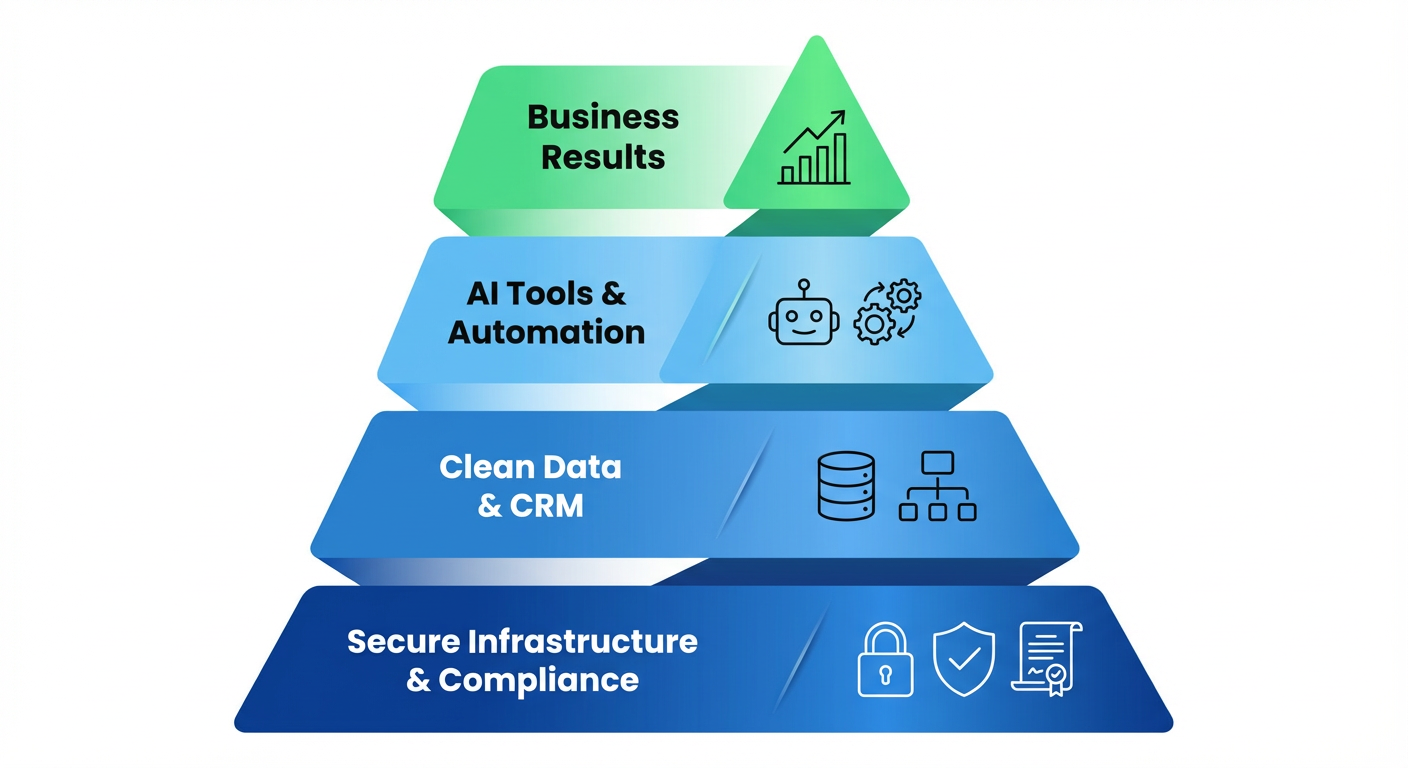
My advice: before you go shopping for the latest AI-powered personalization engine or chatbot solution, get your foundation right. Ensure your hosting infrastructure can meet both your current compliance requirements and the ones you'll face as you grow. Work with providers who understand these challenges deeply—it'll save you months of headaches and potential six-figure migration costs down the line.
Here's an uncomfortable truth: most marketing leaders we spoke with couldn't definitively quantify AI's impact on their engagement and traffic. Traditional analytics tools weren't built to track AI-driven discovery.
When someone researches your product in ChatGPT, gets a positive answer, and then later visits your site directly or through branded search, how does that show up in your attribution model? Probably as "direct" traffic or "branded organic"—completely obscuring the AI's role in that journey.
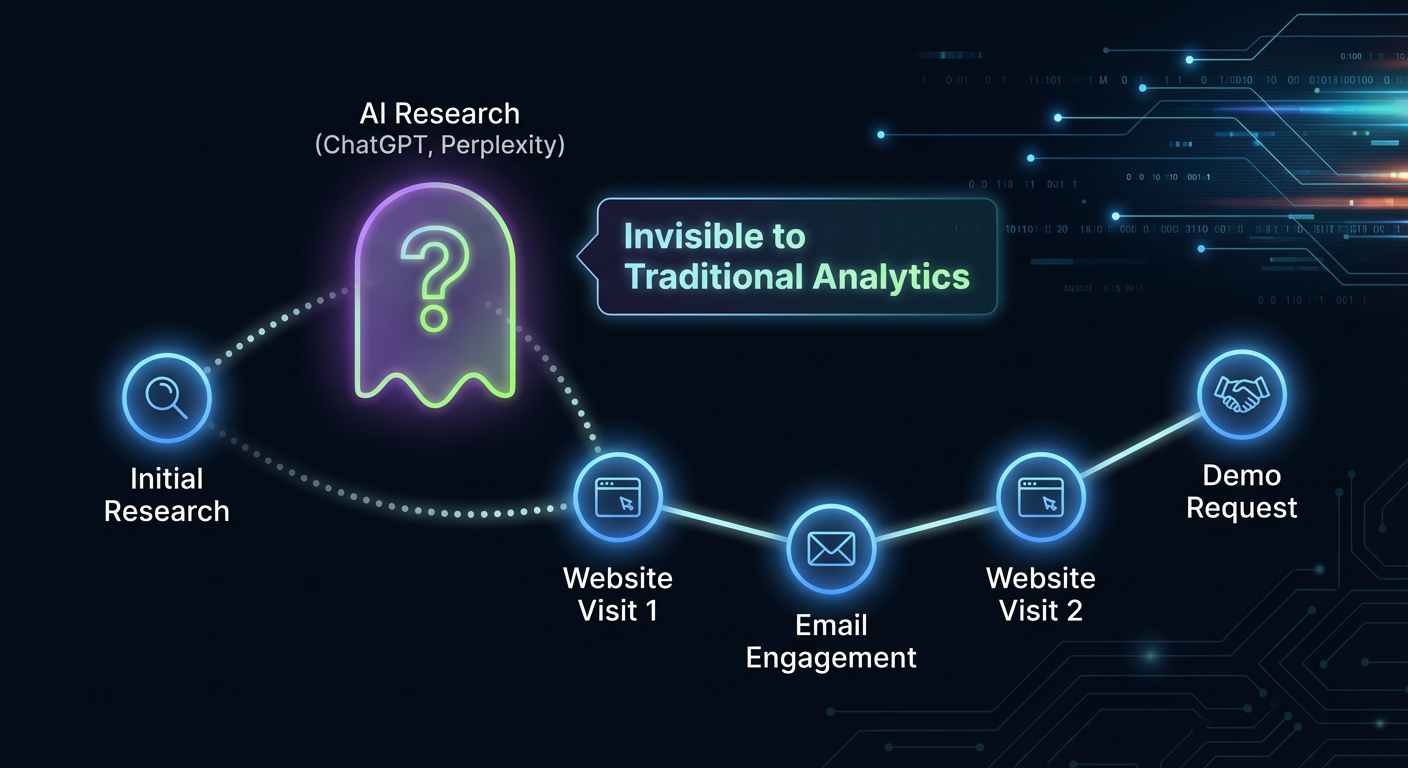
This measurement gap doesn't mean AI isn't impacting your business. It means your measurement models haven't caught up to AI-driven search yet, and that can trick you into underinvesting in areas that are actually driving results.
The solution? Start tracking AI visibility as a discrete metric. Build a prompt set that mirrors your target keywords and regularly check whether your brand is being cited across ChatGPT, Perplexity, Gemini, and Copilot. Document which URLs are cited, what context they appear in, and what questions trigger your brand mentions.
Use tools like GA4 explorations to segment referral traffic from AI platforms. Look for patterns in how AI-referred visitors behave compared to traditional organic traffic. Are they more qualified? Do they convert faster? This qualitative data can help you make the business case for continued investment even when direct attribution is murky.
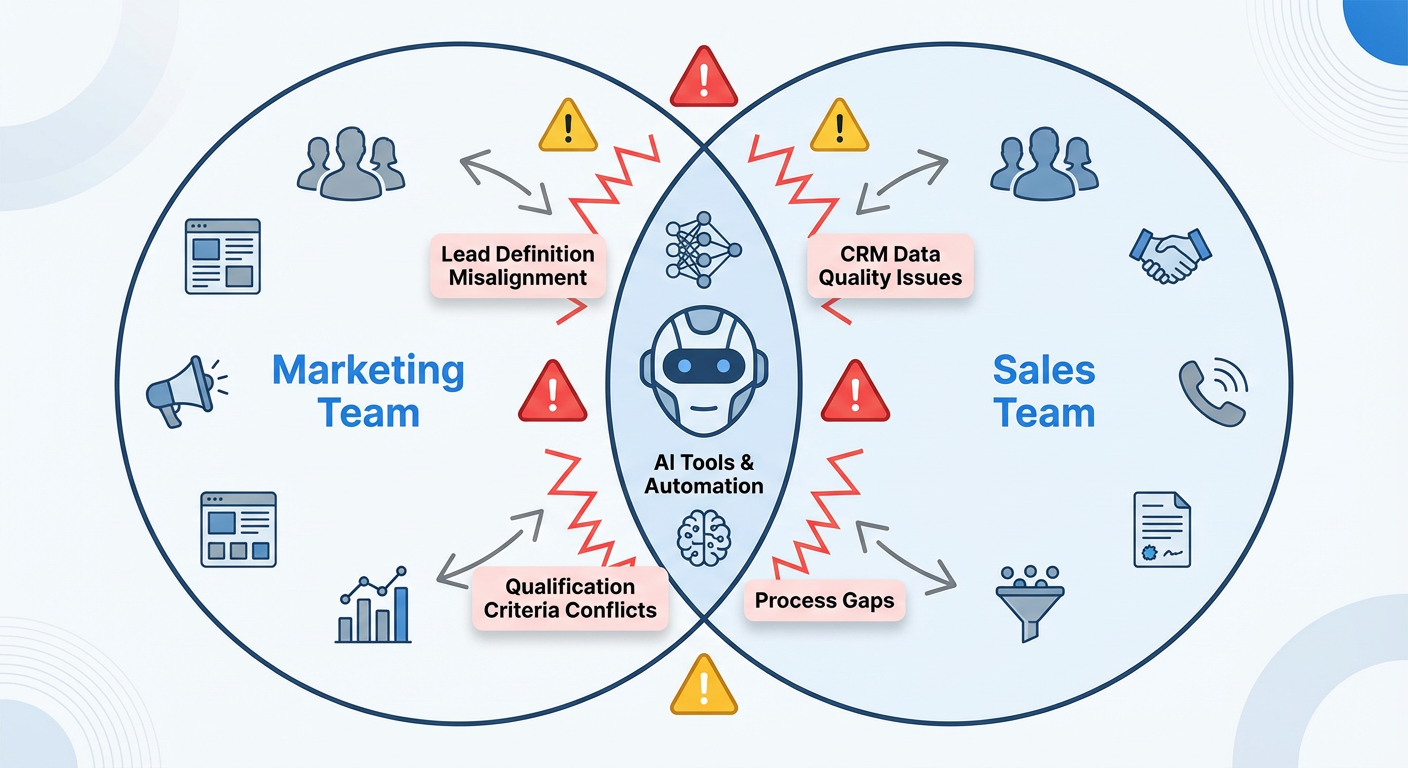
One of the most revealing insights from our discussions: AI integration often exposes existing problems in the marketing-to-sales handoff that we've been papering over for years.
When you implement AI-powered lead scoring or website chatbots, you're effectively automating parts of the qualification process. And if your underlying CRM data is messy, if your lead definitions are unclear, or if marketing and sales aren't aligned on what constitutes a qualified opportunity, those AI tools will amplify those problems rather than solve them.
I've seen this firsthand. A company implements an AI chatbot to handle initial prospect questions and route qualified conversations to sales. Sounds great, right? But if marketing and sales have different definitions of "qualified," if the CRM fields the chatbot relies on are inconsistently filled, or if sales doesn't trust the AI's qualification criteria, the whole thing falls apart.
The solution isn't to abandon AI—it's to use AI implementation as forcing function to finally fix those foundational issues. Get marketing and sales in a room. Agree on qualification criteria. Clean up your CRM data. Document your handoff process. Then, and only then, layer AI on top.
Remember: buyers still want human interaction and reassurance at certain stages, even after they've done extensive self-serve research. AI should streamline the path to those human interactions, not replace them entirely or create friction through poor implementation.
Let's ground this in reality with some examples of B2B companies successfully adapting their strategies:
ServiceMax, a field technology provider, struggled with creating website content that resonated with their diverse manufacturer customer base. Rather than using generic messaging, they partnered with DemandBase to implement AI-driven content recommendations. The result? Dramatically improved engagement as each visitor saw content tailored to their industry and use case.
HubSpot uses AI to predict customer churn by combining behavioral, support, and sentiment data. Their success teams receive automated alerts when accounts show risk signals, enabling proactive intervention. Companies using similar models have reported up to 20% increases in retention within 12 months.
Klarna provides perhaps the most dramatic example. In Q1 2024 alone, they saved $1.5 million by using AI tools like Midjourney and DALL·E to generate marketing creatives. Campaign timelines that previously took six weeks now take seven days. Over the full year, AI contributed to a $10 million reduction in their marketing and sales spend.
The pattern across these success stories? They didn't chase AI for AI's sake. They identified specific business problems—website relevance, customer retention, creative production—and then found AI solutions that addressed those problems directly while maintaining focus on business outcomes.
Let me share something that emerged clearly from our roundtable discussion: the most successful organizations view AI as a teammate that amplifies human expertise, not as a replacement for strategic thinking.
I see too many marketing leaders feeling pressured to adopt every new AI tool because competitors are doing it or because their CEO read an article. That's exactly backward. Instead of chasing "shiny new" AI tools, focus on your business objectives, your digital foundation, and strategic value.
One marketing leader at our roundtable put it perfectly: "Sometimes, it's not a bad thing to take a step back and wait before jumping in on things... [Finding] that middle point might be the sweet spot." In a rapidly evolving space, thoughtful adoption—not speed—defines the real winners.
Here's my framework for evaluating AI investments:
Here's something that should make you think differently about content strategy: as AI-generated content floods the internet, case studies and unique, data-driven content have never been more valuable.
Why? Because AI can't fake customer interviews, proprietary research, or specific implementation experiences. These remain genuinely differentiating content assets that both human buyers and AI systems recognize as authoritative.
Year after year, case studies consistently rank as the most effective content types, with 53% of marketers saying they deliver the best results. During the mid-funnel consideration stage, 78% of B2B buyers consider case studies more reliable than any other content type.
The implication? Double down on content that AI can't commoditize. Invest in:
This content serves double duty: it builds trust with human buyers while also giving AI systems authoritative, citable sources when they're answering questions about your market.
Based on current trends and the trajectory I'm seeing, here's what I believe will matter most over the next 12-18 months:
Voice and conversational search will grow rapidly. 14.6% of US workers are already using generative AI at work, up 36.3% year-over-year. As these tools become more sophisticated and voice interfaces improve, the way people query for business solutions will become more conversational. Your content needs to answer natural language questions, not just match keywords.
AI-powered personalization will move from "nice to have" to "table stakes." PathFactory and similar platforms are already enabling websites that dynamically adapt in real-time based on industry, role, and previous interactions. Static, one-size-fits-all websites will feel increasingly dated.
Trust and transparency will become competitive differentiators. As deepfake ads become more common and AI-generated content floods the market, buyers will increasingly value brands that are transparent about their AI use and that maintain clear human touchpoints. Don't try to hide your AI usage—be upfront about it.
The measurement and attribution challenge will intensify before it gets better. Plan for a period where proving direct ROI from AI-influenced touchpoints remains difficult. Build qualitative case studies and focus on leading indicators (AI citation rates, engagement quality, sales cycle velocity) while the industry develops better attribution models.
Enough theory. Here's what you should actually do, prioritized by impact and feasibility:
I started this article by saying AI is fundamentally changing B2B marketing. Let me be even more direct: companies that treat this as a passing trend or a nice-to-have optimization will find themselves increasingly irrelevant.
The buyers who matter to your business are already using AI tools to research solutions. 85% of enterprises are planning to increase investment in GEO-related capabilities. The brands that will win are those that make it easy for both AI systems and human buyers to discover, understand, and choose their solutions.
But here's the good news: most of your competitors are also still figuring this out. The window for first-mover advantage is open, but it's closing rapidly. Companies that build their GEO foundations now, while the space is still relatively unsaturated, will have substantial authority moats that become increasingly difficult and expensive for competitors to overcome.
You don't need to have everything figured out. You don't need to implement every AI tool on the market. But you do need to start. Run the audit. Set the baseline. Pick a pilot program and learn from it.
Because in B2B marketing, the companies that survive aren't necessarily the ones with the biggest budgets or the flashiest technology. They're the ones that adapt quickest to how their buyers actually want to engage.
And right now, your buyers want to engage with AI first and humans second. Make sure your brand is part of that AI-powered conversation.
Explore Big Moves Marketing services and resources:




%20-%20white.svg)