%20png%20copy.avif)
Effective lead generation is all about building a predictable system that brings in and qualifies potential B2B customers. It’s a process that begins with a razor-sharp understanding of your ideal buyer and flows into strategic outreach designed to turn their initial curiosity into a sales-ready conversation.
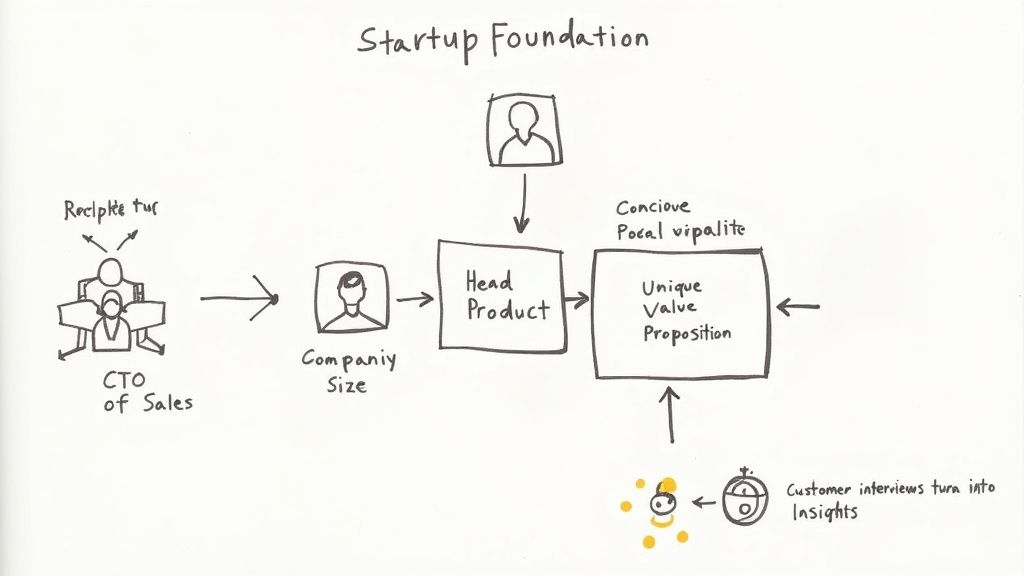
Before you spend a single dollar on ads or an hour on cold outreach, you have to get your foundation right. I’ve seen too many startups skip this part, and even the most creative tactics fall flat as a result. This foundational work isn’t glamorous, but it’s the bedrock of a lead-gen machine that actually works.
The entire process hinges on two things: knowing exactly who you're selling to and having a crystal-clear message about the unique value you offer them. Get these two elements right, and everything else falls into place.
It all starts with defining your Ideal Customer Profile (ICP). This isn't just a vague idea of your target market. It’s a hyper-specific, data-informed picture of the perfect company for your product. Getting this right stops you from wasting time and money on businesses that will never buy—or worse, will churn right after signing up.
To get started on your ICP, you need to go deep on the firmographics—the basic DNA of a company. Your profile should be so clear that anyone on your team can immediately spot a good-fit company.
Here are the key attributes you need to nail down:
To make this process more concrete, here's a worksheet you can use to map out your own ICP. It forces you to ask the right questions and move from abstract ideas to a specific, actionable profile.
Filling this out gives you a filter for every lead that comes your way. Once you’ve profiled the ideal company, the next step is to identify the key people within it. This is where you develop your buyer personas. You need to think about the specific job titles of decision-makers, influencers, and end-users who will touch your product.
The goal isn’t to create a profile that includes every possible customer. The goal is to create a profile that describes your best customer—the one who sees immense value, stays long-term, and becomes an advocate.
With a clear ICP in hand, you can craft a Unique Value Proposition (UVP) that speaks directly to their most urgent problems. A strong UVP isn't a catchy slogan; it's a clear, concise statement explaining the tangible benefit you provide, who you provide it for, and why you're the best choice.
From your ICP's perspective, a powerful UVP answers three questions:
For example, instead of a generic line like, "We sell an AI-powered analytics platform," a powerful UVP gets specific: "Our AI platform helps B2B marketing teams at mid-sized SaaS companies reduce customer acquisition costs by 30% by identifying their most profitable channels."
This foundation—a sharp ICP and a compelling UVP—will inform every piece of content you create, every ad you run, and every sales call you make. It's the starting point for building real relationships that turn into revenue. And it's worth the effort, because companies with strong lead nurturing generate 50% more sales-ready leads at a 33% lower cost.
For a brand-new B2B startup, that first handful of leads is more than just potential revenue—it’s validation. It’s the first real signal that you're onto something, that your solution is hitting a nerve in the market. This early momentum is your lifeblood.
The good news? You don't need a huge marketing budget to get things moving. What you do need is a bit of hustle, a clear focus on who you're helping, and a willingness to do the unscalable things that build your foundation.
Think of these first few strategies as the kindling. They won’t create a bonfire overnight, but they are absolutely essential for getting the fire started and gathering the feedback you need to build something much, much bigger.
Your first champions are probably already in your contacts list. We often overlook the most obvious starting point: our own networks of former colleagues, mentors, and industry connections. This isn't about blasting your LinkedIn connections with a generic sales pitch. It’s about using trust to find your first few believers.
Start by making a simple list of people in your network who either fit your Ideal Customer Profile or know people who do. Then, reach out with a personal, genuine message. Explain the problem you’re obsessed with solving and ask for their honest feedback or if they know anyone who’s struggling with it. People are surprisingly willing to help someone they know, especially when the ask is for advice, not a hard sell.
The goal here isn’t to close a deal on the first call. It’s about starting conversations. An introduction from a trusted mutual contact is the warmest lead you can possibly get, cutting through all the noise and skepticism of cold outreach.
Your ideal customers are already out there, gathered in digital watering holes, talking about their biggest headaches and looking for solutions. Your job is to find these spots and join the conversation—authentically. Forget the massive, generic LinkedIn groups and go deeper.
Find the niche communities where the real talk happens. These places are goldmines for early-stage startups because the people there have high intent and are actively trying to solve problems.
Look for places like:
Guest posting on established industry blogs is a classic for a reason: it lets you tap into a pre-built, relevant audience. It immediately positions you as an expert and builds valuable backlinks that will pay dividends for your SEO down the road.
The trick is to be highly selective. You need to pick blogs that your ICP actually reads and trusts.
Identify 5-10 blogs in your niche that accept guest contributions. Don't just pitch them generic articles. Spend time reading their content to understand their style and audience, then propose a topic that fills a genuine gap and showcases your unique point of view. You can subtly introduce your company’s solution within the article, but only in a way that provides real value to the reader.
These early-stage activities are absolutely crucial for building a pipeline from scratch. For more hands-on advice, our guide on finding your first 10 B2B customers without a marketing team dives even deeper into these foundational steps.
Once your quick wins start bringing in some early traction, it's time to shift gears. The goal now is to build a repeatable, scalable engine for growth—moving from manual hustle to creating systems that consistently deliver qualified leads. This is where you strategically invest in the right B2B marketing channels to build a predictable pipeline, ensuring your time and budget are spent where they'll have the biggest impact.
For a lot of early-stage startups, growth starts from the inside out. You begin with your trusted networks and gradually expand into broader communities before you're ready to pour fuel on the fire with larger marketing channels.

It’s a natural progression that builds momentum before you start scaling up.
For any B2B SaaS or AI startup, content isn't just "marketing." It's your product before the product. This is your chance to prove you know your stuff, build genuine trust, and educate your ideal customers about a problem you are perfectly positioned to solve. Your content should speak directly to the deepest pain points of your ICP, making your solution feel like the only logical next step.
Don’t just churn out random blog posts. Instead, think in terms of high-value assets you can create once and repurpose everywhere.
This approach isn't just effective; it's efficient. Content marketing is proven to be three times more effective than traditional outbound marketing while costing 62% less. That makes it a no-brainer for startups trying to make every dollar count.
Organic search (SEO) is the ultimate long game. It takes time and patience to see results, but the leads it generates are often the highest quality you can get. Why? Because they come from people who are actively looking for a solution to a problem they already have.
The trick for startups is to sidestep the big, high-volume keywords. Instead, you need to get laser-focused on specific, high-intent search terms. Think about the exact phrases your ideal customer would type into Google when they’re ready to pull out their credit card. These are your "bottom-of-the-funnel" keywords.
For example, forget a broad term like "AI analytics." A much smarter play would be to target something like "AI tool for B2B SaaS churn prediction." The search volume will be lower, but the person behind that search has a specific, urgent need you can solve right now.
SEO for startups is a game of precision, not volume. Your goal is to own the conversation around the very specific problem your product solves. When a prospect searches for that problem, you need to be the definitive answer they find.
To make this happen, your content needs to be built around these keywords. Those high-value assets we talked about—the whitepapers and case studies—should be optimized for these themes. This creates a powerful feedback loop where your content efforts directly boost your organic search visibility, building a sustainable source of inbound leads. The payoff is huge: SEO leads have a remarkable 14.6% close rate, blowing many other channels out of the water.
While content and SEO are building your long-term foundation, paid acquisition is all about speed and predictability. For B2B startups, there's no platform more powerful for reaching key decision-makers than LinkedIn Ads. It lets you get surgically precise with your targeting, zeroing in on users based on their job title, company size, industry, and even specific skills.
To get the most out of LinkedIn, don't just run generic "brand awareness" ads. Use it to put your best content directly in front of the right people.
Here’s a simple, effective workflow to get you started:
This integrated approach ensures that each channel makes the others stronger. Your content fuels your paid campaigns, your paid campaigns drive immediate traffic and leads, and your SEO efforts build a long-term, compounding asset. Mastering these core B2B marketing channels is how you build a lead generation machine that can truly scale.
Once your foundational lead channels are humming along, it’s time to shift from casting a wide net to spearfishing. This is where you graduate to more sophisticated, high-impact strategies that target your most valuable potential customers with surgical precision. For B2B startups, two of the most powerful advanced plays are strategic partnerships and Account-Based Marketing (ABM).
Let's be clear: these strategies require more upfront planning and coordination than your standard content or paid ads. But the payoff can be immense. We're talking larger deals, faster sales cycles, and much deeper market penetration. It's about shifting from a volume game to a value game.
One of the quickest ways to build trust and reach a qualified audience is to work with someone who already has it. Strategic partnerships let you tap into complementary, non-competing businesses that already serve your Ideal Customer Profile.
Think of it as getting a warm introduction to a room full of your perfect buyers.
The key is finding a partner whose product solves an adjacent problem to yours. For instance, if you sell an AI-powered email marketing tool, partnering with a CRM provider is a smart move. Their customers need a tool like yours to get more value from their CRM, and your customers could likely benefit from their platform.
You can kick things off with a few high-value, low-effort collaborations:
Successful partnerships are built on mutual value, not a one-sided sales pitch. When you approach a potential partner, lead by explaining how a collaboration will benefit their customers and their business first.
While traditional marketing is all about attracting a broad audience, Account-Based Marketing (ABM) completely flips the script. Instead of marketing to a wide funnel of leads, you identify a small, curated list of high-value target accounts and treat each one as its own market.
This is the definition of working smarter, not just harder.
ABM is perfect for startups aiming to land those larger, more strategic "logo" customers. The whole process hinges on tight alignment between your marketing and sales teams to orchestrate a personalized, multi-touch campaign that surrounds key decision-makers within a target company.
A startup-friendly ABM campaign doesn't need to be overly complex. You can break it down into a few focused moves:
The beauty of ABM is its focus. By concentrating your resources on the accounts most likely to become major customers, you eliminate waste and dramatically increase your chances of closing those game-changing deals. It’s an approach that demands patience and personalization, but the returns are often well worth the effort.
For a deeper dive, our guide can help you maximize ROI with Account-Based Marketing and build a program that actually delivers results.
Getting a steady flow of qualified leads is a huge win, but it's only half the battle. The real magic happens when your sales team can step in, armed with the right tools, and confidently guide those prospects across the finish line. This is where a solid sales enablement strategy becomes your secret weapon.
Think of it this way: your marketing efforts build the bridge to the customer. Sales enablement assets are the planks that make that bridge solid, allowing your sales team to walk prospects across without anything falling through the cracks. These aren't just fancy brochures; they're strategic tools designed to answer tough questions, build unshakable trust, and ultimately, shorten the sales cycle.
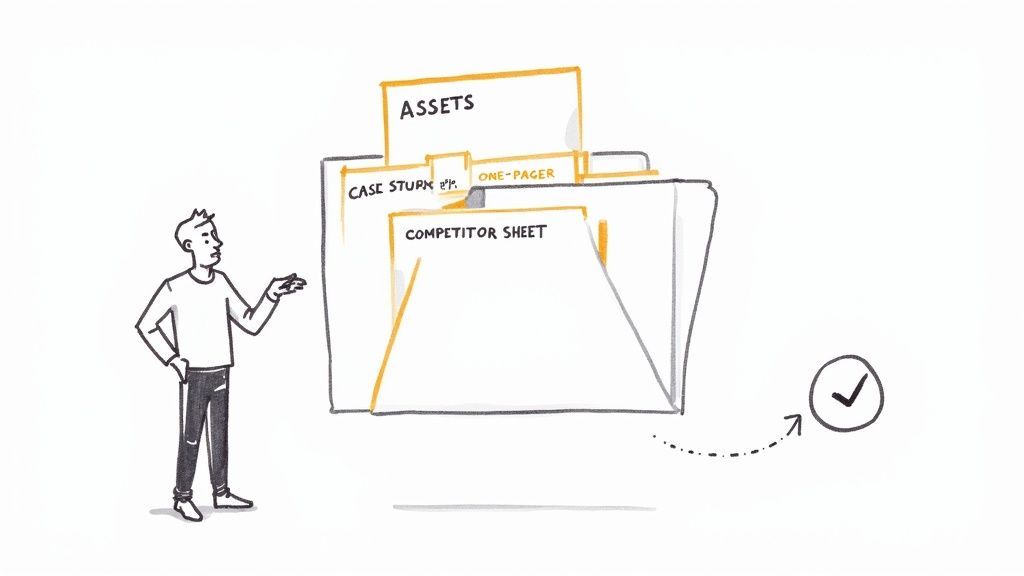
To turn genuine interest into actual revenue, your sales reps need a core set of assets they can pull from at a moment's notice. Each piece serves a specific purpose, tackling different questions and concerns that pop up as a prospect moves through their decision-making process.
Here are the non-negotiables every B2B startup needs in its arsenal:
Compelling Case Studies: This is your social proof in action. A killer case study doesn't just list features; it tells a relatable story of a customer who had a specific problem, used your solution, and got a measurable, impressive result. It's the most effective way to say, "We don't just claim we can help; we've already helped others just like you."
Concise One-Pagers: Decision-makers are busy. A one-pager is a quick, digestible summary of your product’s value, key features, and who it's for. It’s the perfect thing to leave behind after a call or attach in an email for a prospect to forward to their boss.
Detailed Competitor Comparison Sheets: Your prospects are absolutely checking out the competition. A well-researched comparison sheet arms your sales team to handle the inevitable "So, how are you different from Company X?" questions with confidence and facts. The key is to honestly highlight your unique strengths without trashing the other guys.
A great sales asset doesn't just inform; it persuades. It anticipates the buyer's next question and provides a clear, confident answer, moving the conversation forward every single time.
How you structure these documents is just as critical as the information inside. They need to be designed for a sales conversation, not just as marketing collateral. That means a relentless focus on clarity, scannability, and providing direct answers to common objections.
To help your team know exactly what to use and when, it helps to map out each asset's purpose.
The table below breaks down the essential sales enablement assets, what they're for, and the best time to deploy them in a deal cycle.
This structured approach makes sure your team is ready for any scenario, armed with the right content to keep the momentum going.
Finally, creating world-class assets is completely useless if your team can't find them when they need them. One of the oldest points of friction between marketing and sales is the frantic Slack message: "Where's the latest version of the pitch deck?!"
Set up a single source of truth—a centralized, easy-to-navigate spot for all sales enablement materials. This could be a dedicated folder in Google Drive, a specific channel in Slack, or a section in your company’s internal wiki. The tool matters far less than the discipline to keep it updated.
When your sales team can instantly grab the right content for the right conversation, they stop searching and start selling. This alignment is the final, crucial step in converting those hard-won leads into happy, paying customers.
A lead generation program isn't a "set it and forget it" machine. It’s a living, breathing system that needs constant attention—you have to measure, analyze, and continuously tweak it to get results.
Without hard data, you’re just flying blind, pouring precious time and money into activities that feel productive but don’t actually move the needle. This is where you shift from just doing marketing to building a predictable engine for growth.
It all starts by ruthlessly cutting out the vanity metrics. Things like impressions, social media likes, and even raw website traffic might look good on a dashboard, but they don’t pay the bills.
For an early-stage B2B startup, your measurement framework should be dead simple and focused on what directly impacts revenue. Your goal is to understand not just what’s working, but why it’s working and how much it costs you.
Start tracking these essential Key Performance Indicators (KPIs) from day one. You can use free tools like your CRM dashboard and Google Analytics to get started. Don't overcomplicate it; just be consistent.
Here are the key startup metrics you should have your eyes on:
Data is only useful when it leads to action. You need to build a tight feedback loop where you measure, learn, and refine your strategy every single week or month. This iterative process is what separates startups that stall from those that achieve sustainable growth.
The purpose of measurement isn't to create perfect reports; it's to make smarter decisions. Is one channel delivering leads with a much shorter sales cycle? Double down on it. Is a specific whitepaper generating high CPL but low conversion? It's time to tweak the content or the promotion strategy.
This kind of analysis can also reveal powerful insights about your business. The average global CPL is around $198, but B2B tech leads often cost more, hovering at $208 due to longer sales cycles. If your CPL is way higher, it could be a signal to refine your ICP or sharpen your value proposition.
By constantly asking what the data is telling you, you move from guesswork to a data-driven approach. For a more detailed framework, check out our guide on how to measure marketing success for data-driven B2B growth. This relentless cycle of refinement is the key to building a predictable and scalable lead generation engine.
Starting your lead gen journey can feel like navigating a maze. I get it. Founders often grapple with the same tough questions about where to begin, how much to invest, and which channels will actually deliver results instead of just noise.
Let’s tackle the most common ones I hear.
This is the big one, and the honest answer is: there's no magic number. A smarter approach is to start small and focused.
Don't try to boil the ocean. Dedicate a modest, fixed budget to one or two channels you have high conviction will reach your ICP. Maybe it’s a targeted LinkedIn campaign or a super-niche content strategy. Then, you need to track your Cost per Lead (CPL) and Cost per Acquisition (CPA) obsessively.
Once a channel proves its value with a positive return, you’ll have the data to justify scaling your investment. It stops being a guess and starts being a calculated business decision.
Right after the budget question comes the "where should I be?" question. The temptation is to be everywhere at once. Resist it.
Your Ideal Customer Profile is your compass here. If you’re targeting VPs of Engineering at tech companies, they’re far more likely to be on LinkedIn than on Instagram. It sounds obvious, but you’d be surprised how many startups misalign their channel with their customer.
For most B2B startups, a powerful starting combination is:
Social media, especially LinkedIn, has become a serious lead gen engine. In fact, about 68% of marketers now generate leads from social media, with LinkedIn leading the pack for B2B.
The platform's own LinkedIn Lead Gen Forms can hit a remarkable 13% conversion rate—that's over five times higher than typical industry averages. You can dig into more of these powerful lead generation statistics to see just how effective a focused social strategy can be.
Knowing when to scale is the final piece of the puzzle. The signal to go bigger isn't just a high volume of leads; it's a consistent flow of qualified leads that your sales team is successfully turning into customers. That’s when you hit the accelerator.
If you're ready to move beyond questions and start building a predictable lead generation engine, Big Moves Marketing can help. I partner with B2B SaaS and AI startups to craft the strategies and sales tools that turn interest into revenue.
Let's build your growth plan together at https://www.bigmoves.marketing.
Explore Big Moves Marketing services and resources:



%20-%20white.svg)