A Modern B2B Marketing Strategy for SaaS Growth
December 8, 2025

A solid B2B marketing strategy is your roadmap for finding, connecting with, and ultimately winning over high-value business customers. It's much more than a list of tactics; it’s the definitive plan that spells out who you're selling to, what unique value you bring to the table, and how you'll build a reliable pipeline for real growth. This is the foundation that directs every blog post, ad campaign, and sales call you'll ever make.
Crafting Your Foundational B2B Marketing Strategy
Before you write a single line of copy or launch your first LinkedIn ad, you have to get the foundation right. Your success hinges on it. This isn’t about abstract marketing theory; it’s about making deliberate, tough choices that carve out a unique space for your SaaS or AI solution. Nail this part, and every single thing you do afterward becomes more effective.
This core identity is the single most critical component of your marketing strategy. Every ad, every piece of content, and every sales conversation will flow from the decisions you make right here.
Define a Market Position That Wins
Positioning is the art of owning a specific, valuable piece of real estate in your customer's mind. It's the instant answer to the question, "Why should I pick you over anyone else?" For a B2B SaaS or AI startup, this means finding a very specific problem for a very specific group of people and becoming the only logical choice to solve it.
Don't fall into the trap of trying to be everything to everyone. Find your niche. A "CRM for enterprise finance teams" is infinitely more powerful than a generic "CRM for business." That kind of focus clarifies your marketing instantly and pulls in buyers who feel like your solution was tailor-made for them.
Your market position isn't just what you say about your product; it's the story your ideal customers tell themselves about why you are the only logical choice to solve their problem.
Build Your Ideal Customer Profile
An Ideal Customer Profile (ICP) is a detailed description of the perfect company to buy your product. This goes way beyond surface-level demographics like industry and company size. A truly useful ICP gets into the specifics of their real-world challenges, what drives them, and the operational issues they’re trying to manage.
To build out your ICP, you need to ask tougher questions:
- What specific pain are they feeling? Go deeper than the obvious. Is their current process slow and riddled with errors? Is it actively costing them money or missed opportunities?
- What are their real business goals? Think about how solving their immediate pain helps them hit their bigger targets, like boosting revenue, cutting operational costs, or making their team more efficient.
- Who is on their buying committee? In B2B, you've got the end-user, the person holding the budget, and the technical decision-maker. Each one cares about something different and needs a slightly different version of your message.
Getting this profile right is a foundational step, and it's absolutely crucial. If you need a framework to get started, you can explore our guide on building an ideal customer profile to make sure you’re not missing any critical details.
Develop Messaging That Resonates
Once you've locked in your positioning and ICP, you can start crafting messaging that speaks directly to your business audience. This isn't about rattling off a list of features. It's about translating those features into tangible outcomes and benefits that your business customer actually cares about.
Your messaging framework needs to be consistent everywhere—from your website's homepage to the slides in your sales deck. This alignment is what builds trust and hammers home your unique value at every single touchpoint. The goal is simple: when your ideal customer reads your message, they should feel like you understand them and see a clear, straightforward path to solving their problem with your help.
This focused approach is critical in a growing market. The global B2B marketing market was valued at USD 18.89 billion in 2024 and is projected to hit USD 30.79 billion by 2030, a surge driven by smart strategies like account-based marketing and AI analytics. You can learn more about the B2B marketing market forecast and its growth drivers to see just how important this is.
Designing Your Demand Generation Engine
Okay, you've nailed down your strategy. Now it's time to build the engine that actually brings in the leads. This isn't about throwing tactics at the wall to see what sticks; it's about making smart, focused bets on the channels where your Ideal Customer Profile (ICP) actually operates.
A solid demand engine is what turns all that foundational work on positioning and messaging into a predictable pipeline. It's the heart of your entire B2B marketing strategy. And it all starts with the same building blocks: your ICP, messaging, and positioning. You can't pick the right channels until you're absolutely certain who you're talking to and what you need to say.
This simple flow chart really drives home the sequence. It all starts with the ICP.
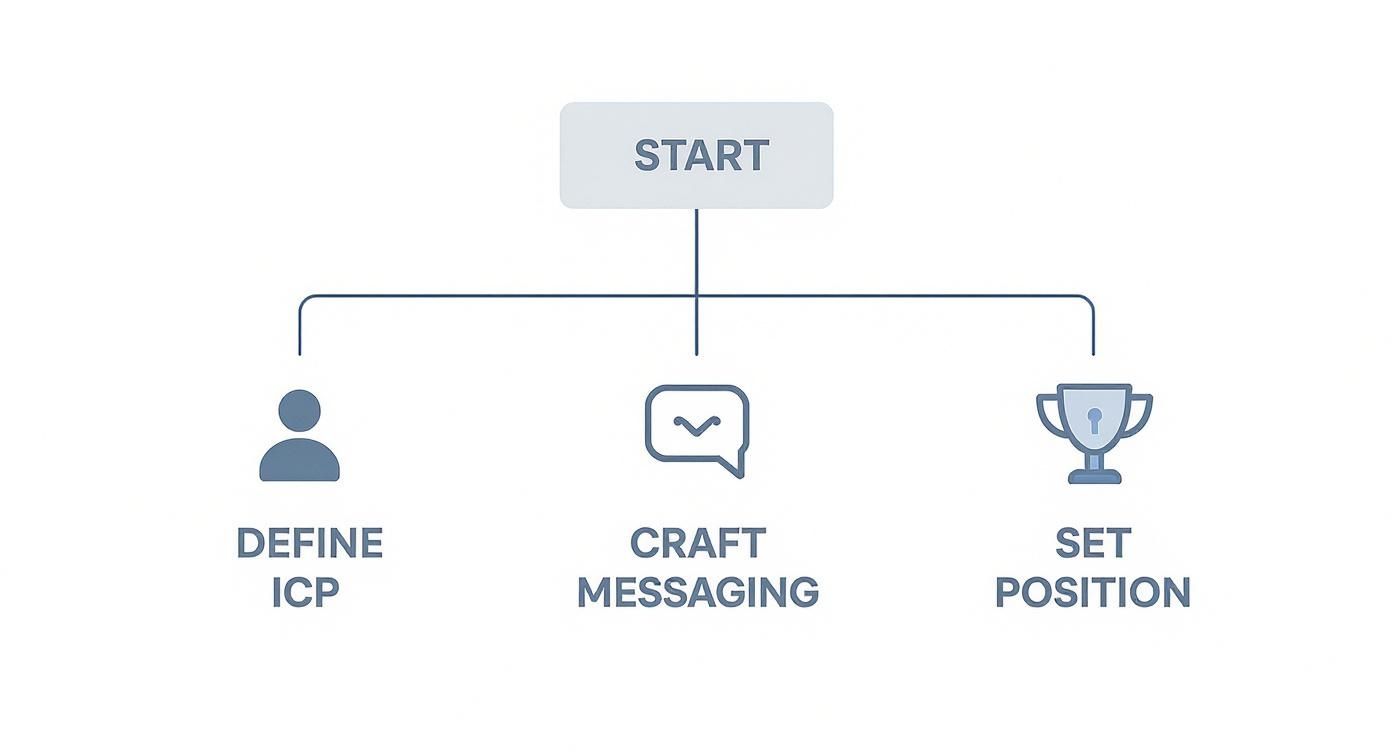
Get that wrong, and everything that follows will be fighting an uphill battle. Defining your ICP is the non-negotiable first step.
Selecting Your Core Marketing Channels
For a B2B SaaS or AI startup, focus is your superpower. Resist the temptation to spread your budget across a dozen different platforms. The goal is to pick one or two core channels and completely dominate them first. You want to become an unmissable voice in the places that truly matter to your buyers.
I've seen startups burn through cash trying to be everywhere at once. Don't make that mistake. Pick your spots.
Here's a quick comparison of the usual suspects to help you decide where to place your initial bets.
B2B Demand Generation Channel Comparison
Choosing the right channel is less about what's trendy and more about what aligns with your ICP's behavior and your company's stage. This table breaks down the most common B2B channels to give you a clearer picture of where to start.
Ultimately, the best channels are the ones that provide a direct line to your ICP. Start with one primary channel, master it, and then expand.
A powerful B2B marketing strategy doesn't rely on being everywhere. It thrives on being overwhelmingly present in the few places that truly matter to your ideal customer.
Building a Buyer-Centric Content Plan
Your content plan is the fuel for your demand gen engine. It's the roadmap that guides prospects from initial awareness to making a purchase decision.
This isn’t about churning out blog posts for the sake of it. It’s about creating a library of resources that answers your prospect's questions before they even think to ask them. Think of it from their perspective:
- Top of Funnel: What problems are they trying to solve? Blog posts, industry reports, and short videos work well here.
- Middle of Funnel: How do they evaluate solutions? Webinars, in-depth guides, and case studies are perfect for this stage.
- Bottom of Funnel: Why should they choose you? Demo videos, implementation guides, and ROI calculators help seal the deal.
A well-structured plan ensures you have the right asset for every conversation, making your sales team's job infinitely easier.
Structuring a Predictable Paid Media Program
Paid media is your accelerator. While organic channels build momentum over the long haul, paid campaigns can start generating pipeline almost overnight.
The key here is discipline. Start with a modest budget to test your messaging, targeting, and offers. Don't try to promote ten different things at once. Focus on a single, compelling call to action—a demo, a strong whitepaper, a must-see webinar—and drive all traffic to a dedicated landing page.
Speaking of landing pages, getting them right is critical. You can learn more about current landing page optimization best practices to make sure you're not leaving conversions on the table.
From there, it's all about the numbers. Track your return on ad spend (ROAS) diligently. Double down on what's working and ruthlessly cut what isn't. This isn't gambling; it's building a predictable system for growth. For a much deeper look at this, check out our guide on building a modern https://www.bigmoves.marketing/blog/demand-gen-strategy.
Creating Content That Actually Converts
Content is the fuel for your growth, but here’s a secret many marketers miss: the goal isn't creating more content—it's creating better content. Your B2B marketing strategy hinges on producing high-impact assets that solve real problems, build undeniable authority, and push prospects to take action.
It’s about becoming the go-to expert in your niche, not just another voice shouting into the void.
This means you have to move past generic, top-of-funnel blog posts that just rehash what everyone else is saying. Think of each piece of content as a tool. Are you handing your ideal customer something that helps them do their job better? Does it make a complex problem feel simple? If so, you're on the right track.
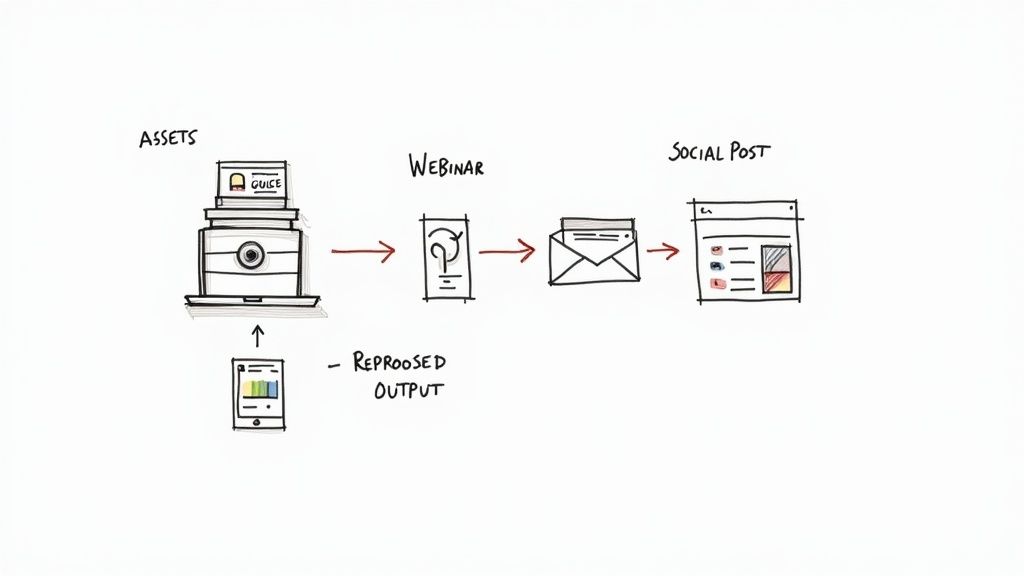
This workflow is a perfect example of working smarter. One powerful idea gets repurposed into multiple assets, letting you maximize your effort and reach buyers wherever they are. It’s how you scale your influence without scaling your workload.
From Content Creator To Thought Leader
True thought leadership isn't about having a strong opinion; it's about providing a clear, valuable perspective that helps people see their own challenges in a new light. It's the difference between telling your audience what to do and showing them how to think.
To build this kind of authority, your content needs a distinct point of view rooted in your unique expertise. Don’t just summarize what’s already out there. Instead, offer a fresh angle, challenge a common assumption, or give your audience a framework that simplifies a tough process.
Thought leadership isn't about being the loudest voice in the room. It’s about being the most trusted. It’s the content that your ideal customer forwards to their boss with the note, "We need to be thinking about this."
This mindset shift is why 91% of B2B marketers now use content marketing. A staggering 74% report that it generates more leads than other channels, and 52% plan to invest more specifically in thought leadership to build that critical trust. You can dig into more of the numbers in these latest B2B marketing statistics that highlight this trend.
Building Your Content Asset Library
A strong B2B marketing strategy needs a diverse library of content assets. Each piece should be designed to meet a specific need somewhere along the buyer's journey. Don't get stuck in a rut with just one format.
Start by building out these key assets:
- In-Depth Guides and Whitepapers: These are your cornerstone pieces. Tackle a complex industry problem with a comprehensive, data-backed guide that prospects will download and reference for months. This is how you prove you know your stuff.
- Webinars and Virtual Events: A webinar lets you connect with your audience in a more personal, interactive way. Use it to demo your product, host a panel with other industry experts, or teach a valuable skill. It puts a human face on your brand.
- Case Studies and Success Stories: Nothing builds trust like social proof. A great case study doesn't just list results; it tells a relatable story of a customer's transformation, zeroing in on the specific challenges they overcame with your help.
- Sales Enablement One-Pagers: These are your sales team's secret weapon. They're concise, powerful documents that arm them with the key talking points, value props, and differentiating factors needed to close deals.
By developing a mix of formats, you cater to different learning styles and buying stages. For a more detailed walkthrough, check out our guide on how to create a content marketing strategy that ties directly to your business goals.
Master the Art of Repurposing
The smartest marketers don't create more content; they get more mileage out of what they already have. A single, high-effort asset can be the wellspring for dozens of smaller pieces, extending its reach and impact exponentially.
Think about it this way:
- That hour-long webinar you hosted? It can become a series of short video clips for LinkedIn, a summary blog post with key takeaways, and a dozen insightful quotes for social media.
- The in-depth industry report you published? That’s an infographic, several targeted blog posts, and a full email nurture sequence just waiting to happen.
- A compelling customer case study can provide the story for a short video testimonial, a key slide in your sales deck, and a targeted social media ad.
This approach respects your team's time and ensures your best ideas reach the widest possible audience. It turns content creation from a constant sprint into a sustainable system for building authority and driving demand.
Integrating AI into Your Marketing Workflow
For modern B2B startups, AI isn't some far-off concept anymore—it's a practical, powerful tool for getting a real edge. This isn't about replacing your team. It's about amplifying their skills, automating tedious work, and finding insights that were just out of reach before. It's how you make your entire B2B marketing strategy smarter, not just busier.
The whole point is to weave AI into your daily operations so naturally that it feels like an extension of your team, freeing them up for the big-picture thinking and creative problem-solving that actually moves the business forward.

Supercharging Content Creation
Right out of the gate, one of the easiest wins with AI is content creation. Let's be clear: this doesn't mean you let a robot write your blog posts. It’s about using AI to fast-track the most time-consuming parts of the process, from generating initial ideas to drafting foundational copy that your expert marketers can then polish into something truly great.
AI-powered tools are quickly becoming essential for B2B marketers, handling everything from routine tasks to making customer interactions better. For example, you can use AI Chatbots for Your Business to keep prospects engaged and supported all the way through their buying journey.
The adoption rates tell the story. A massive 85% of B2B marketers are already using AI tools for content creation. Drilling down, 62% use them for brainstorming, 53% for summarizing complex topics, and 44% for getting that first draft on the page.
Unlocking Advanced Personalization
Beyond just creating content, AI opens up a whole new level of audience segmentation and personalization. Let’s face it, generic, one-size-fits-all campaigns just don't work anymore. B2B buyers now expect messaging that speaks directly to their specific challenges, their industry, and their role. Manually, that's impossible at scale. With AI, it’s not.
By processing huge datasets, AI can spot subtle patterns in customer behavior that a human would miss, helping you create incredibly specific audience segments. This means you can deliver the perfect message on the right channel at the exact moment it will land best.
AI transforms personalization from a nice-to-have goal into a practical, scalable reality. It's the difference between blasting a mass email and having what feels like a one-on-one conversation with thousands of prospects at once.
This is an absolute game-changer for account-based marketing (ABM), where customizing your outreach for key accounts is the entire point.
Finding High-Intent Leads with Predictive Analytics
Maybe the most powerful way to use AI in your B2B marketing strategy is with predictive analytics. Instead of just waiting for leads to come to you, AI models can analyze your sales history, website behavior, and third-party intent data to predict which accounts are most likely to buy your solution right now.
This lets your sales and marketing teams stop wasting time on long-shot prospects and focus their energy where it will actually make a difference. Predictive analytics helps you answer the big questions:
- Which of our current prospects are showing signs they're ready to buy?
- What new companies fit our ideal customer profile and are actively looking for a solution like ours?
- Which of our existing customers might be at risk of churning?
By pinpointing these high-intent leads, you shorten your sales cycles, boost conversion rates, and build a much more predictable revenue pipeline. It makes your marketing proactive instead of reactive.
If you want to dig deeper into this, check out our ultimate guide to using generative AI for B2B marketing and sales growth for more ideas you can put into action.
Unifying Marketing and Sales for Revenue Growth
Let's be blunt: even the most brilliant marketing strategy is just an academic exercise if it doesn’t translate into actual revenue. This is where the rubber meets the road—the critical, and often broken, link between marketing and sales.
When these two teams operate in separate worlds, leads get dropped, messaging gets muddled, and deals stall out. You end up with a marketing team celebrating vanity metrics while the sales team complains about lead quality. Sound familiar?
Building a genuine partnership is non-negotiable for any B2B SaaS startup. It requires a shared language, common goals, and a deep, mutual respect for the role each team plays in moving the business forward. This alignment is what turns marketing activities into closed-won deals.
Arming Sales with the Right Tools
Sales enablement is the most practical expression of this partnership. It's marketing's job to equip the sales team with the precise tools they need to have more effective conversations and, ultimately, win more deals. These aren't just pretty documents; they are strategic assets designed to overcome objections and clarify your value proposition on the spot.
Think of it as building an arsenal. Your sales reps are on the front lines, and they need the right weapon for every scenario they walk into. Giving them a library of high-quality, on-brand materials means they can respond to any buyer question with confidence and consistency.
A great sales enablement program doesn't just hand over a stack of PDFs. It delivers the right information, in the right format, at the exact moment a salesperson needs it to move a deal forward.
This isn't about creating dozens of documents nobody will ever use. It’s about building a small, high-impact kit of essential assets.
Table: Essential Sales Enablement Assets
Start with these three, get feedback from sales, and build from there. The goal is utility, not volume.
Defining the Handoff and Closing the Loop
One of the biggest friction points between marketing and sales is the lead handoff. Marketing celebrates a high volume of leads; sales complains they aren't qualified. The cycle of blame is endless and unproductive.
The only way out is to create a crystal-clear, mutually agreed-upon definition of what makes a lead ready for a sales conversation. This is your Marketing Qualified Lead (MQL) definition.
This definition can't be created in a vacuum by the marketing team. It has to be a collaborative agreement based on firmographic data (like company size and industry) and behavioral signals (like downloading a specific guide or attending a demo). Once you have it, document it in a simple Service Level Agreement (SLA) so everyone is accountable.
But the communication can't stop there. The single most powerful source of insight for improving your entire B2B marketing strategy comes directly from the sales team. They are the ones hearing objections, questions, and competitor mentions straight from the source.
You need to create a structured, consistent feedback loop. This could be a standing weekly meeting, a dedicated Slack channel, or a shared document where sales can log real-time insights from their calls.
When marketing hears that three prospects in a row mentioned a competitor's new feature, they can adjust messaging and content immediately. This continuous flow of information turns your strategy into a living, breathing system that gets smarter with every single sales conversation.
Measuring Performance and Optimizing Your Strategy
A marketing strategy isn't something you "set and forget." The most powerful strategies are living, breathing things that adapt based on real data, not guesswork. This is the final, crucial part of the framework where you stop spending money and start making predictable investments.
Your goal here is to build a system of measurement and continuous improvement. This isn't just about reporting—it's about creating a culture where data informs every decision. Let’s get into how to track what’s working, run smart experiments, and double down on the channels that drive real growth for your startup.
Identify KPIs That Actually Matter
It’s incredibly easy to get distracted by vanity metrics. Things like social media likes or overall website traffic might look good on a chart, but they don't tell you if marketing is actually affecting revenue. For a B2B SaaS or AI company, you have to anchor everything to business outcomes.
Forget the fluff. Instead, zero in on a handful of Key Performance Indicators (KPIs) that directly track the health of your sales pipeline.
- Marketing Qualified Leads (MQLs): This is the number of leads that hit a specific, pre-agreed-upon standard that says, "Hey, sales, this person is ready for a conversation." It’s your main handoff metric.
- Sales Qualified Leads (SQLs): This is the number of MQLs the sales team has actually accepted and verified as real opportunities. A high MQL-to-SQL rate is a great sign that marketing and sales are perfectly aligned.
- Pipeline Contribution: What's the total dollar value of sales opportunities that marketing either sourced directly or had a major hand in influencing? This is one of the most compelling numbers you can show to prove marketing’s ROI.
- Customer Acquisition Cost (CAC): Simple math here: divide your total sales and marketing spend by the number of new customers you brought in over a certain period. The mission is to keep this number as low as you can without stalling growth.
- Customer Lifetime Value (LTV): This is the total revenue you can realistically expect to earn from a single customer over their entire relationship with you. For a healthy business, your LTV needs to be significantly higher than your CAC—a common benchmark is a 3:1 ratio or better.
Tracking these specific metrics gives you an honest, unfiltered look at how your strategy is performing. If you want to go deeper on this, we've laid out a more detailed measurement framework in our guide on how to measure marketing success for data-driven B2B growth.
Build a Simple Marketing Dashboard
You don't need a crazy-expensive, enterprise-level analytics suite to get started. Honestly, the best dashboards are the simplest ones—clear, focused, and built around the handful of KPIs we just talked about. The whole point is to give you and your leadership team an at-a-glance view of progress.
Your marketing dashboard shouldn't be a data dump. It should tell a clear story about what’s working, what isn’t, and where you are placing your next bets. It's a tool for decision-making, not just reporting.
A tool like Google Data Studio, HubSpot's reporting, or even just a well-organized spreadsheet can work perfectly. The key is to visualize trends over time. Are your MQLs climbing month-over-month? Is your CAC slowly ticking down? Seeing the data visually makes it so much easier to spot the patterns and opportunities you’d otherwise miss.
Adopt a Framework for Continuous Improvement
Having all this data is useless if you don't act on it. A culture of optimization is built on a simple, repeatable loop for running experiments to make your campaigns and your overall strategy better over time.
Think of it as a constant cycle:
- Analyze: Look at your dashboard and find a weak spot. For example, maybe you see a landing page that gets a ton of traffic but has a terrible conversion rate.
- Hypothesize: Come up with a clear, testable idea. "I bet that if we change the headline on this landing page to focus on the outcome instead of the feature, we can increase demo sign-ups by 15%."
- Test: Run a controlled experiment to see if you're right. An A/B test is perfect for this. Just make sure you let it run long enough to get data that's statistically significant.
- Learn & Iterate: Dig into the results. If your hypothesis was right, roll out the change. If it wasn't, figure out what you learned and come up with a new hypothesis.
This disciplined process of testing and learning is the engine that drives optimization. It transforms your marketing from a series of static, one-off campaigns into a dynamic system that gets smarter with every single experiment. This is how you build a resilient, high-impact marketing function that truly drives the business forward.
Got Questions About B2B Marketing Strategy? We’ve Got Answers.
Building a B2B marketing strategy from the ground up can feel like you’re trying to solve a puzzle with half the pieces missing. Over the years, I’ve heard the same critical questions from founders and marketing leaders. Let’s cut through the noise and get straight to the practical answers you need to move forward.
What’s The Single Most Important Piece of a B2B Marketing Strategy?
If you only get one thing right, make it your Ideal Customer Profile (ICP). It’s not just important; it’s the absolute bedrock of your entire strategy.
Get your ICP wrong, and everything else you do—from the messaging on your homepage to the channels you buy ads on—will be a costly guessing game. A well-defined ICP is more than just firmographics like company size or industry. It’s a living document that captures the urgent, specific pains your buyers are trying to solve, how they evaluate new tools, and the business outcomes they’re accountable for.
Without that level of clarity, you’re just shouting into the void.
How Do You Actually Measure the ROI of B2B Content Marketing?
This is where so many teams get stuck. They track surface-level metrics like page views or social media likes, which are nice for vanity but mean nothing for the business. To prove the value of your content, you have to connect it directly to revenue.
Stop obsessing over traffic and start tracking metrics that tell a financial story:
- Pipeline Contribution: What’s the total dollar value of the sales opportunities your content has touched?
- Marketing Qualified Leads (MQLs): How many leads from your content were actually good enough to hand over to the sales team?
- Customer Acquisition Cost (CAC): Is your content making it cheaper to acquire new customers over time?
The secret to this is connecting your marketing analytics platform to your CRM. That’s how you can finally attribute a closed-won deal back to the specific blog post a customer read six months ago, or the webinar they attended last quarter. It’s the only way to prove your content isn’t just a cost center—it’s a revenue engine.
What Are The Most Common B2B Marketing Mistakes to Avoid?
I’ve seen a lot of startups make the same unforced errors. The biggest one? A massive disconnect between the marketing and sales teams. When these two teams aren’t aligned, you get inconsistent messaging, low-quality leads being tossed over the fence, and a whole lot of friction that grinds momentum to a halt.
Another classic mistake is trying to be everywhere at once. Founders get excited and want to be on LinkedIn, Twitter, TikTok, and a dozen other platforms. The reality is that your resources get spread so thin that you make zero impact anywhere. You’re far better off mastering the one or two channels where your ICP actually spends their time.
Finally, too many companies focus 100% of their content on top-of-funnel awareness. They write endless blog posts to attract traffic but completely forget to create assets that guide prospects through the middle and bottom of the funnel. When a serious buyer is ready to make a decision, they have nothing to help them compare solutions or build a business case. Don't leave them hanging.
Ready to build a B2B marketing strategy that drives real revenue? Big Moves Marketing specializes in helping SaaS and AI startups craft the positioning, messaging, and go-to-market plans that win deals. Learn more at https://www.bigmoves.marketing.
%20-%20Alternate.svg)

%20-%20white.svg)